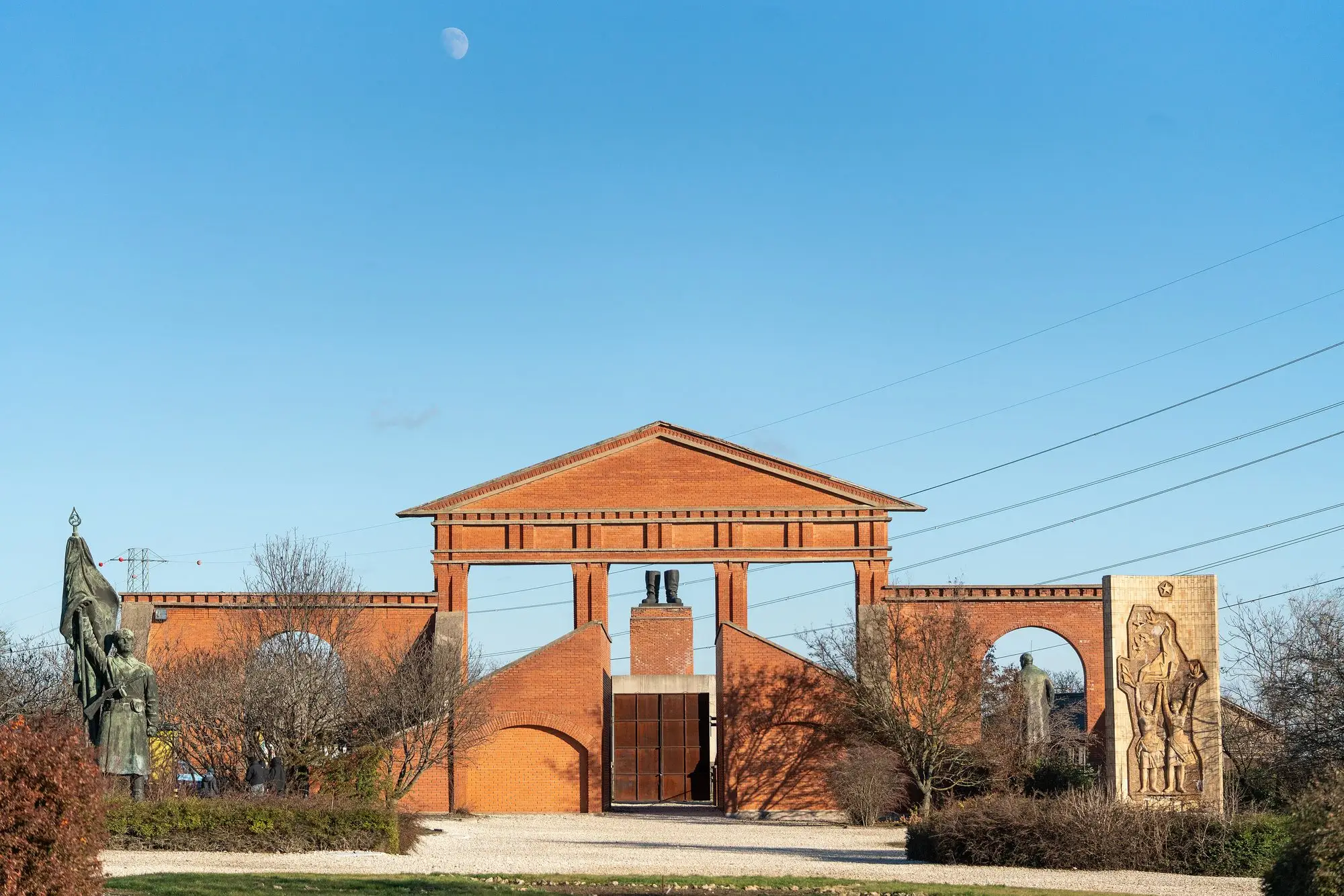
Memento Park is the answer to a question Budapest had to face in 1989: what to do with the statues of communist leaders and Soviet soldiers that suddenly nobody wanted on their plinths. The city could have melted them down. It chose to gather them on the edge of town, in a park designed so that they could be neither glorified nor erased.
The park is built around an older story too, of the 8-metre Stalin that stood on a grandstand in the centre of Budapest for five years, until a crowd sawed it off at the knees on the first night of the 1956 revolution.
At a glance
Timeline
- 1945
The takeover begins
Hungary ends the war on the losing side. Backed by the Soviet Red Army, communist politicians take power and build a Soviet-style dictatorship. Over the following decades thousands of public statues go up across the country praising the regime and its Soviet backers.
- Dec 1951
Stalin is unveiled
Sándor Mikus’s 8-metre bronze Stalin, made for the dictator’s 70th birthday, is inaugurated on a grandstand on Felvonulási tér, the parade square in central Budapest. Party leaders stand at his feet on communist holidays.
- 23 Oct 1956
Stalin comes down
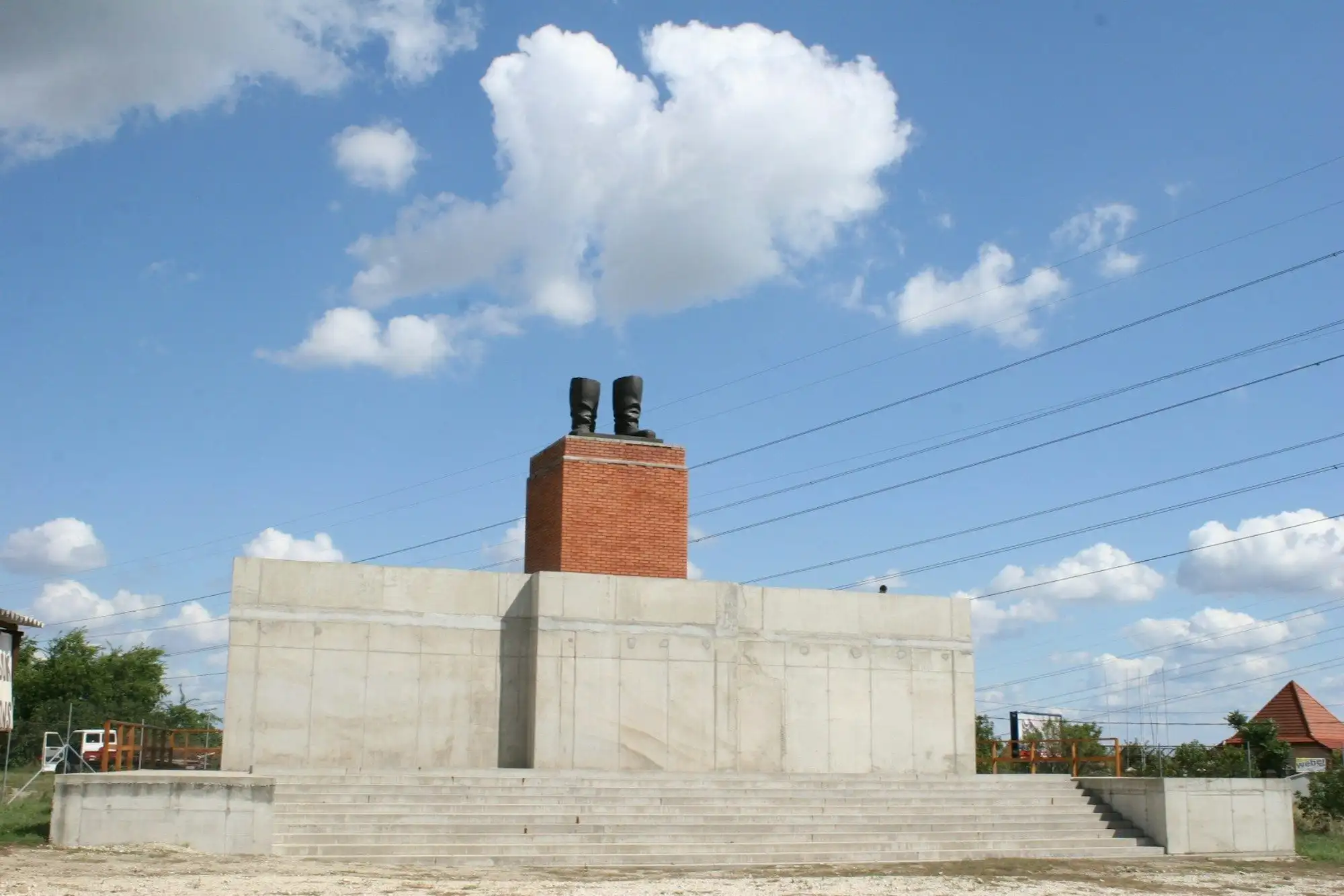
On the first evening of the revolution the crowd cuts the statue off at the knees with flame-cutters brought from the factories. The boots stay on the plinth; the rest is towed to Blaha Lujza tér and cut into pieces.
- 1989 to 1990
The regime collapses
The dictatorships of Eastern Europe fall. Budapest puts the fate of its communist statues on the agenda, and some people call for them to be destroyed and melted down.
- 1991
A statue park is ordered
The municipality rejects destruction and orders a statue park. In December the Budapest Assembly decides that each district should choose the statues to remove, and the assembly’s cultural committee invites a tender for the park. Ákos Eleőd’s concept wins.
- 19 Jun 1991
The last Soviet soldier leaves
Lieutenant General Viktor Silov crosses the Tisza bridge at Záhony. Almost 50,000 soldiers and their families have gone, and for the first time since March 1944 no foreign troops are stationed in Hungary.
- 27 Jun 1993
Memento Park opens
The park opens on the Tétény plateau in District XXII, two years after the withdrawal. The statues are in place; the brick wall meant to ring them is not.
Key facts
- Statues
- 41 works, made between 1945 and 1989
- Architect
- Ákos Eleőd
- Opened
- 27 June 1993
- Where
- Tétény plateau, District XXII
- Hungarian name
- Szoborpark, the statue park
- Concept
- One Sentence About Tyranny
The concept
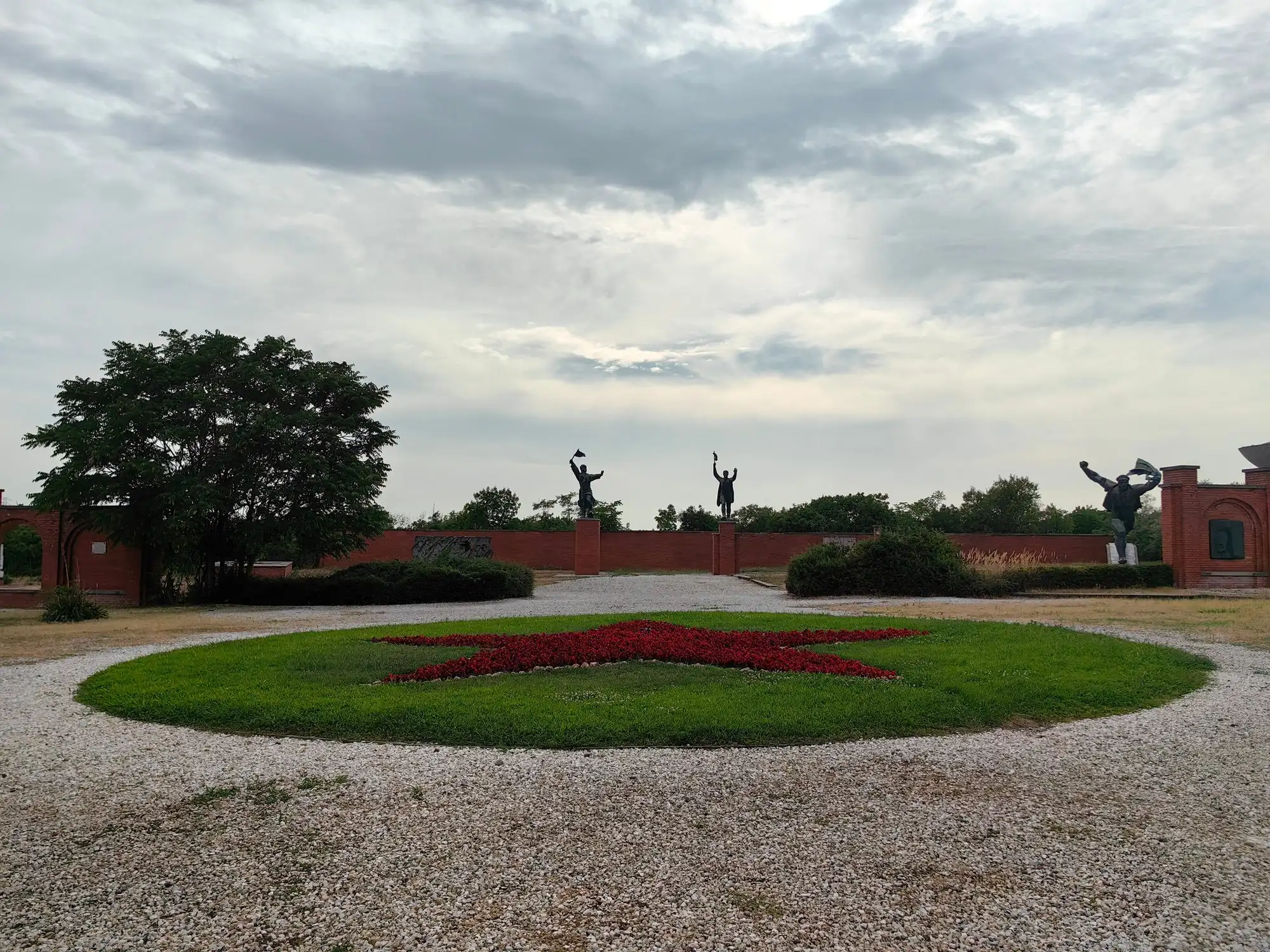
Eleőd’s park does not introduce the statues, the people they show or the events they mark. Its job, in the park’s own words, is to summon the period that produced them: art made to order for a centralised party propaganda machine.
His own line on it is the one the park quotes: “This Park is about dictatorship. And at the same time, because it can be talked about, described and built up, this Park is about democracy. After all, only democracy can provide an opportunity to think freely about dictatorship.”
The layout follows that idea. Five semicircles of statues sit inside one big circle, walled in brick, with the star-shaped flowerbed in the middle, and nothing is ranked or explained.
Witness Square
The square in front of the gate is Witness Square, and in Eleőd’s design it stands for six squares at once: Széna tér in Budapest in 1956, Wenceslas Square in Prague in 1968, Castle Square in Warsaw in 1981, Opera Square in Timișoara in 1989, Potsdamer Platz in Berlin and the National Assembly square in Sofia.
The barracks exhibition on it is built around the same idea, the shared fate of Eastern Europe in the second half of the 20th century.
Its two monuments face each other: the grandstand, which the park calls a memento of the megalomania of dictatorship, and the boots, which it calls a monument in their own right to people’s longing for freedom.
The history of Memento Park
The Stalin statue, 1951 to 1956
Sándor Mikus won the competition to make a Stalin for the dictator’s 70th birthday in 1949, and by December 1951 the 8-metre bronze stood on a plinth 15 metres high on Felvonulási tér, the parade square in central Budapest where the regime held its marches. On communist holidays the party leaders stood on the grandstand at Stalin’s feet, waving at crowds that had no choice but to cheer.
It lasted five years. On the evening of 23 October 1956, the first day of the revolution, a crowd gathered at the statue and began to pull it down.
Workers arriving from the factories brought flame-cutters, cut through the bronze at the boots, and the figure was towed to Blaha Lujza tér, where people cut it into pieces. The boots were left on the plinth, and the torso became one of the images of the uprising.
Communist statues, 1945 to 1989
The Stalin was the biggest, but the regime put up thousands of statues across Hungary between 1945 and 1989: Lenin, Marx and Engels, Red Army soldiers, Hungarian communists from 1919 onwards, and allegories of liberation and Hungarian-Soviet friendship. Every one was commissioned to order and censored to fit.
The 41 that stand in the park all came from Budapest, and each plaque records where: Zsigmond Kisfaludi Strobl’s Liberating Soviet Soldier from Gellért Hill, Pál Pátzay’s Lenin from Dózsa György út, and so on. The park says the statues from the rest of the country mostly ended up in local collections, over Soviet soldiers’ graves, or in storage.
The decision to keep them, 1989 to 1991
When the system collapsed in 1989 and 1990 the statues came off their plinths, and the question of what to do with them went to the city. Some people wanted the most radical answer, the immediate destruction and melting down of the lot. The idea of a statue park had been floated in 1989 by the literary historian László Szörényi, and the Municipality of Budapest chose that road.
In December 1991 the Budapest Assembly decided that each district should pick the statues to be removed, and its cultural committee invited a tender for a park to hold them. Ákos Eleőd, of the studio Vadász and Partners, won with the concept he called One Sentence About Tyranny.
District XXII offered a site on the Tétény plateau, on the south-western edge of the city. It is hard to think of another capital that answered the question this way.
Opened in 1993, never finished
Memento Park opened on 27 June 1993, two years after the last Soviet soldier left Hungary. It has run without state subsidy ever since, on ticket sales, the shop and donations.
It has also never been finished. Eleőd’s plan needed a continuous brick wall to give the statues one setting, and some of the visitor buildings were never built either; the wall runs in sections, and the ground between the semicircles is gravel and grass.
That is part of why the park reads as it does, half museum and half storage yard, and it is not a flaw in the experience so much as a fact of it.
Visiting today
The park is what it was designed to be: a place where the statues can be looked at and thought about without being honoured. The grandstand, the barracks with its exhibition and secret-police film, and the Trabant by the gate have been added to the statues themselves, and a guide or the booklet from the desk supplies the stories the plaques leave out.