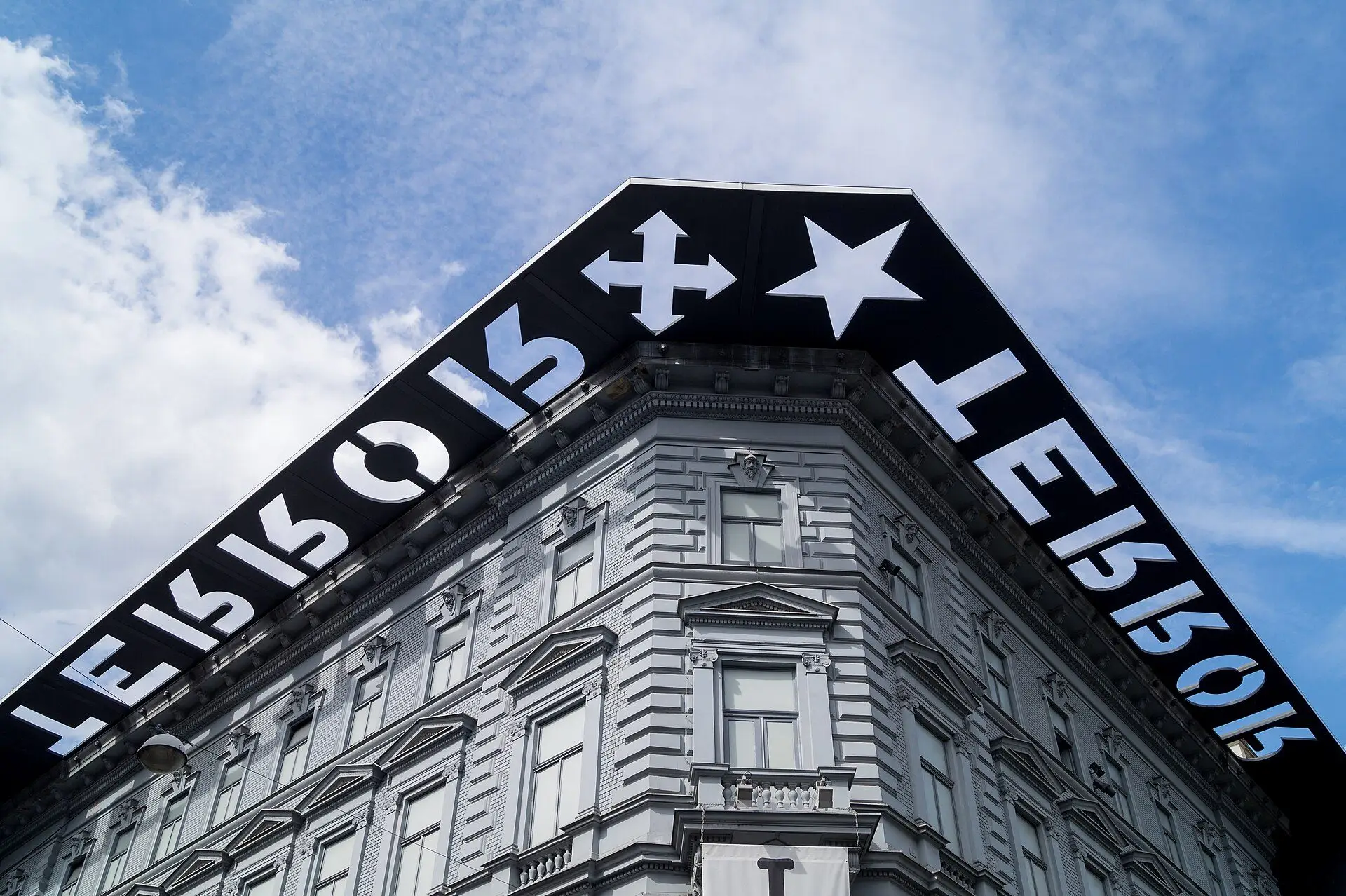
Two of Hungary’s 20th-century dictatorships ran their political police from this building at Andrássy út 60, now the House of Terror Museum. The Arrow Cross, the country’s Nazi-backed government of late 1944 and early 1945, held and tortured hundreds of people in the cellar, most of them Jewish.
From 1945 the communist political police, the ÁVO and then the ÁVH, took the same building and kept the cellar prison running until 1956.
The museum opened on 24 February 2002 and is a memorial to the people held, tortured and killed here. The word TERROR is cut out of the black entablature that frames the building, and on a sunny day it falls as a shadow on the wall. Tickets are sold at the door and nowhere else, and the museum is closed on Mondays.
- Visit length
- 2 to 3 hours with the audio guide
- Entry
- Tickets at the museum only, nothing sold online
- Book ahead
- Not possible for entry. A tour with entry included can be booked
- Opening hours
- Mon closed, Tue to Sun 10:00 to 18:00
- Best time
- Tuesday to Friday at 10:00
- Nearest stop
- Metro M1 Vörösmarty utcaAbout 100 m up Andrássy út. Stairs only, and not to be confused with Vörösmarty tér
- Accessibility
- Lifts between the floors, no official access statement
- Closed
- Mondays (but open 28 December 2026), 24 to 26 December, 1 January, a week in late January
- Audio guide
- Six languages, hired at the desk on top of the ticket
Tickets
The museum sells entry tickets only at its own cash desk, with no online sales, so nobody can book you a plain ticket in advance. What can be booked is a tour that includes entry. Both of ours are three-hour tours of the city’s communist past that bring you here as part of the day.
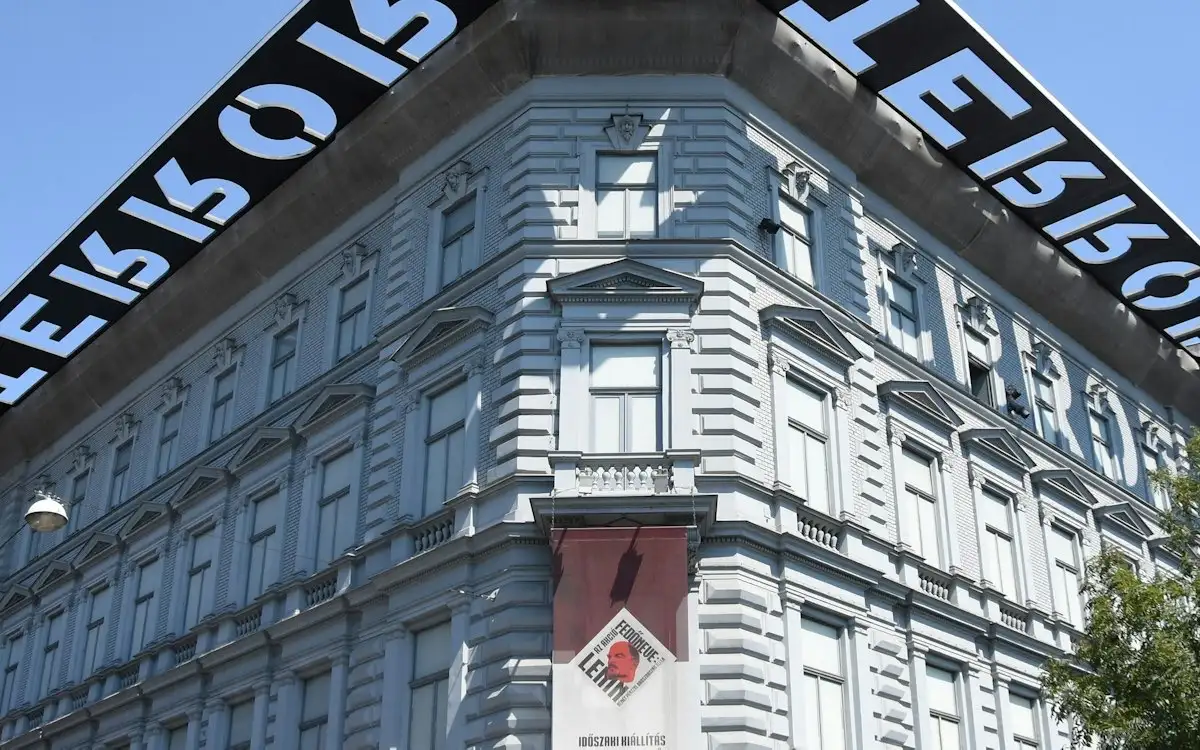
House of Terror Museum: Born Under the Red Star Tour
Best for: The communist past on the streets and in the museum, in one half day
- 3 hours
- Live guide in English
- Free cancellation up to 24 hours ahead
What’s included and more details
What’s included
- A 3-hour walk through communist-era Budapest
- Entry to the House of Terror
- A retro soda in a communist-themed bar
- Public transport during the tour
- Also
- Maps and tips for the rest of your stay
- Arrive
- On time for your slot
- Changes
- You can move the date up to 24 hours before
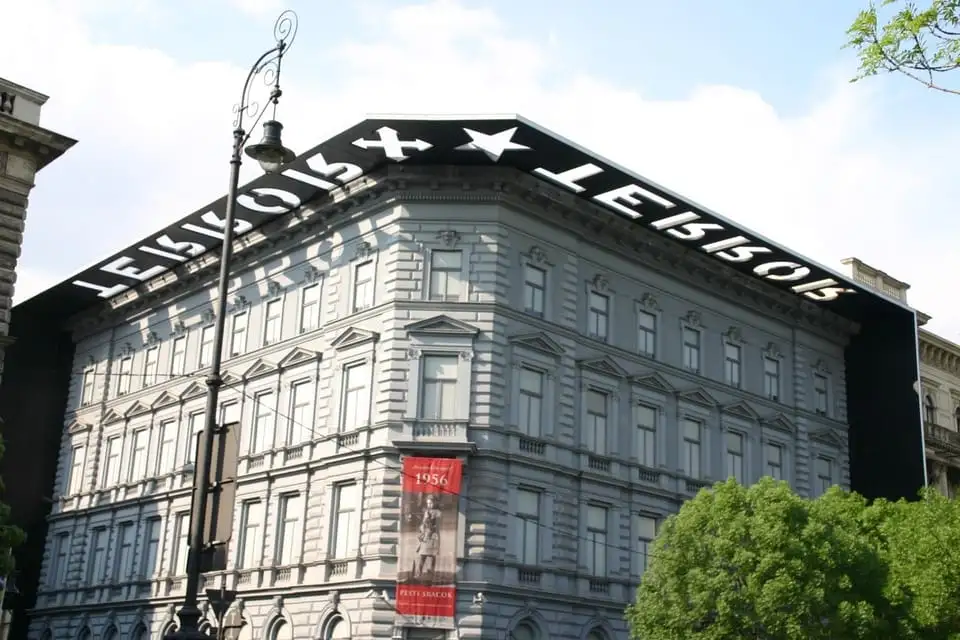
House of Terror Tour of Nazi and Soviet History
Best for: A private tour at your own pace, in your own language
- 3 hours, with 4, 5 and 6-hour options
- Live guide in English, Hungarian, German, French, Italian or Spanish
- Free cancellation up to 24 hours ahead
What’s included and more details
What’s included
- A private tour with a licensed guide
- Entry to the House of Terror
- Choose
- 3 hours at the museum, 5 hours adding a walk to communist-era landmarks, or 4 and 6-hour versions with a private car from your accommodation
- Queue
- Museum tickets are bought on the day, and the wait can be up to an hour
- Before
- The operator emails details the day before
- Also
- Reserve now and pay later
- At the desk, bring photo ID if you qualify for reduced or free entry. Reductions go by age and citizenship of a European Economic Area country, not by student card
- The cloakroom is free and compulsory for luggage, umbrellas, anything larger than A3 and every backpack
- The cash desk closes at 17:30, and you are asked to be out of the exhibition when the closing staff come round
For who pays less, who goes free and how the tours work, see our House of Terror tickets guide. If you would rather go round with a guide, the two tours worth booking are compared in our House of Terror tours guide.
Highlights
The actual headquarters
Walk through the building where the Arrow Cross tortured its prisoners in the winter of 1944 and where the communist ÁVO and ÁVH ran Hungary’s political police until 1956.
The cellar
Take the slow lift down to the reconstructed cells, the wet cell, the fox-hole and the detention cell, directly under the pavement of the grand boulevard.
The tank and the wall
A Soviet T-54 tank stands in the glassed-over atrium beneath a wall of victims’ portraits. It is the one thing in the building you are allowed to photograph.
Plan your visit
Opening hours
Open Tuesday to Sunday from 10:00 to 18:00 and closed every Monday. The cash desk closes at 17:30. The museum opens on the national holidays and closes for Christmas, New Year’s Day and one week of maintenance in late January.
Mon closed, Tue to Sun 10:00 to 18:00Check our detailed opening hours guide for the holiday dates, short-notice closures and how long to allow.
Getting there
The museum stands on Andrássy út, the grand boulevard that runs from the centre to Heroes’ Square, with the M1 metro beneath it. The nearest station is Vörösmarty utca, about 100 m away, and trams 4 and 6 stop at Oktogon, a short walk down the avenue.
Nearest stops
By car: not recommended. Andrássy út is a paid parking district, and the nearest car park is the multi-storey Oktogon Parkolóház, about 200 m west of the museum.
See our complete guide on how to get there for the step-free route, walking distances from the Opera House and Heroes’ Square, and the Vörösmarty utca trap.
Before you go
- Tickets at the door only. Bring photo ID if you qualify for reduced or free entry, which goes by age and citizenship of a European Economic Area country
- Cloakroom: free and compulsory for luggage, umbrellas, bags larger than A3 and every backpack, whatever its size. Security may check bags. Free lockers take a coin that you get back
- No photographs or video anywhere inside except of the tank on the ground floor. Silence your phone and do not use it for calls
- No food in the exhibition, and drinks only in a tightly closed bottle. No smoking, including e-cigarettes, anywhere in the building
- Children under 14 must be with an adult. Small folding children’s scooters go in the cloakroom
- You will be refused entry in swimwear, barefoot, or under the influence of alcohol or drugs. Only assistance dogs are allowed in
Accessibility
- The route runs down through four levels, and the descent to the cellar is by lift. The walking tour we link to is sold as wheelchair accessible
- The reconstructed cells are cramped by design, so do not count on getting into every one
- Disabled visitors and one companion enter free with an official disability ID card from their home country. The museum says it cannot accept medical documents
The step-free way to arrive is in our how to get there guide.
What to see and do
Start on the second floor
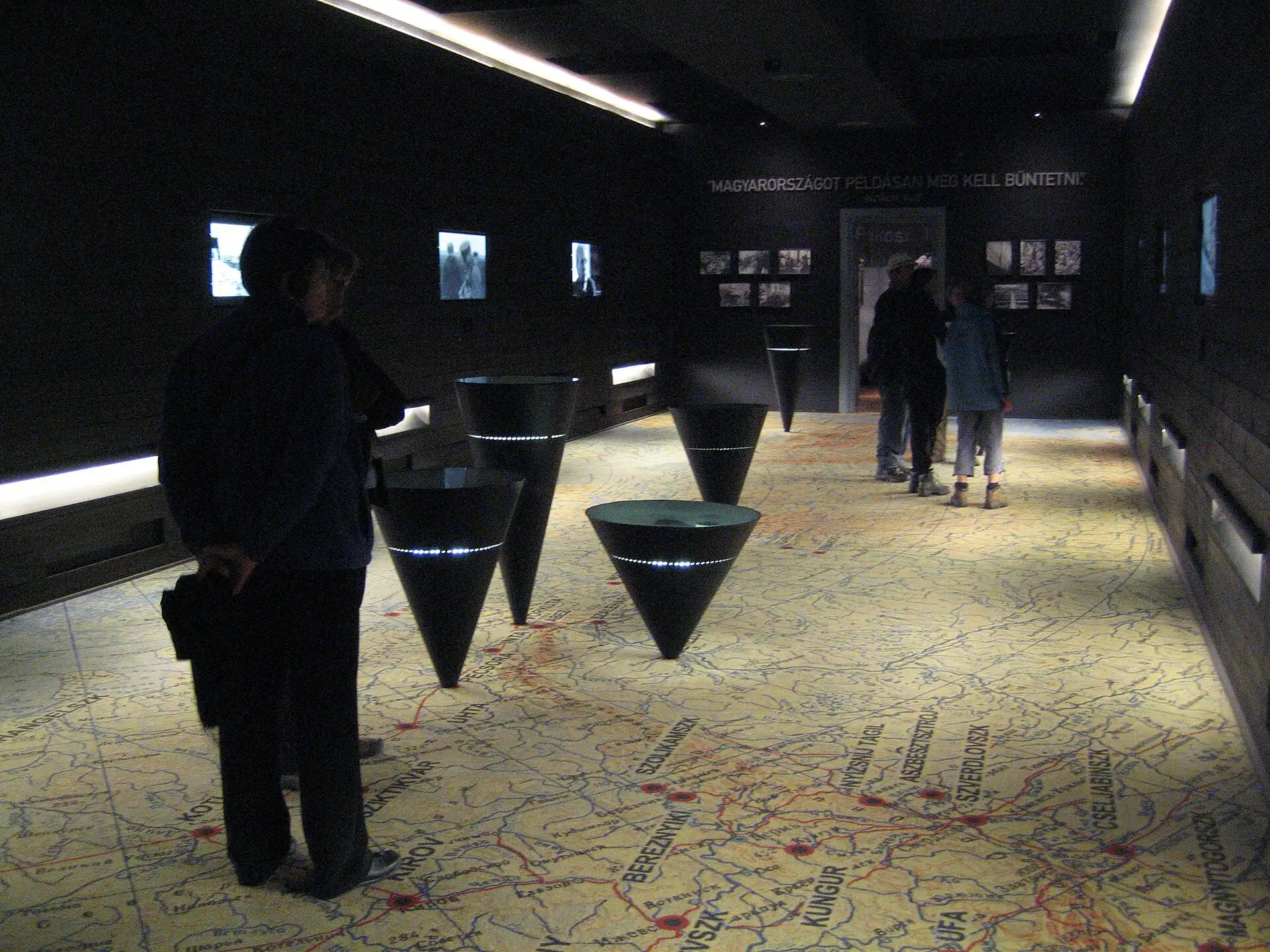
The route begins at the top, in eight rooms that run in date order from 19 March 1944, the day Germany occupied Hungary, to the resistance against communism.
The first hall is Double Occupation, Nazi and Soviet, and the next two belong to the Arrow Cross. Then comes the Gulag room, where the floor is a map of the Soviet Union and the wood-panelled walls commemorate the 700,000 Hungarians taken to Soviet forced-labour camps.
The small room after it, Changing Clothes, has a rotating figure in an Arrow Cross uniform on one side and a secret-police uniform on the other, the museum’s way of saying the two regimes were two sides of the same coin.
The Fifties room opens with polling booths for a one-party election and turns, behind the scenes, into a room about total control. The floor ends with the Soviet Advisors and a projection room where you can sit and watch full-length propaganda films.
Give this floor the most time. The room texts are in Hungarian, so pick up the printed English sheet at each door or use the audio guide, and do not try to read everything.
Find the gym on the first floor
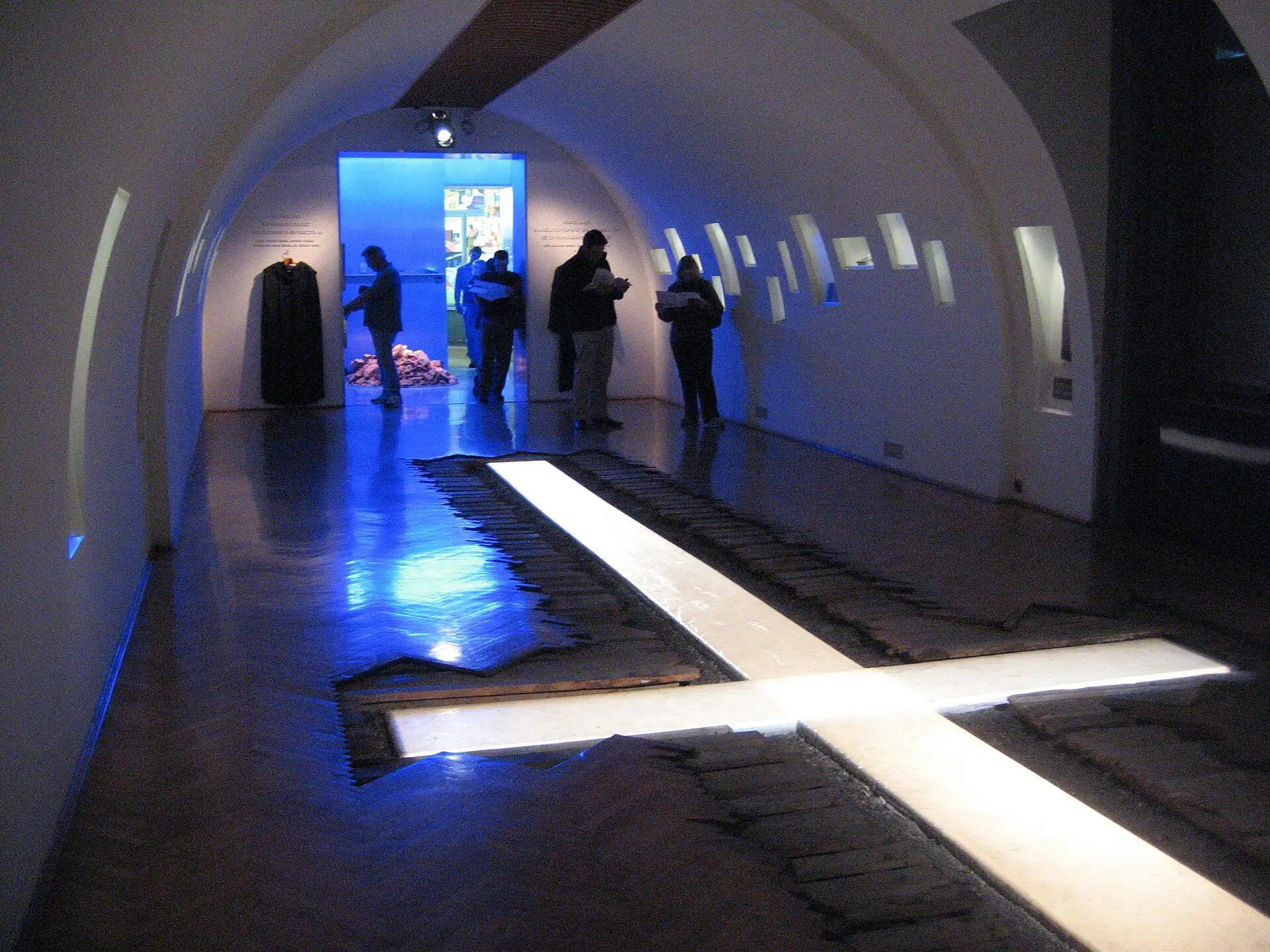
The first floor is about what the communist state did to people who were not in prison: the deportations of Hungarians of German descent and of Hungarians from Czechoslovakia, the peasants stripped of their crops in a labyrinth walled with blocks of lard, the show trials, the propaganda, everyday life, and the war on the churches, with Cardinal Mindszenty’s cape in the last room.
On this floor is a recess the ÁVH called the gym. When the political police left in 1956 they smashed and rebuilt the cellar prison so that no trace of it remained, and this interrogation room is the one room the ÁVH forgot to destroy.
On the wall are the words of János Kádár, interior minister in 1948, that you must be able to hit with every means, and along the end wall hang the instruments that were used.
Look for the desk and bunk in the room of Gábor Péter, the head of the ÁVH, and the Imre Nagy trial playing in the centre of the Justice room.
Stop at the tank in the atrium
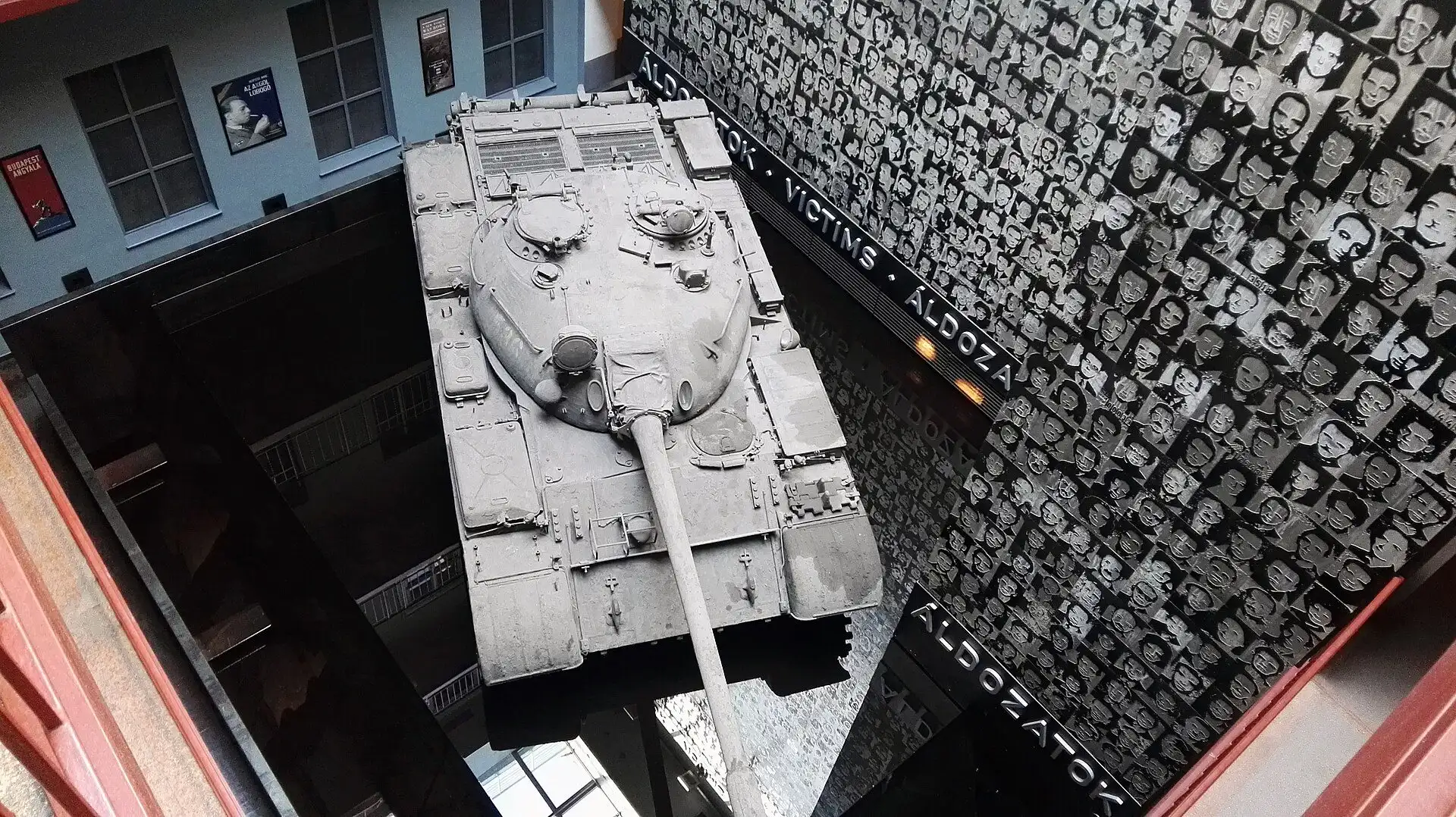
The inner courtyard of the old apartment block is roofed over now, and a Soviet T-54 tank sits in it beneath a wall of portraits that rises the full height of the building under the words ÁLDOZATOK, VICTIMS.
The ground floor, the staircase and the yard are not strictly exhibition space, but the tank is the image everyone leaves with, and you cross the galleries above it more than once on the way down.
It is a symbol, not a relic of the building. The tanks that mattered here were the ones that brought the communists to power in 1945 and the ones that crushed the revolution in 1956, and the museum’s route ends with the Soviet army’s departure in 1991.
This is the one place in the museum where photographs are allowed. Take yours from the gallery, where the whole wall fits in the frame. Notice, too, the two marble memorial slabs at the steps in the entrance hall and the string music that plays through the building, a score written for the museum by Ákos Kovács.
Take the slow lift down to the cellar
The way down is by lift, and the lift is part of the exhibition. It takes three or four minutes to descend, and on a screen in the dark a man describes, in a flat voice and with English subtitles, how an execution was carried out. Nobody talks much when the doors open.
The Arrow Cross used the coal cellars here to hold and beat the people it rounded up in the winter of 1944, and many of them died. After 1945 the political police divided the cellars into cells, took over the neighbouring buildings and joined their cellars with tunnels so that prisoners could be moved without being seen in the street.
One sealed tunnel, to number 62, was found when the museum was built and is on show in the Emigration room. The ÁVH wrecked the prison before it left in 1956, so half of what you walk through is a reconstruction of how it stood in the 1940s and 1950s.
The cells are the point: a wet cell where a prisoner stood for days in cold water to the knees, a fox-hole with a ceiling a metre high and no light, a detention cell with half a metre of floor. As the museum puts it, this is not a distant military prison but half a metre from the pavement of the city’s finest avenue.
The other half of the basement continues the story through internment, 1956, the reprisals and emigration, and ends with the Hall of Tears, with its list of the dead, the Perpetrators’ Wall, naming those who kept the regimes running, and a memorial to the Soviet troops leaving in 1991.
Read the building from the pavement
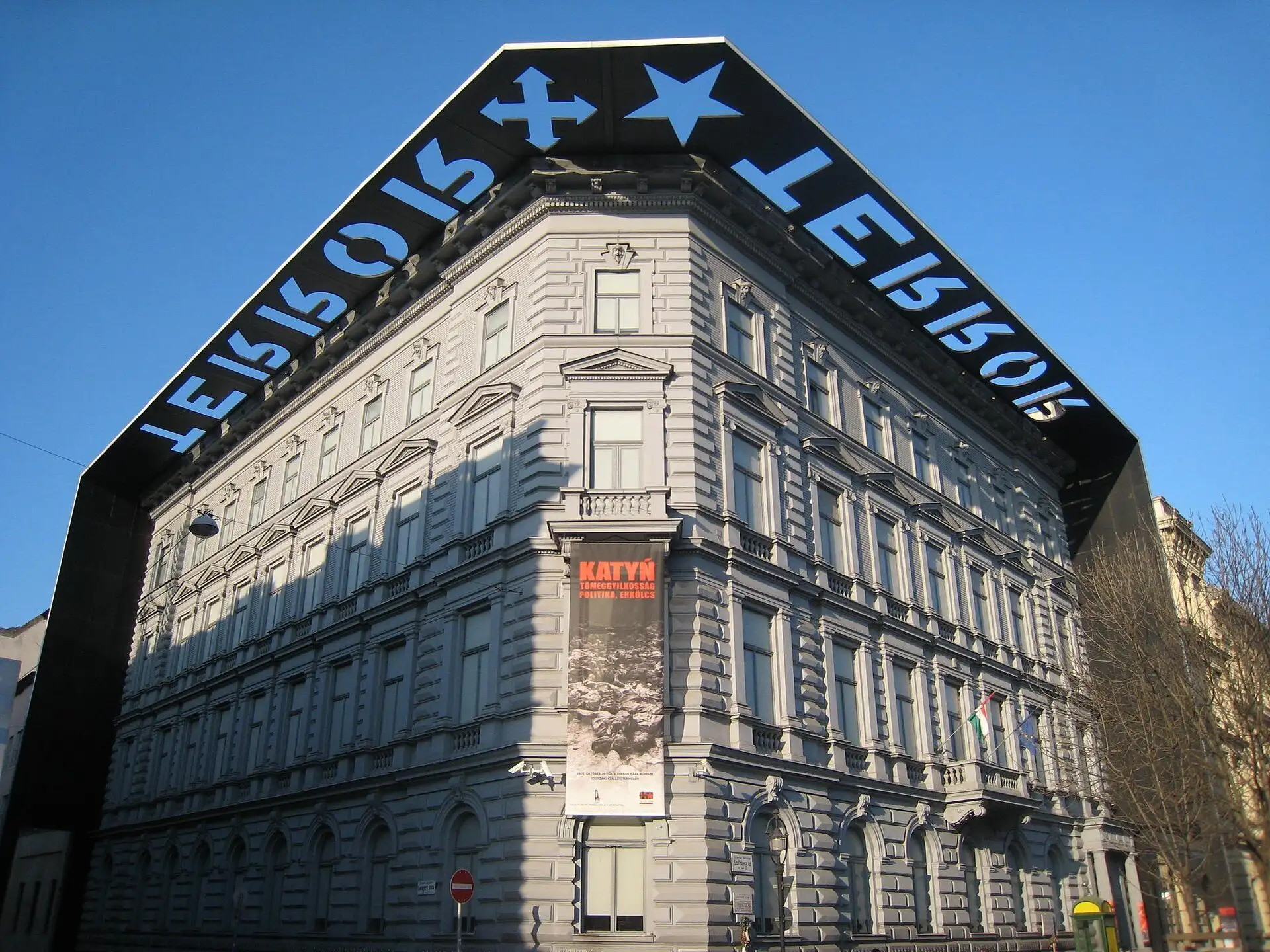
Before or after your visit, cross Andrássy út and look back. The building is an 1882 apartment block, and everything that makes it look different from its neighbours was added when it became a museum in 2002.
The architect Attila F. Kovács, who designed the exhibition, gave it a black frame, a heavy entablature along the roofline, blade walls down the sides and a granite pavement, so that it stands out from the street. The entablature is cut with the word TERROR, the Arrow Cross symbol and the five-pointed star, and when the sun is on it the word is written in shadow on the wall.
Along the base of the frame runs a row of small oval photographs with candles and flowers beneath them. This is the museum’s Wall of Heroes, the heroes and victims of the 1956 revolution, and people still stop at it.
A few steps along the pavement stands the Iron Curtain, a wall of rusted chains hung from steel girders, also by Kovács, marking the forty years of closed borders and the fact that Hungary was the first country to cut the fence, in 1989.
The exterior is the only part of the museum you can photograph without restriction, and the shadow needs a sunny day.
Insider tips
Don’t try to visit on a Monday
The museum is closed every Monday, year-round, and turning up on one is the standard first-time-visitor mistake. If your trip is short and Monday is the only free day, swap another day’s plans around rather than lose the museum.
Be at the door at 10:00 on a weekday
There is no advance ticket, so everyone queues at the same desk, and when a coach group of up to 30 arrives at the same time the cloakroom queue is longer than the ticket one.
Arrive when it opens, on a Tuesday to Friday, and you have the second floor to yourself for a while. The first Sunday of the month is free for many European visitors and is likely to be busy.
Decide about the audio guide before the desk
Every room has a printed English sheet, and some people find them enough. If you would rather listen than read, hire the audio guide at the desk on the way in. It explains the films and the rooms, where the sheets give the history behind them. It is charged on top of the ticket and you cannot go back for it later without queueing again.
Don’t make it the last stop of the day
The cellar is heavy, and most people come out quieter than they went in. Go in the morning or early afternoon with nothing pressing afterwards, and give yourself half an hour on Andrássy út before the next thing.
Use the bookshop without a ticket
The book and gift shop by the entrance can be visited in opening hours without paying to go in. If you want the history in more depth than the room sheets give, it is the place to find it in English.
Nearby attractions
The museum is halfway along Andrássy út, with the Opera House down the avenue towards the centre and Heroes’ Square at the far end.
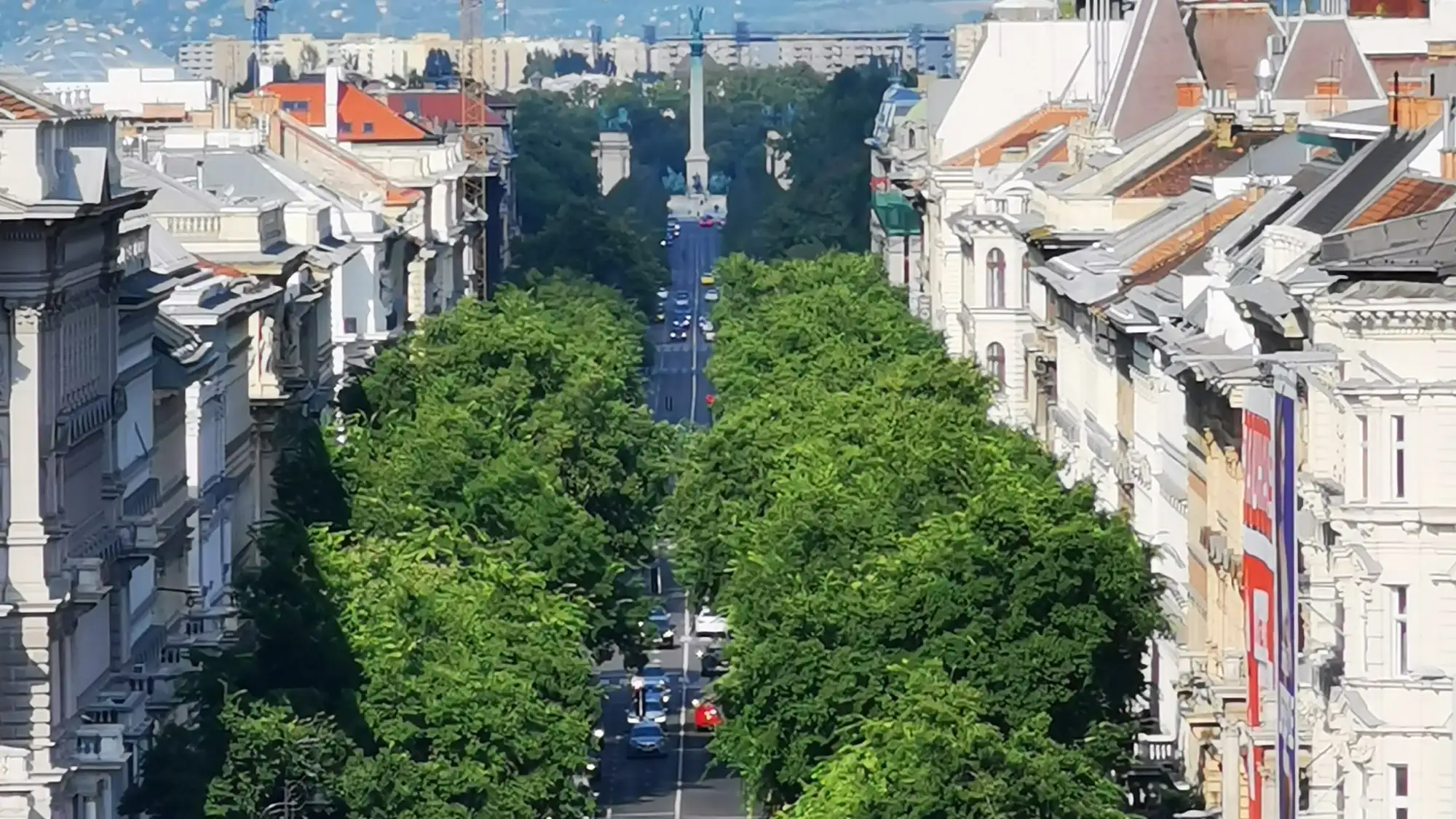
Andrássy Avenue
You are standing on it. The boulevard runs from Erzsébet tér to Heroes’ Square, with the M1 metro underneath.
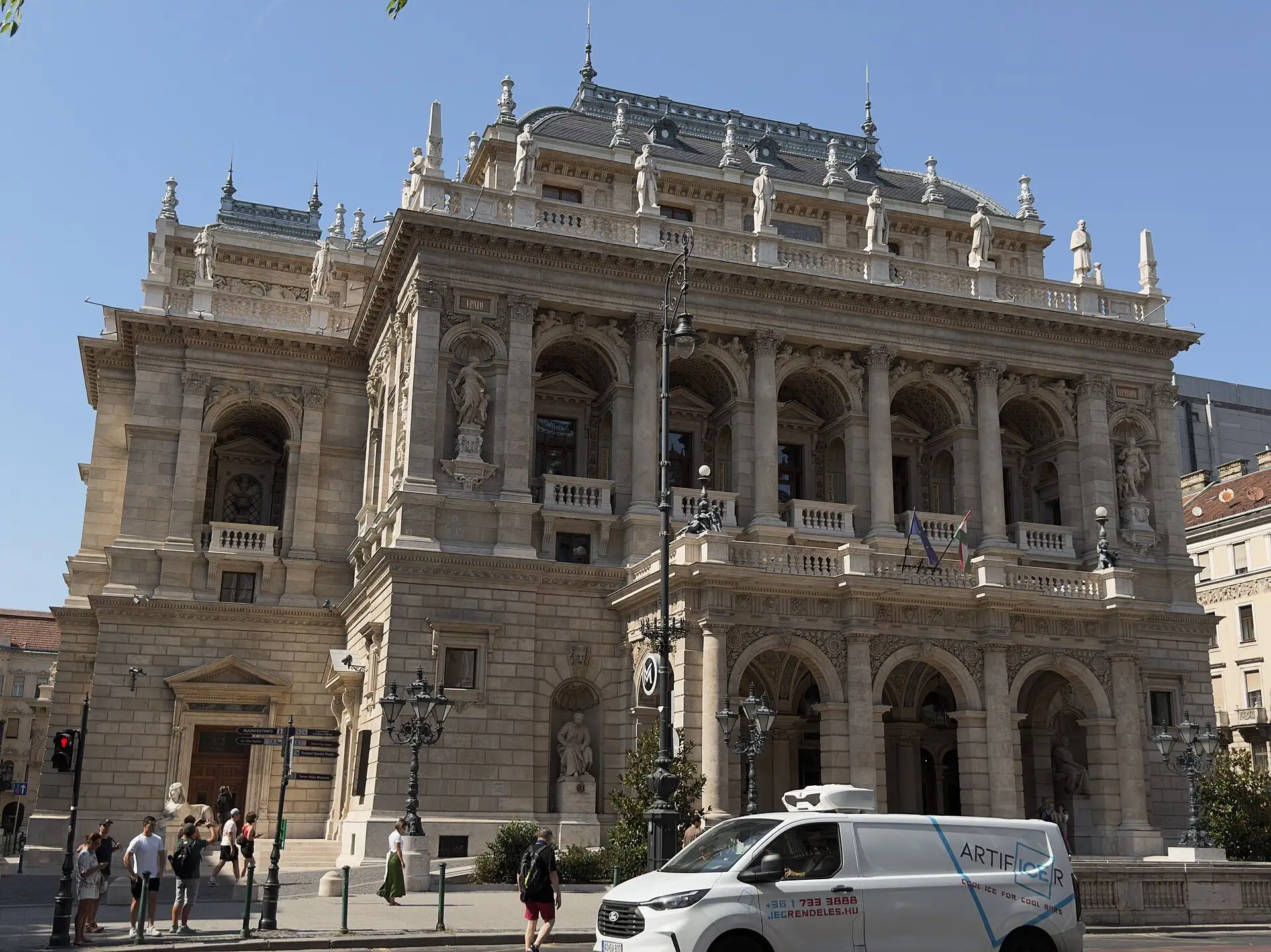
Hungarian State Opera House
About 11 minutes on foot, down Andrássy út towards the centre. Miklós Ybl’s opera house, with guided tours of the auditorium.
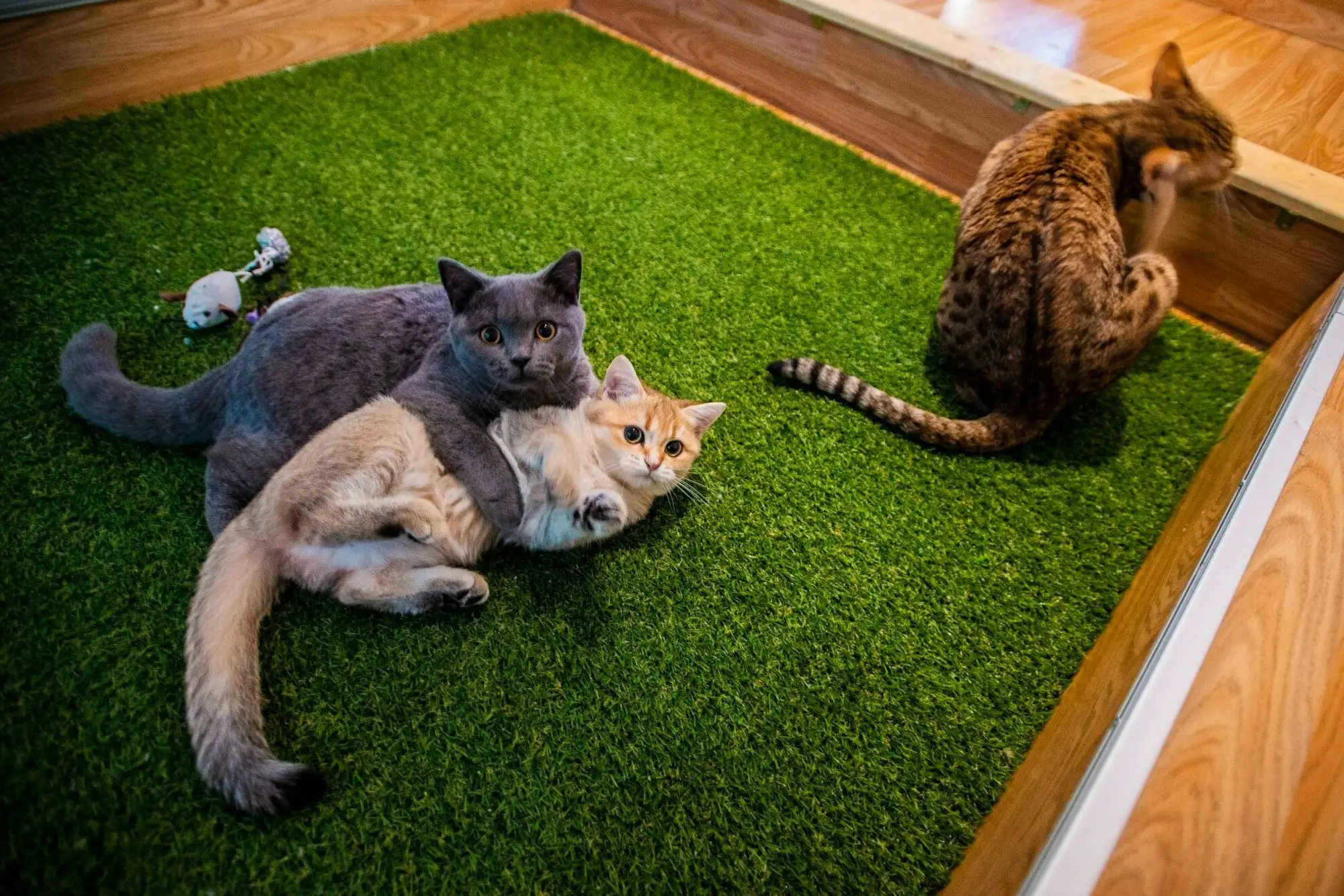
Cat Museum Budapest
About 19 minutes on foot, south-west off Andrássy út. A light antidote to the cellar.
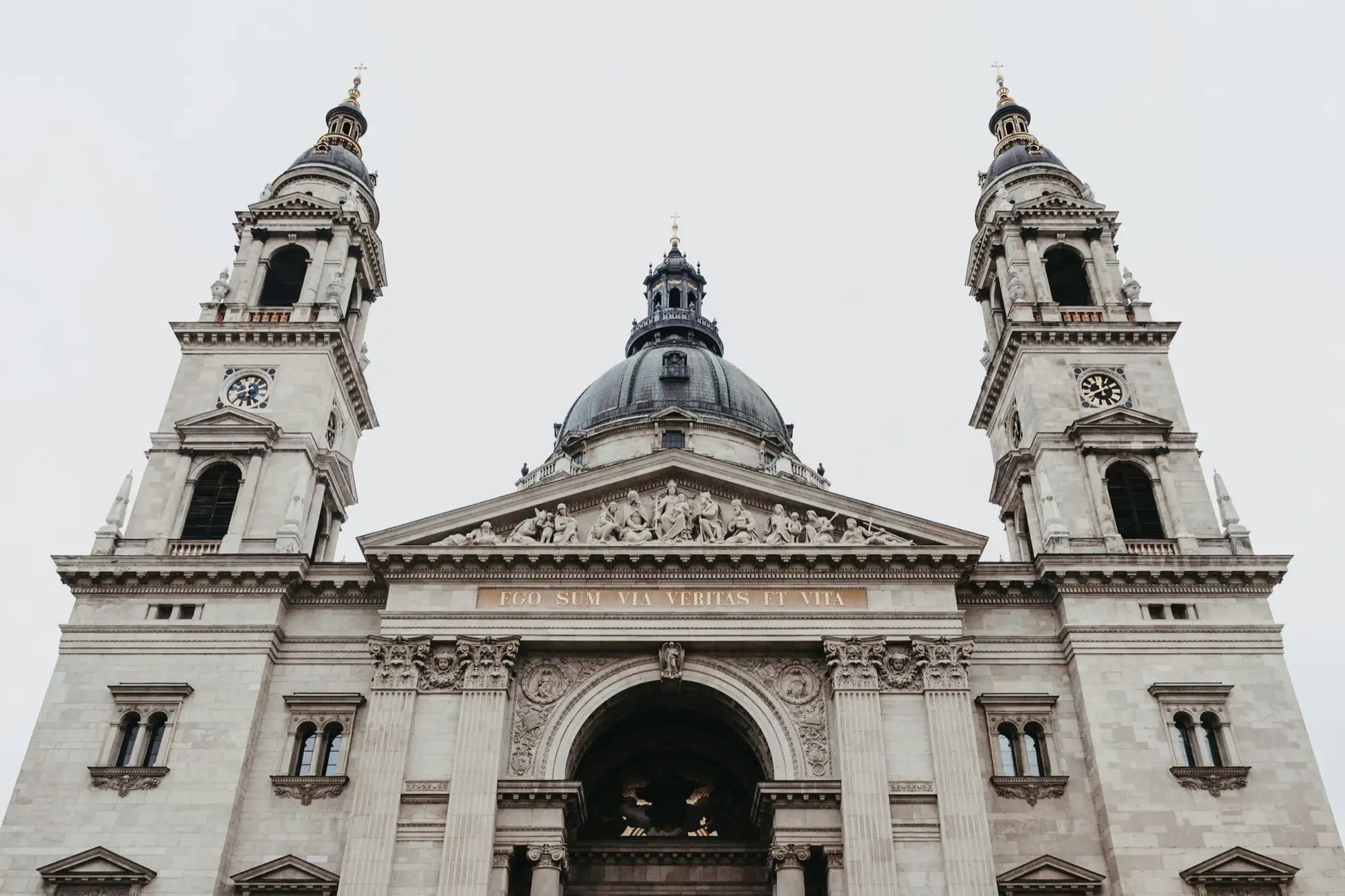
St. Stephen's Basilica
About 16 minutes on foot, south-west, just off Bajcsy-Zsilinszky út. The largest church in Budapest and a panorama terrace.
Did you know?
- The building was a grand block of flats, built in 1882 to plans by Adolf Feszty, and the far right rented rooms in it from 1937. Ferenc Szálasi’s party made the first floor its official address that autumn, seven years before it took power, and called the place the House of Loyalty.
- The political police did not own the building either. It rented it from the widow who had inherited it, and paid rent through her lawyer, until the state simply expropriated the house in 1951.
- Andrássy út was renamed Sztálin út from the end of 1949, so the ÁVH’s address for most of its life was Stalin Road 60.
- The music you hear through the building is a string-orchestra score written for the museum by Ákos Kovács.
History
Forty-six years passed between the ÁVH’s departure and the day the building reopened as a memorial. The full story, from a painter’s block of flats to a national memorial site, is on our history page.
- 1882
Built as a block of flats
The apartment building at Andrássy út 60 goes up to plans by Adolf Feszty. It later belongs to the painter Izsák Perlmutter, who leaves it to his widow and adopted daughter.
- 1937
The far right moves in
The Racial Protection Socialist Party rents rooms in June, and in October the merged Hungarian National Socialist Party under Ferenc Szálasi makes the first floor its headquarters, the House of Loyalty.
- 15 Oct 1944
Arrow Cross takes power
After Horthy’s failed attempt to leave the war, the Germans install Szálasi. Through the winter the party holds and tortures hundreds of people in the cellar here, most of them Jewish, and many are killed.
- 1945
The political police arrive
With the Soviet army in Budapest, the new political police under Gábor Péter take the building. The cellar is divided into cells and the neighbouring buildings are taken over and joined by tunnels.
- 1946 to 1950
ÁVO, then ÁVH
The countrywide State Protection Department, the ÁVO, is formed in October 1946, renamed the State Protection Authority, the ÁVH, in September 1948, and made an independent authority in January 1950.
- 1956
The ÁVH leaves
On 28 October Imre Nagy announces the abolition of the ÁVH. After the revolution the political police leave Andrássy út 60, having smashed the cellar prison so that no trace of its use remains.
- 19 Jun 1991
Last Soviet soldier leaves Hungary
Lieutenant General Viktor Silov crosses the border at Záhony, the last of more than 44,000 Soviet soldiers to go. The date has been a national remembrance day since 2001.
- 24 Feb 2002
The museum opens
Bought by a public foundation in December 2000 and rebuilt in a year to Attila F. Kovács’s design, the House of Terror Museum opens at 17:00 with hundreds of thousands of people in the street outside.