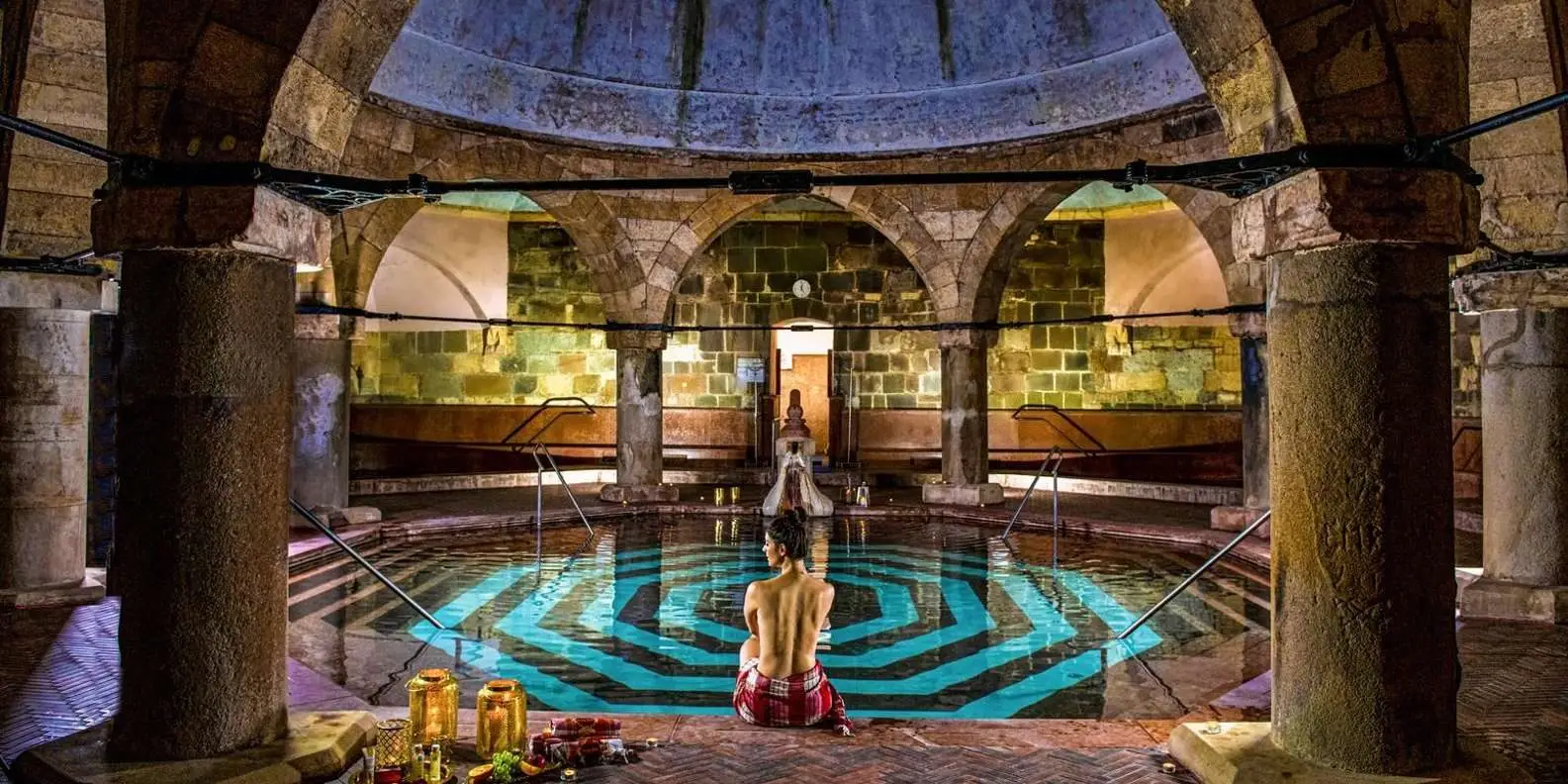
At Rudas you can still bathe in the room the Ottomans built. The domed Turkish bath went up between 1566 and 1572 and has been used, with small repairs, for more than 450 years.
Everything else grew around it: guest rooms and corner pools in the 1700s, a swimming hall in the 1890s, bottled water, a war that took the north wing, a long restoration and a rooftop pool.
At a glance
Timeline
- 1566 to 1572
The Turkish bath
Sokollu Mustafa, Pasha of Buda, has the domed bath built over the springs, with the octagonal pool at its centre.
- 1 December 1696
To the city
After Buda is retaken from the Ottomans, Leopold I hands the bath to the city.
- 1700s
Corner pools
Separate baths with guest rooms are built, and four corner pools are added under the dome.
- 1831
Rebuilt
The bath is rebuilt to plans by József Dankó, with a 15-room guest house.
- 1866
A medical institute
The Rudas bath and medical institute opens.
- 1890s
The swimming hall
The covered swimming pool opens, the second in the city.
- 1916
Bottled water
A bottling plant starts selling the Hungária spring’s water. It runs until 2005.
- 1936
Men only
Women’s days end for lack of interest.
- Second World War
The north wing lost
The north part of the bath is destroyed. The Turkish bath survives.
- 15 November 2012
Restored
The restoration of the whole building is handed over.
- September 2014
The rooftop pool
The new wellness wing opens, with the panorama pool on its roof.
- 18 November 2025
Full single-sex days
Tuesday becomes a full women’s day and Wednesday a full men’s day.
Key facts
- Turkish bath built
- 1566 to 1572
- Built under
- Sokollu Mustafa, Pasha of Buda
- Dome
- 10 metres across, on eight pillars
- Turkish bath pools
- Six, 16 to 42°C
- Swimming hall
- 1890s
- Rooftop pool
- Opened September 2014
- Women's days ended
- 1936
- Bottled water
- 1916 to 2005
The name
Under the Ottomans this was the Zöld oszlopos fürdő, the Green-pillared bath, probably named after a green column that no longer stands. Green stones can still be seen built into the walls.
Where the name Rudas came from is less certain, and the bath itself gives two theories. One is the pole, rúd in Hungarian, of the ferry that landed here. The other is Rudna ilidzse, meaning mineral bath, the name used by the Rác, the Serb community who lived nearby.
The history of Rudas Thermal Bath
The Ottoman bath, 1566 to 1572
Rudas is an Ottoman bath, built between 1566 and 1572 under Sokollu Mustafa, Pasha of Buda, as an ilidzsa, a bath over a thermal spring. The pool took up the centre of the building, under a dome 10 metres across resting on eight pillars.
The octagonal pool is the one piece that goes back to the Ottomans. The four corner pools you see today were added in the 1700s.
The city takes over, 1696 to 1866
After Buda was retaken in 1686, Leopold I treated the land as crown property, and on 1 December 1696 he gave the bath to the city. Through the 1700s it grew into a small resort, with separate baths, guest rooms and the corner pools under the dome.
In 1831 it was rebuilt to plans by József Dankó, with a 15-room guest house, and in 1866 it opened as the Rudas bath and medical institute. Several expansion plans followed in the late 1800s, one of them a study by Miklós Ybl.
The swimming hall and the bottled water
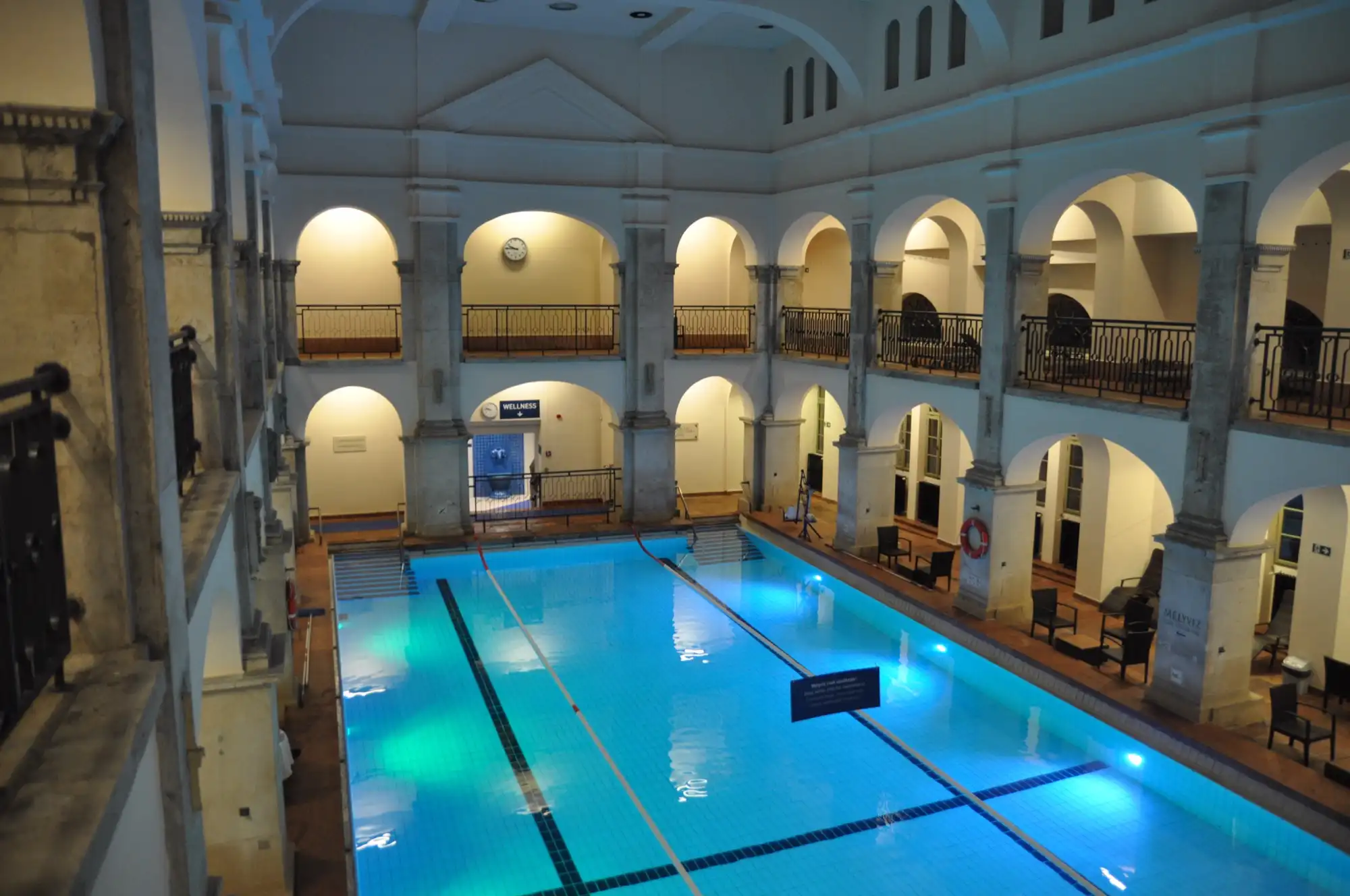
A people’s bath for men and women was finished in 1885, and the covered swimming pool followed in the 1890s, only the second in the capital.
In 1916 a bottling plant opened in the former Aranybárány inn at the south end of the bath, selling the Hungária spring’s water, and a carbonated version as Harmatvíz. It ran until 2005. In 1924 a drinking hall for the Hungária spring went up in the park between the bath and Elisabeth Bridge.
Second World War damage and the 1953 rebuild
In 1935 and 1936 the bath added tub baths, a doctor’s surgery, a restaurant and 23 hotel rooms. The Second World War did very heavy damage. The north part of the bath was destroyed, but the original Turkish bath came through untouched.
The ruins and the damaged spa hotel were demolished, and the passage between the Turkish bath and the swimming pool became the shared entrance hall. The works were finished by 1953.
The 2012 restoration and the rooftop pool
Archaeologists and building researchers went through the bath in 2004, ahead of its restoration. The main works, supported by the European Union, were handed over on 15 November 2012. The facade and roof were put back to how they looked in the late 1800s, from period photographs and plans.
That restoration also let one ticket cover the steam bath and the swimming pool, which had been sold separately. In September 2014 a new wellness wing opened alongside, with four ground-floor pools, a restaurant and the panorama pool and sun terrace on the roof.
Men's days and women's days
In 1936 the women’s days ended for lack of interest, and for almost 70 years the Turkish bath was visited by men only. After the renovations that began in 2004, women came back, with Tuesdays of their own and mixed bathing in swimwear.
When Gellért closed on 1 October 2025, Rudas grew noticeably busier, mostly with visitors who wanted mixed bathing. The compromise agreed with the regulars took effect on 18 November 2025: a full women’s day on Tuesday, a full men’s day on Wednesday, and the old men’s mornings kept on the other weekdays.