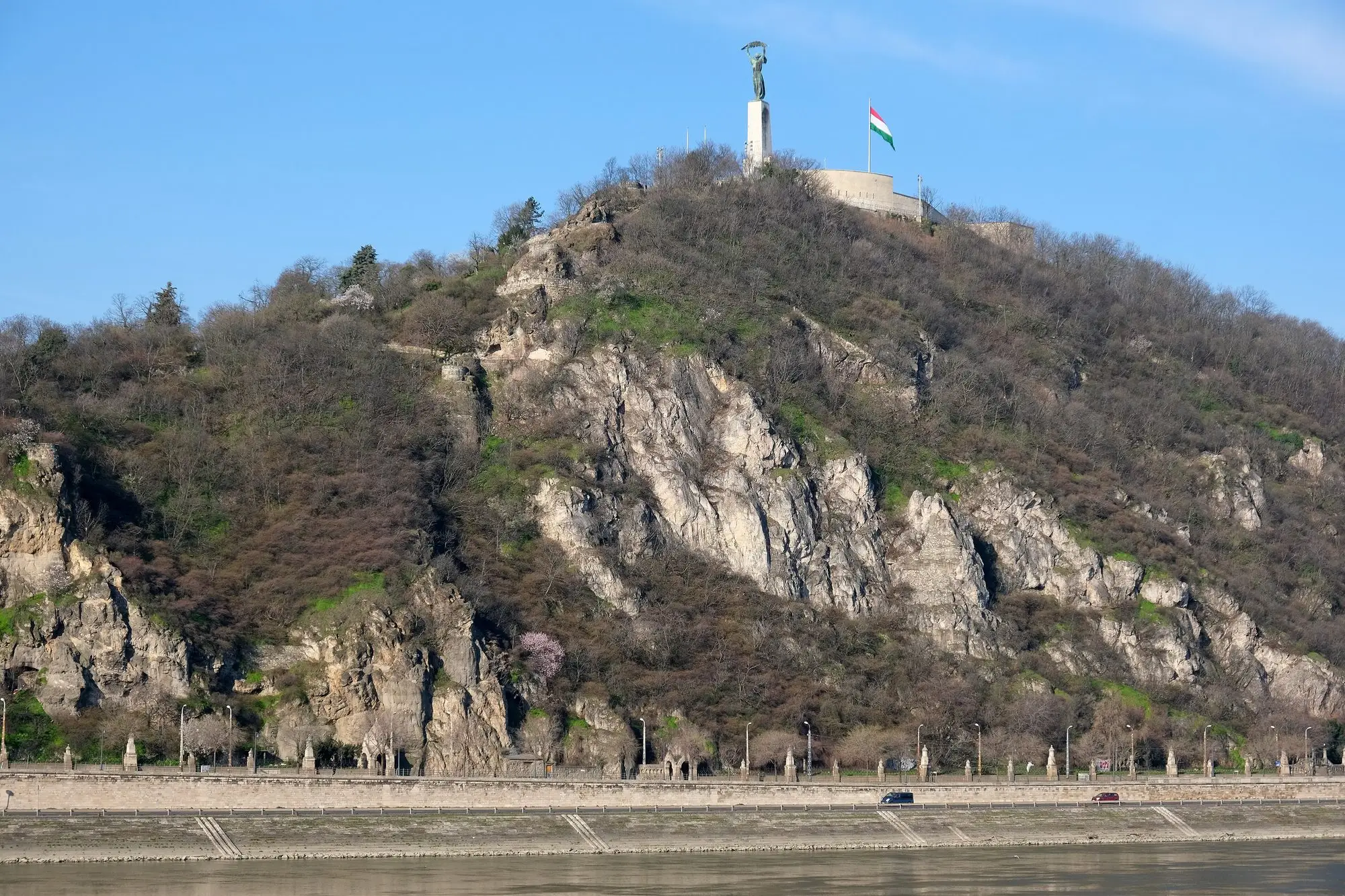
The summit of Gellért Hill has carried in turn a cross, an Ottoman palisade, an observatory, a Habsburg fortress and a Soviet monument, and each one was put up by whoever was running the country at the time. Almost nothing on this rock was put there for the view.
What follows is the long version, from the Celts who worked the hilltop to the rebuild that opened it again in 2026. The short version, and what there is to see today, is on our Gellért Hill guide.
At a glance
Timeline
- 1st century AD
The Eravisci
The Celtic Eravisci hold the hilltop until Rome relocates them into the civitas Eraviscorum below.
- 1046
Bishop Gerard
Gerard is hurled from the rock face above the Danube in the pagan uprising associated with Vata.
- 16th century
The Ottoman palisade
A timber palisade on the summit replaces the chapel. The hill takes the name of Gürz Elias, a Muslim holy man buried there.
- 1813 to 1815
The observatory
The Csillagda is built at Palatine Joseph’s initiative and inaugurated before Emperor Francis I, King Frederick William III of Prussia and Tsar Alexander I.
- 1849
Destroyed
The observatory is wrecked in the siege of Buda in May.
- 1850 to 1854
The fortress
Built at General Haynau’s order to designs by Ignaz Weisz. Imperial troops are in place by 1854.
- 1867
Obsolete
After the Austro-Hungarian Compromise the fortress’s military importance declines rapidly.
- 1871
The pantheon competition
A national competition for a pantheon on the hill is won by Gyula Berczik. Nothing is built.
- 1899
The citizens pull it down
With the garrison gone, Budapest’s citizens begin demolishing the walls. The money runs out.
- 1904
The St Gellért monument
Unveiled on 16 June on the north face, one of ten statues given to the city by King Franz Joseph.
- 1945
The siege
The Citadella falls to Soviet troops in February after heavy fighting. The gunfire scars remain in the walls.
- 1947
The Liberty Statue
Zsigmond Kisfaludi Strobl’s forty-metre monument is raised on the eastern end of the hill.
- 1956
The soldier comes down
The statue of the Soviet soldier is toppled during the revolution.
- 1987
World Heritage
The Citadella joins Budapest’s UNESCO World Heritage listing.
- 2020 to 2026
The rebuild
Work begins in autumn 2020 with archaeology. The site reopens to visitors on 5 April 2026.
Key facts
- Fortress built
- 1850 to 1854
- Built at the order of
- General Haynau
- Designed by
- Ignaz Weisz
- Size
- 220 m long, 60 m wide
- Walls
- About 4 m thick, 12 to 16 m high
- Laid out for
- Sixty cannon and several hundred men
- Water
- A rainwater cistern under the artillery terrace
- Liberty Statue
- 1947, by Zsigmond Kisfaludi Strobl
The fortress as built
The Citadella was built to hold Budapest, not to defend it, and the design says so. It runs 220 metres along the ridge and 60 across, with walls averaging four metres thick and 12 to 16 metres high, anchored into the bedrock.
A D-shaped multi-storey round bastion sealed the west end, and a semicircular bastion stood behind what is now the Liberty Statue. Pentagonal outworks projected north and south for flanking fire, the main entrance opened from the north beside the cannon tower, and a glacis with a dry ditch faced Sas Hill.
The casemates could only be reached through one another, by doorways cut in the thick dividing walls. They had embrasures and pivot bases so the guns could be swung, ventilation openings for the artillery smoke, and fixings in the vaulting so a cannon could be changed with hooks and ropes.
On top was an artillery terrace over a rainwater cistern, which supplied a permanent garrison of 250 men and made the fort independent of outside water in a siege.
The history of Gellért Hill
The hill before the fortress
The Celtic Eravisci held this hilltop in the first century AD, until Rome moved them down into the civitas Eraviscorum on the plain below. The rock was useful long before it was decorative.
In 1046 Bishop Gerard, an Italian-born missionary at the centre of Hungary’s early Christian state, was thrown from the slope facing the Danube during the pagan uprising associated with Vata. From the fifteenth century the hill was increasingly called after him.
Under Ottoman rule a timber palisade on the summit replaced the chapel, and the hill took the name of Gürz Elias, a Muslim holy man buried there. Then, at Palatine Joseph’s initiative, something quite different: an astronomical observatory, the Csillagda, built from 1813 and inaugurated in 1815 in front of Emperor Francis I, King Frederick William III of Prussia and Tsar Alexander I. It lasted barely three decades, destroyed in the siege of Buda in May 1849.
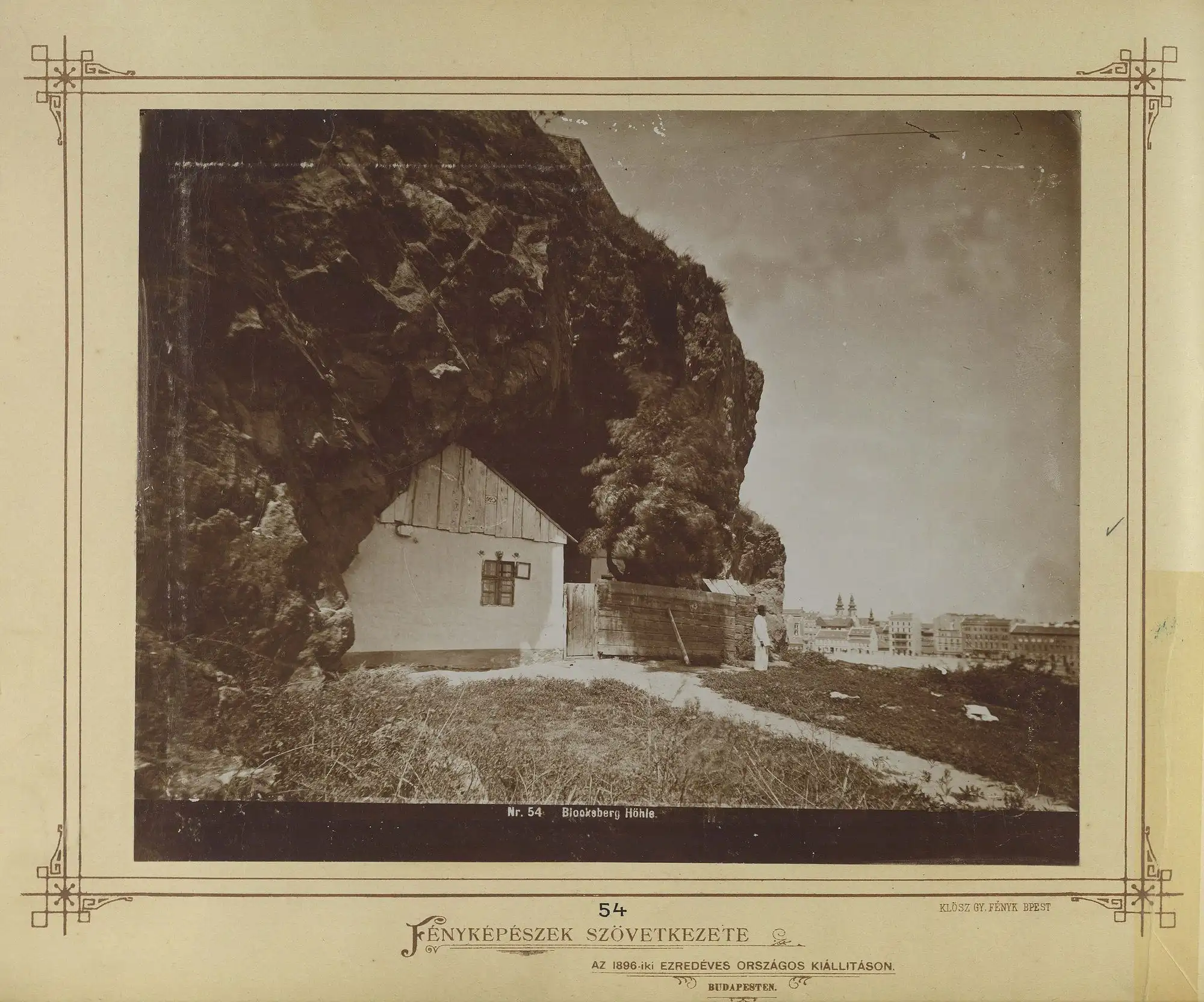
At the foot of the rock, meanwhile, people lived in the caves. A photograph from about 1874 shows a cave dwelling on the site where the Cave Church was later made.
Haynau's fortress, 1850 to 1854
After the defeat of the War of Independence the Habsburg military command resolved on a ring of forts around the city, and the hill was the obvious first one. Construction began in 1850 at General Haynau’s order, to designs by Ignaz Weisz, overseen by the Austrian military engineer Emanuel Zitta, with Mátyás Zitterbarth winning the building commission on the cheapest bid. Even Adam Clark, who built the Chain Bridge, put in a proposal. By 1854 imperial troops were in place.
The building was done in Sóskút limestone, delivered by Antal Hofhauser’s firm, with Tardos red limestone coping, in alternating courses of brick and stone. Some 2,500 cubic metres of stone and earth went down the hillside on rail carts.
It did not hold its purpose for long. After the Austro-Hungarian Compromise of 1867 its military importance declined rapidly, and within a generation Hungarians were arguing about what to do with it.
The pantheon that was never built, and the demolition that never finished
Count István Széchenyi had proposed a national pantheon on the hill in the 1840s. His son Ödön revived the idea after the Compromise, and a national competition followed in 1871. Gyula Berczik won it with a domed Byzantine building, Frigyes Feszl came second, and the other entries included a fairytale castle by Gyula Kolbenheyer and Sándor Straub, a pyramid whose author is not certain, and a Hungaria statue in the manner of the Acropolis by Adolf Wilhelm. Not one stone was laid.
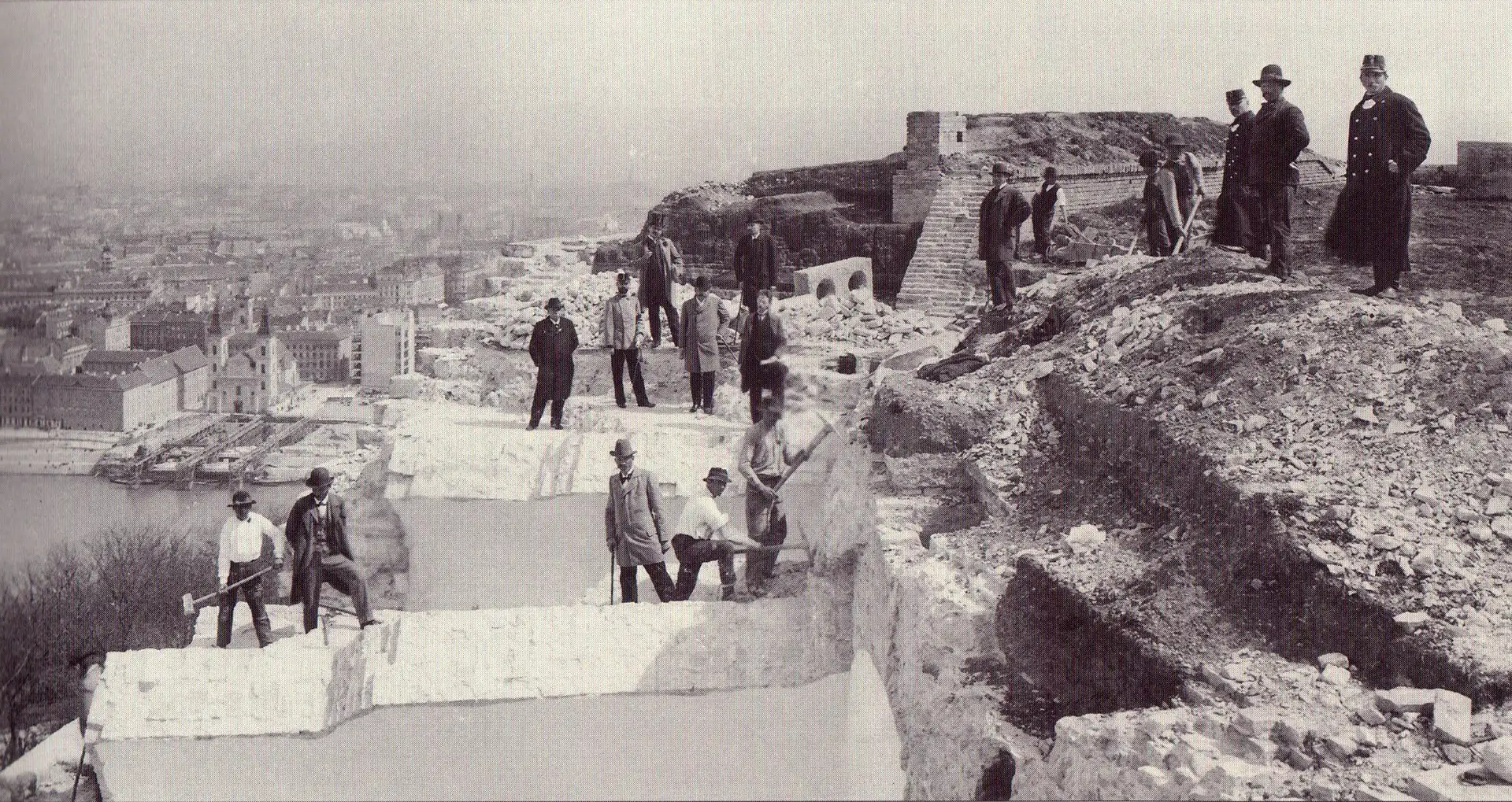
What happened instead was simpler. When the imperial garrison withdrew in 1899, the citizens of Budapest started pulling the walls down themselves. The money ran out before the work was finished, which is why the fortress still has a V-shaped gap above its former main gate, now called the Great Gate. There is a lookout there today, facing north.
Slum years, the siege and the Liberty Statue
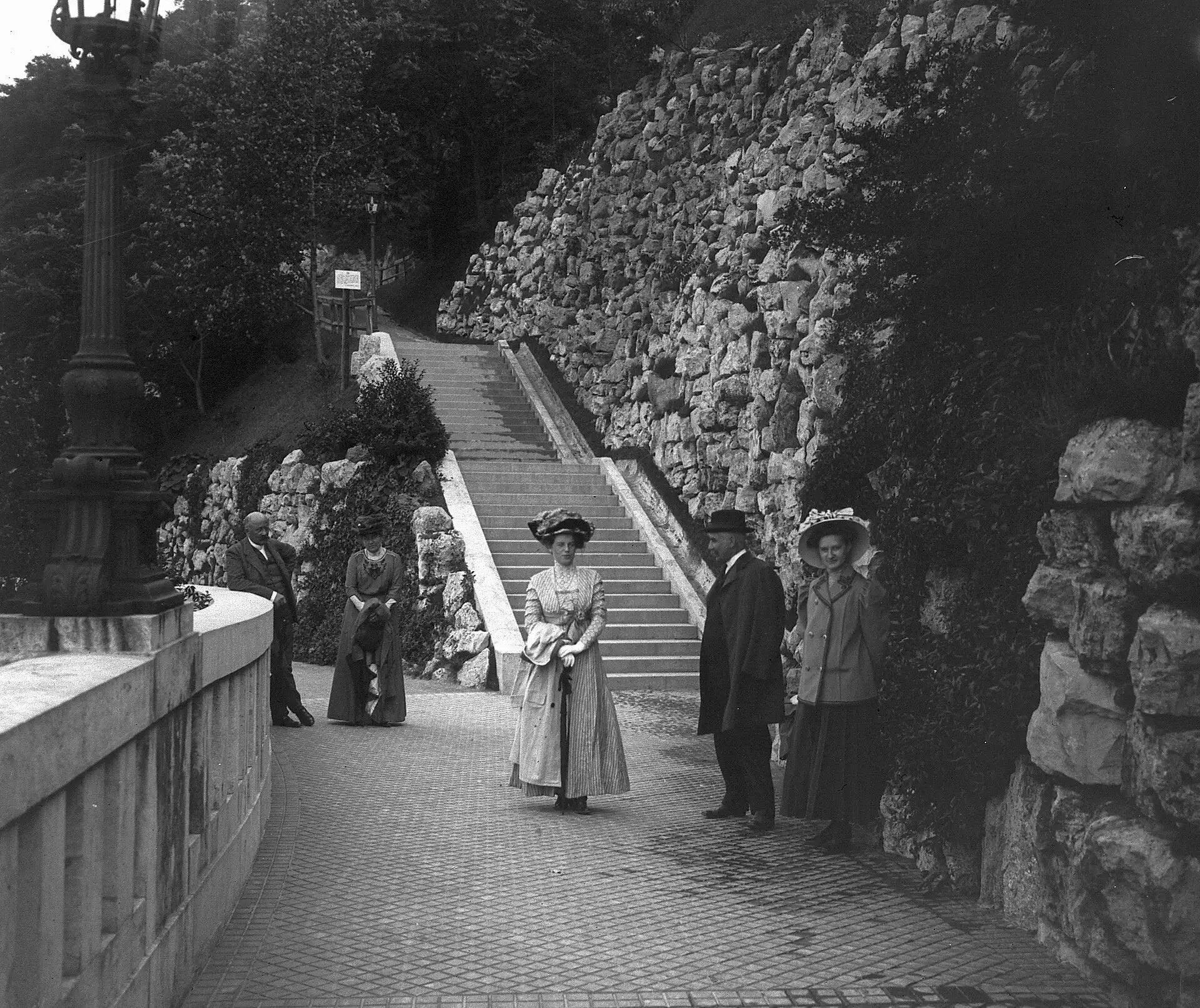
For the first half of the twentieth century the fortress drifted. It held police housing at times, and at others it was a notorious slum and a refuge for criminals. Between the wars the hill around it was landscaped in the English manner, with rock gardens, scenic roads and the fortress floodlit for the first time.
The war put it back in uniform. A bunker and anti-aircraft positions went into the courtyard and the casemates took the wounded, and in February 1945 the Citadella fell to Soviet troops after the siege of Budapest. The structure was damaged in several places and the scars of gunfire are still in the walls.
In 1947 Zsigmond Kisfaludi Strobl’s monument went up on the eastern end of the hill, forty metres from the ground to the top, with the fourteen-metre bronze Genius at its centre. It was the Liberation Monument then, and a figure of a Soviet soldier stood with it. During the 1956 revolution that soldier was toppled, and later political changes removed further Soviet references.
Decline, and the rebuild that reopened it
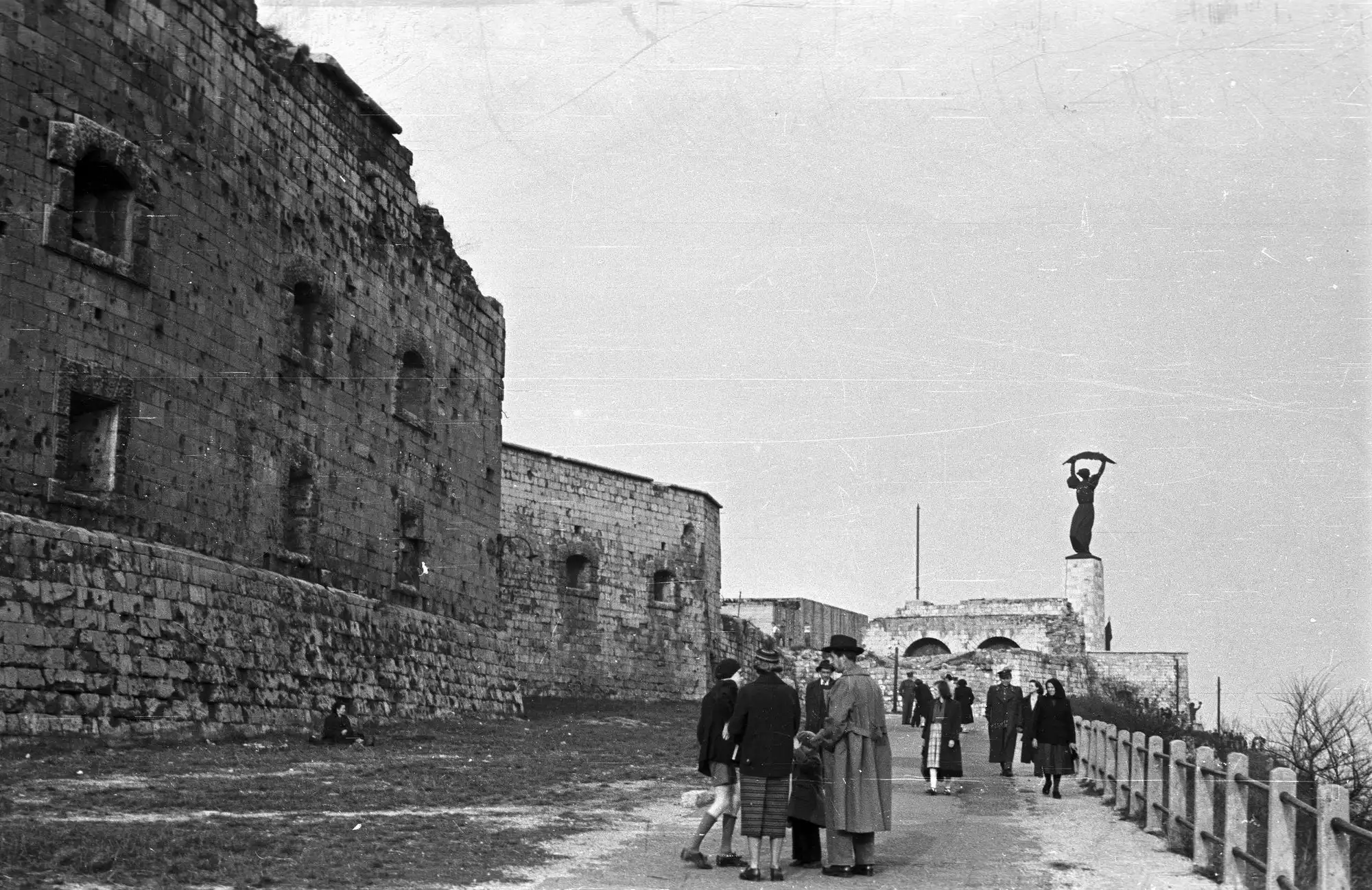
The Kádár era organised volunteer campaigns to dismantle the combat-damaged parts, then changed its mind. By the 1960s the fortress was a protected monument, and tourist facilities, restaurants and viewing terraces followed, with new access roads, a promenade and a city bus route to bring people up. In 1987 it joined Budapest’s UNESCO World Heritage listing.
After 1989 the ideological functions went and the maintenance went with them. Visitor numbers rose while the fabric fell apart, and privatisation brought a run of temporary bars and venues inside the walls. The city wanted a tourist destination, residents wanted a public park, and for thirty years neither happened.
Work finally began in autumn 2020, with archaeology that turned up the remains of the 1815 observatory, a First World War anti-aircraft gun mount and unexploded ordnance the Hungarian Defence Forces had to clear. Structurally unsound sections of wall were taken down and rebuilt by the original methods with the same stones. The interiors of the round bastion and the central courtyard were cleared of later additions to restore the original plan, new entrances were cut through the walls and lifts put into every level.
The architectural concept is Dániel Taraczky’s, of the art1st design studio, and the idea was to separate the “head” of tyranny, the Western Round Bastion, from the body of the fortress so that the space between them could be opened to the city. It reopened on 5 April 2026.