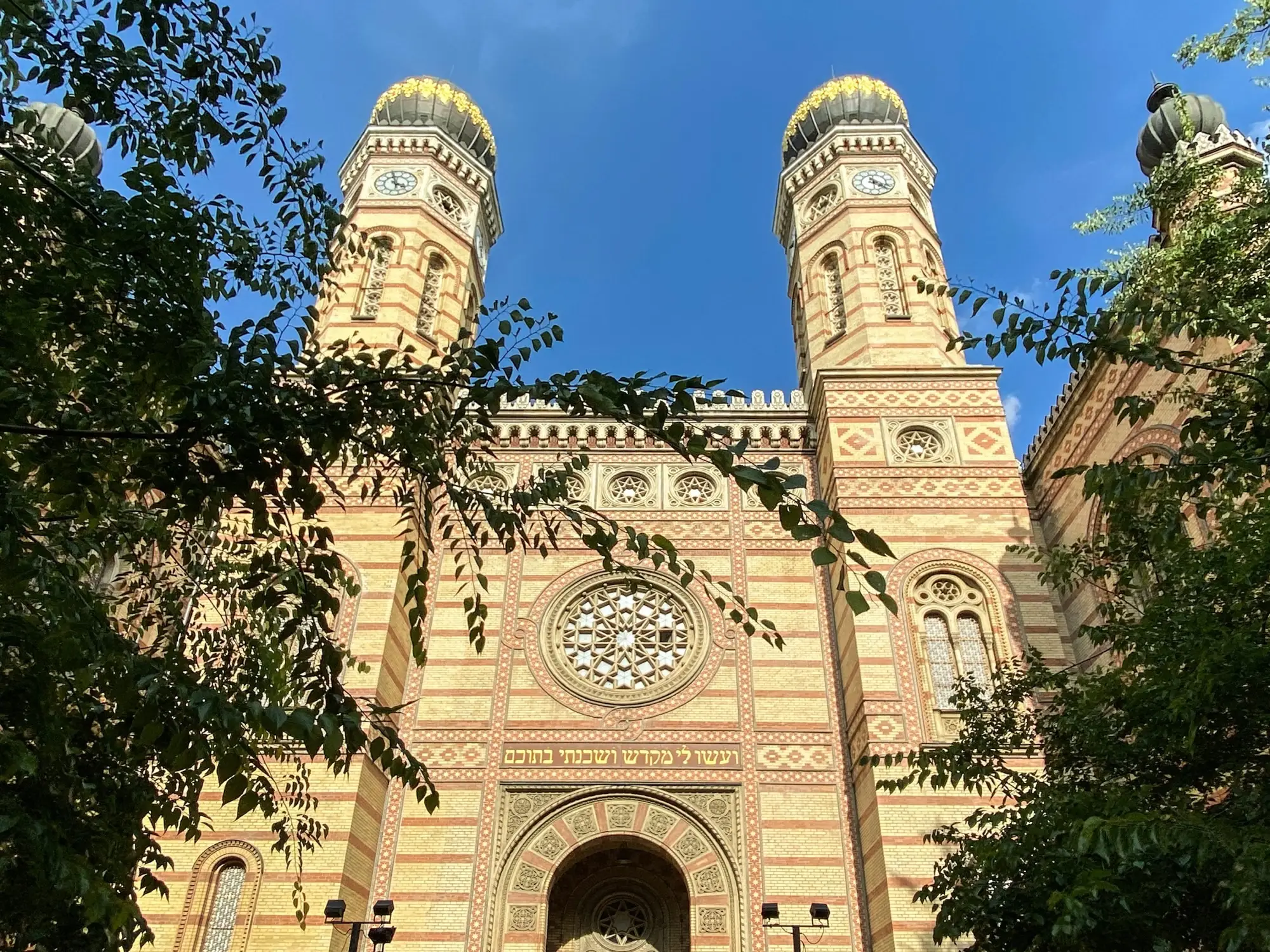
When it opened in 1859, the Dohány Street Synagogue was the largest Jewish place of worship anywhere, and it is still the largest synagogue in Europe. Built to a Moorish Revival design by Viennese architect Ludwig Förster, it was conceived as a public statement, a building that would house Pest’s growing Jewish community and signal Jewish presence in a rapidly modernising Habsburg city.
Within decades it became the spiritual home of Hungarian Neolog Judaism, and the house next door was the birthplace of Theodor Herzl. In the winter of 1944 to 1945 it stood on the edge of the Budapest ghetto, and its garden became a graveyard.
This is the story of how the synagogue came to be, who designed it, what happened to it across the twentieth century, and why a metal weeping willow now stands in its rear courtyard.
At a glance
Timeline
- 1854
Building begins
Construction begins on Dohány utca to Ludwig Förster’s design, on land owned by the Jewish community of Pest.
- 1859
Synagogue consecrated
The synagogue is consecrated on 6 September, with seating for nearly 3,000 worshippers and an organ.
- 1860
Theodor Herzl is born next door
The future founder of political Zionism is born on 2 May in the house beside the synagogue.
- 1916
The Jewish Museum opens
The Hungarian Jewish Museum shows its first collection in a rented flat on Hold utca.
- 1931
Heroes’ Temple and museum wing added
László Vágó’s 186-seat Heroes’ Temple and the arcades go up beside the synagogue, in memory of the 10,000 Hungarian Jewish soldiers who died in WWI. The museum moves into a new wing on the site of Herzl’s birthplace.
- 3 Feb 1939
Arrow Cross attack
The far-right Arrow Cross movement bombs the synagogue.
- 1944
Occupation and ghetto
Germany occupies Hungary on 19 March. In November the Arrow Cross government orders Budapest’s remaining Jews into a closed ghetto, which holds about 70,000 people. Dohány utca is its border.
- 18 Jan 1945
Ghetto liberated
Soviet troops liberate the ghetto. More than 2,000 of the dead found in the streets are buried in 24 common graves in the synagogue’s garden.
- 1990s
Major restoration
The war-damaged building is restored with state money and private donations, Estée Lauder’s prominent among them.
- 1996
New organ
Jehmlich of Dresden builds the present four-manual organ.
- Today
Active synagogue and visitor compound
The synagogue is the working centre of Budapest’s Neolog Jewish community and a memorial site.
Key facts
- Built
- 1854 to 1859
- Consecrated
- 6 September 1859
- Architects
- Förster (building), Feszl (sanctuary and Ark)
- Style
- Moorish Revival
- Capacity
- 1,497 seats for men, 1,472 for women
- Dimensions
- 53.1 m long, 26.5 m wide, towers 44 m
- Organ
- Jehmlich, Dresden, 1996
- Status
- Active Neolog synagogue
The architects
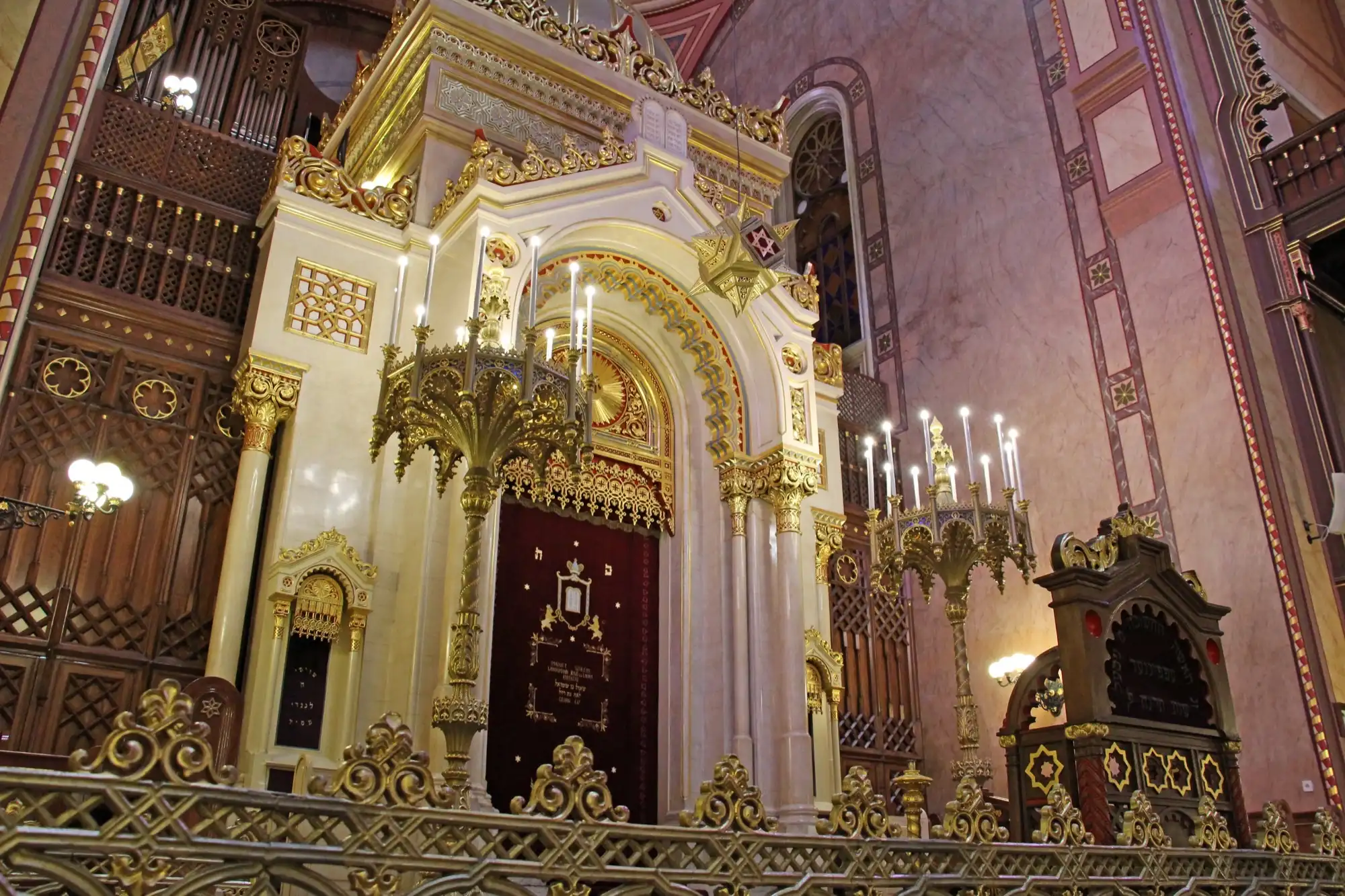
Ludwig Förster (1797 to 1863) was a German-born architect and a professor at the Vienna Academy, renowned in Vienna at the time. His clerk of works in Pest was Ignác Wechselmann, who later left his entire fortune to the Institute of the Blind.
Förster did not finish the job. After he left, the sanctuary and the Ark were designed by the Hungarian architect Frigyes Feszl, best known for the Vigadó concert hall on the Danube. The gilded white Ark in the photograph is his.
The additions of 1931, the Heroes’ Temple and the arcades that enclose the garden, are by László Vágó. Imre Varga designed the Tree of Life memorial in the park behind.
The garden
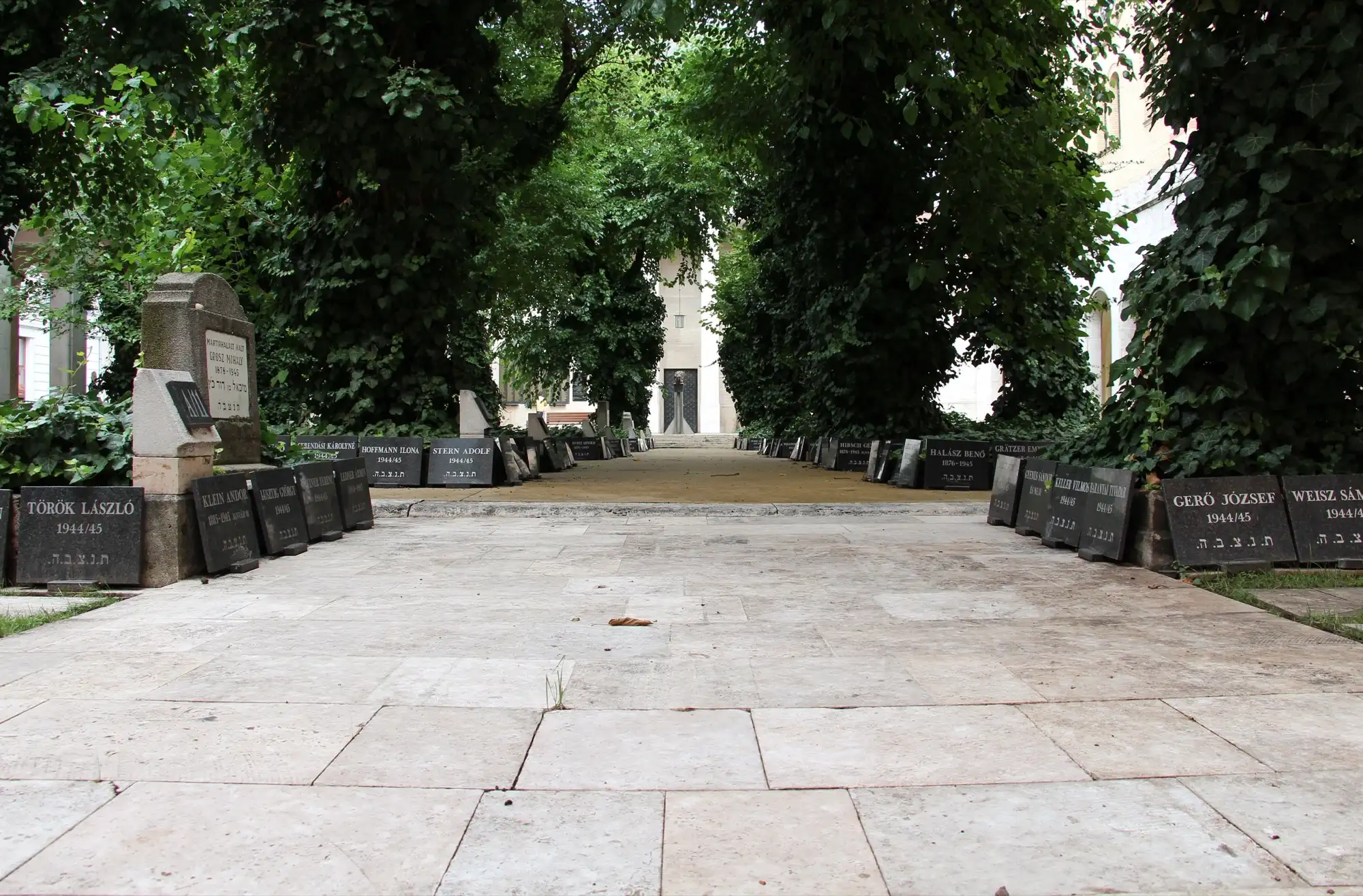
The plot beside the synagogue became a public space around 1900, when the house standing on it was demolished. The Jewish community wanted it badly enough to give up a plot five times the size, where a Lipótváros synagogue was to have been built.
Building only began after the First World War. The Heroes’ Temple, a cultural centre and a park went up, ringed with arcades so that the community’s spaces would be open and visible. A pool was planned for the middle of the park, to reflect the sky.
At the end of the Second World War the garden became part of the ghetto, and then its burial ground. The museum’s own words for it are the plainest. The park with the pool became a graveyard.
The history of the Dohány Street Synagogue
Four threads run through the synagogue’s story that are worth pulling on if you want to understand what the building means today.
Förster’s Moorish Revival design, 1854 to 1859
Förster’s design positioned the synagogue outside European Christian church architecture. He held that there was no Jewish style to build in, so he borrowed the forms of peoples he considered related to the Israelites, above all the Arabs, and looked to Islamic buildings in North Africa and to the Alhambra.
Two colours of brick run in horizontal stripes, a rose window sits over the main entrance, and the twin towers end in onion domes. It has often been mistaken for a mosque.
It was also modern. The building has an iron structure, which the Jewish Museum counts among the forerunners of modern architecture, and it was the first synagogue in Hungary to stand on land the community owned.
Neolog Judaism and the church-like interior
Inside, the plan is closer to a basilica than to a traditional synagogue, with three aisles, galleries on two levels and two pulpits of the kind built in churches. Services were accompanied by an organ and a choir from the start, and the rabbis preached in Hungarian. Franz Liszt played the organ here.
All of that belonged to the modernising, Neolog wing of Hungarian Judaism, and the building became a symbol of the split between Neolog and Orthodox communities. Some things did not change. Men and women still sit separately at services.
The 1944 to 1945 Budapest ghetto
Germany occupied Hungary on 19 March 1944, and between May and July close to 500,000 Jews were deported from the provinces to Auschwitz. Budapest’s Jews were the last large community left. After the Arrow Cross seized power in October, they were ordered into a closed ghetto in the old Jewish quarter, sealed in December, with about 70,000 people inside. Dohány utca was its border.
The synagogue itself was used as a German radio base and as a stable. People in the ghetto died of cold, hunger, the siege and Arrow Cross killings, and as many as 20,000 were taken from it, shot on the banks of the Danube and thrown into the river.
When Soviet troops liberated the ghetto on 18 January 1945, thousands of bodies lay unburied in the streets. More than 2,000 people were buried in 24 common graves in the synagogue’s garden. Jewish tradition keeps cemeteries away from synagogues and forbids exhuming the dead, which is why this one exists, and why it has stayed.
The 1990s restoration and the Tree of Life
The synagogue came out of the war badly damaged and was fully restored only in the 1990s, with state money and private donations, Estée Lauder’s prominent among them. A new organ by Jehmlich of Dresden followed in 1996.
The memorial park behind the building is named after Raoul Wallenberg, the Swedish diplomat who, with other neutral diplomats, issued protective papers and set up safe houses that saved tens of thousands of Budapest’s Jews. Plaques there carry the names of rescuers from Hungary and abroad.
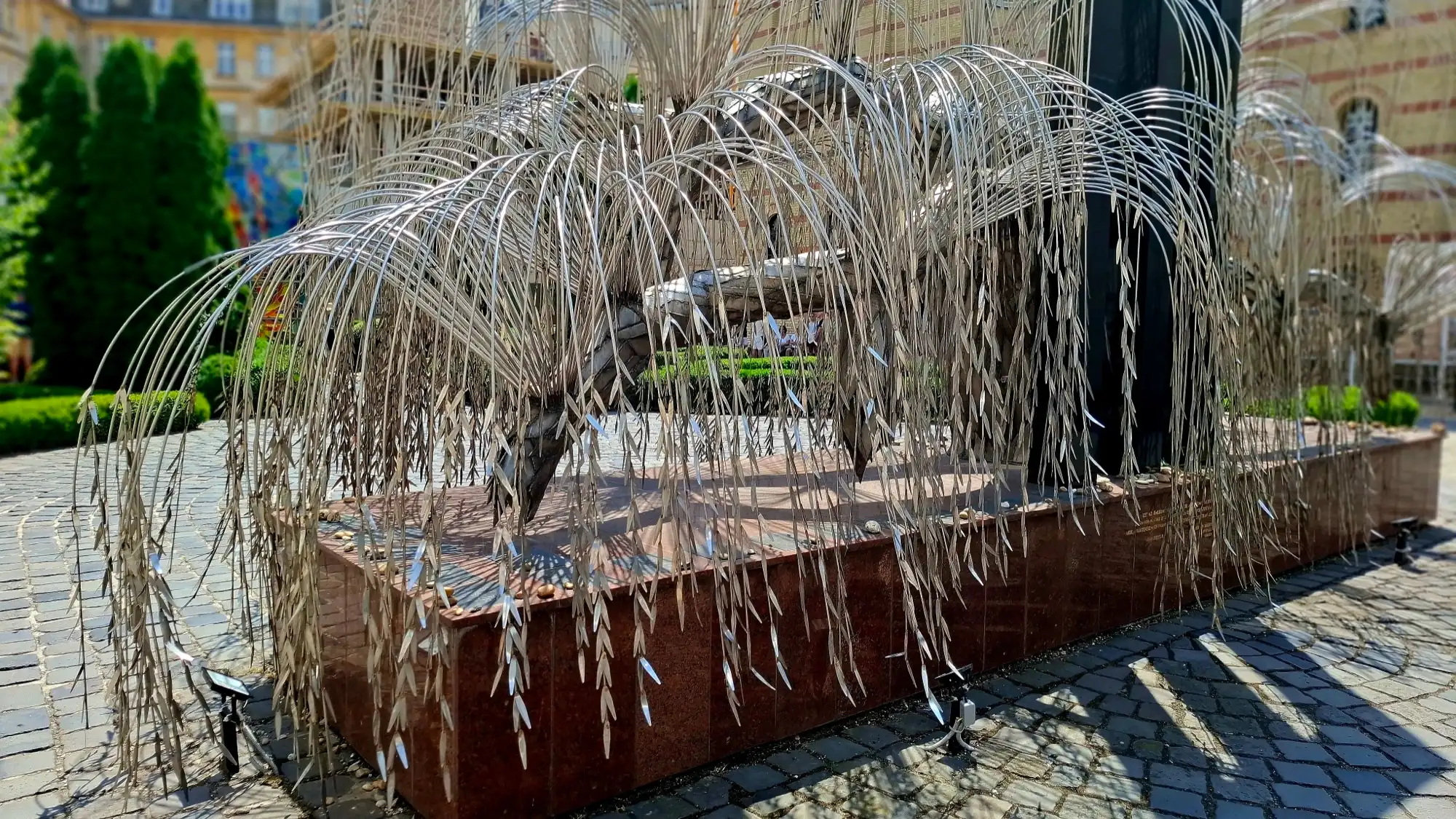
At its centre stands Imre Varga’s Tree of Life, a weeping willow in metal on a red granite base. It was the idea of the actor Tony Curtis, who was of Hungarian descent, and was supported by the Emanuel Foundation he set up to help preserve Hungary’s synagogues and Jewish cemeteries. Families can have the names of relatives who were killed engraved on its leaves.
Visiting today
Understanding the history transforms the visit. Instead of seeing a grand interior, you’ll recognise Feszl’s Ark, the church-like plan of a Neolog synagogue, the Moorish Revival cross-references in the exterior, and the Tree of Life as both memorial and ledger.