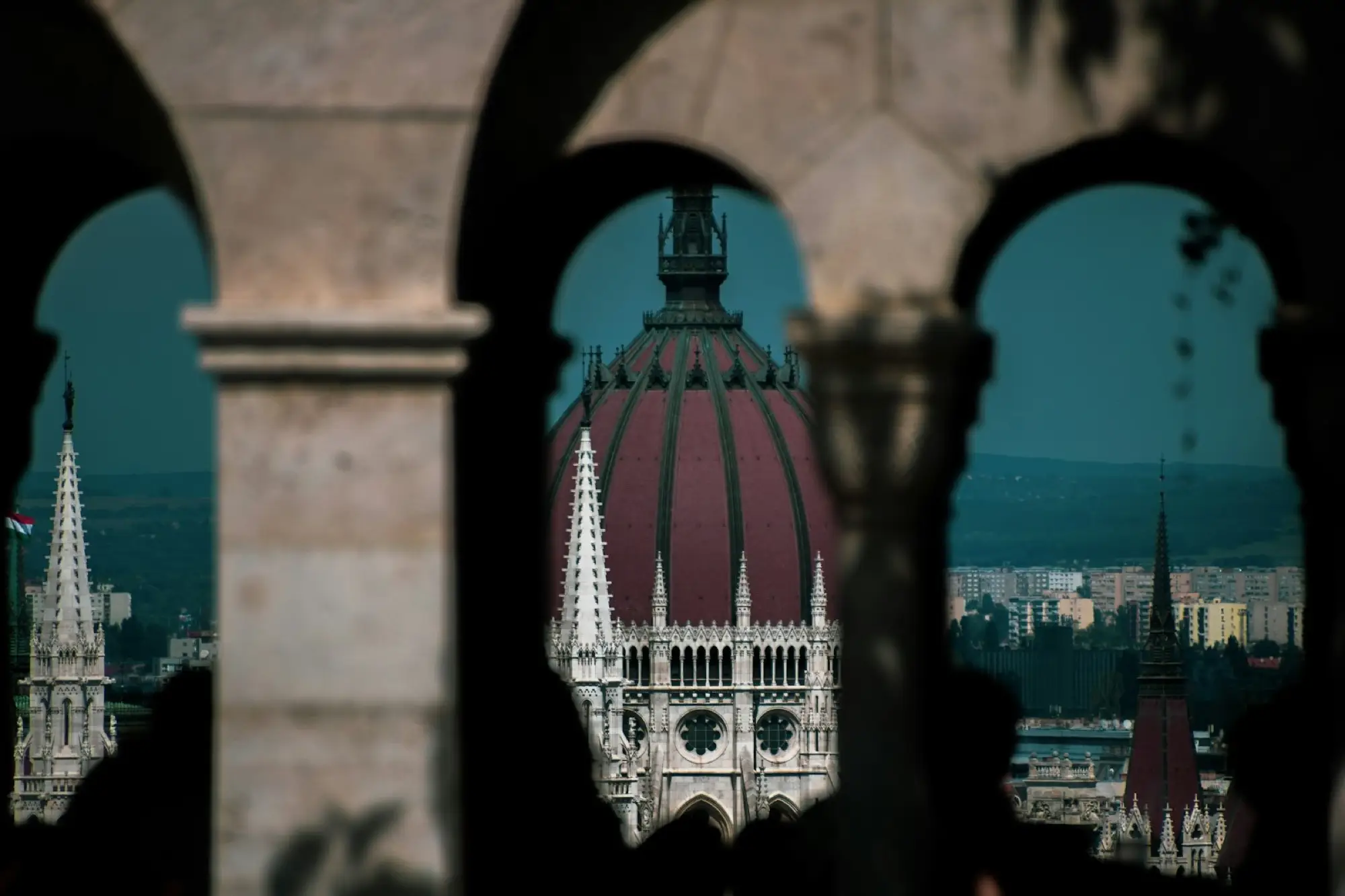
The Hungarian Parliament Building is not a museum piece. It is a working legislative seat, the home of the Hungarian National Assembly, and the site where the country’s modern political identity was forged across more than a century. The Holy Crown of Hungary sits beneath its central dome. Hungary’s transition from communism to democracy was announced from its balcony.
The story begins after the 1867 Compromise with Austria, when the Kingdom of Hungary regained its own parliament but had no building worthy of it. Imre Steindl’s Neo-Gothic design won the international competition of 1882 to 1883.
Building work began in 1885, members first met in the unfinished Dome Hall for Hungary’s millennium in 1896, and the building was handed over in 1902. The 96-metre dome ties to 896 AD, the year of the Magyar settlement of the Carpathian Basin, and for more than a century planning rules kept everything else in the city below it.
At a glance
Four short tabs cover the Parliament’s history at a glance: a timeline, the key facts and figures, the architect, and what the building was meant to say.
Timeline
- 1867
Austro-Hungarian Compromise
The Compromise creates the Dual Monarchy. The Kingdom of Hungary regains its own parliament, but has no permanent building.
- 1873
Budapest unified
Buda, Pest, and Óbuda merge to form Budapest, and the new capital needs a parliament to match.
- 1882 to 1883
The competition
An international design competition is announced in 1882. Nineteen designs arrive by the deadline of 1 February 1883, Steindl shares the first prize, and his Neo-Gothic design is the one built.
- 1885
Building work begins
Work starts on the Pest riverbank on 12 October 1885.
- 1896
The millennium session
On 8 June 1896, with the building still unfinished, members of both houses meet together in the Dome Hall for the 1,000th anniversary of the Magyar settlement.
- 1902
Steindl dies, the building opens
Imre Steindl dies on 31 August 1902. The building is handed over on 8 October, 38 days later.
- 1904
Interiors finished
Work on the interiors, which carried on after the handover, is completed.
- 1944 to 1945
Wartime damage
The Siege of Budapest leaves parts of the facade and several interior rooms in need of major restoration.
- 1987
UNESCO listing
The building is inscribed on UNESCO’s World Heritage List as part of the Banks of the Danube in Budapest.
- 23 Oct 1989
Republic declared from balcony
On the 33rd anniversary of the 1956 Hungarian Revolution, Speaker Mátyás Szűrös declares the new Hungarian Republic from the balcony facing Kossuth Lajos tér, ending more than 40 years of communism.
- 2000
Holy Crown moves in
The Holy Crown of Hungary is transferred from the Hungarian National Museum to the Parliament’s central Dome Hall.
- Today
Working seat and visitor landmark
The Parliament is both the working seat of the Hungarian National Assembly and a visitor landmark, open to the public on timed 45-minute tours.
Key facts
- Built
- 1885 to 1902, interiors to 1904
- Rooms
- 691, round 10 courtyards
- Statues
- 242
- Dimensions
- 268 m long, 96 m tall
- Style
- Neo-Gothic outside, eclectic within
- Materials
- 40 million bricks, 40 kg gold
- Holy Crown
- Displayed in Dome Hall since 2000
- Annual visitors
- More than 700,000
The architect
Imre Steindl (1839 to 1902) was a professor of architecture at the Budapest Technical University and one of the leading Hungarian architects of the historicist generation. The competition for the Parliament was announced in 1882, and by the deadline of 1 February 1883 nineteen designs had arrived. Steindl was one of four entrants to share the first prize, and his Neo-Gothic design was the one chosen.
Steindl died on 31 August 1902, 38 days before the building was handed over, and never saw it in use.
The interior decoration was carried out by Hungarian artists and workshops: the ceiling paintings of the Grand Staircase and the Dome Hall are by Károly Lotz, and the stained-glass windows either side of the staircase came from Miksa Róth’s workshop.
Symbolism
The jury chose Steindl’s design as the most fitting architectural expression of the Hungarian constitution and of national self-awareness, and the building was planned to read that way. It stands on the river like the Palace of Westminster in London, which Count Gyula Andrássy is said to have admired, and it houses two matching chambers either side of the dome, one for each house of the old parliament.
The 96-metre dome height was chosen to mark 896 AD, when the Magyar tribes are said to have settled the Carpathian Basin, and the first session in the Dome Hall was timed to the millennium in 1896. St. Stephen’s Basilica, also 96 metres, shares the reference.
The Dome Hall carries the argument inside. Its sixteen sides hold statues of sixteen Hungarian rulers with their coats of arms, a short history of the kingdom in stone. The building’s watchword was the same: Hungarian materials, Hungarian technology, Hungarian craftsmen.
The history of the Hungarian Parliament
Beyond the dates, four threads explain what the Parliament means to Hungarians today, and what you are looking at when you stand in front of it.
Imre Steindl’s Neo-Gothic design
Steindl gave the outside to the Gothic and the inside to everything else. The exterior is Neo-Gothic from end to end: pinnacles, pointed arches and a skyline of spires, 268 metres long on the river and 123 metres deep. Inside, the rooms mix Baroque and Renaissance elements, and UNESCO sums up the whole as a textbook case of 19th-century eclectic architecture, on a par with the great official buildings of London, Munich, Vienna and Athens.
The scale is easier to grasp in numbers. About 176,000 cubic metres of earth were moved, 40 million bricks laid, and more than half a million ornamental stones carved for the walls. Inside there are 691 rooms, 10 courtyards, 29 staircases and 27 gates, and 40 kilograms of gold leaf went on the decoration. Of the 450 statues planned, 242 were made.
The facade is clad in limestone from Sóskút, chosen because it was cheaper and softer to carve. City air damaged it quickly, and UNESCO still lists the decay of limestone among the threats to the whole World Heritage Site. From the square, look up at the statues on the facade and the tracery round the windows: most of what you see is carved, not cast.
The Dome Hall and the Holy Crown
The sixteen-sided central hall sits beneath the Parliament’s 96-metre dome, with statues of sixteen Hungarian rulers round the walls and Lotz’s paintings overhead.
Since 2000 it has held the Holy Crown of Hungary with the sceptre, orb and sword, guarded by soldiers of the Crown Guard. What the crown is made of, how old each part is and how it spent 33 years at Fort Knox are on our Holy Crown of Hungary page.
The Old Upper House Chamber
Hungary now has a single-chamber parliament, so the former upper house is preserved as a ceremonial room, one of the two matching chambers either side of the dome. The benches still have cigar holders built into the railings, a leftover from the days when members smoked in the building.
The chamber is on the public tour, and it gives a sense of the political theatre of late-imperial Hungary.
The 1989 republic and the World Heritage listing
The Parliament has been the seat of the legislature across the late Habsburg period, the interwar kingdom, the war, the People’s Republic and the democratic Republic that followed it. The most consequential modern moment was 23 October 1989, when Speaker Mátyás Szűrös announced the new Hungarian Republic from the balcony.
The building has been part of the Budapest World Heritage Site, the Banks of the Danube, since 1987. In 2000 the Holy Crown moved in from the Hungarian National Museum. Today it is both a working legislative seat and a landmark open to visitors.
Did you know?
A handful of quieter facts about the Parliament that rarely make the headline tour patter.
The architect never saw it open
Imre Steindl died on 31 August 1902, 38 days before the building was handed over on 8 October. He had spent twenty years on it.
The dome is exactly the same height as St. Stephen’s Basilica
Both buildings stand 96 metres tall, and the number references 896, the year of the Magyar settlement of the Carpathian Basin. For more than a century, planning rules kept everything else in the city below them.
Members met in it six years before it opened
The first session in the building was held in the unfinished Dome Hall on 8 June 1896, for the millennium, when most of the interior was still a building site.
The Upper House benches still have cigar holders
Members parked their cigars in holders built into the benches of the Upper House. The holders are still in place, though no longer used.
Hungary’s Republic was declared from the balcony
On 23 October 1989, the 33rd anniversary of the 1956 Hungarian Revolution, Speaker Mátyás Szűrös declared the new Hungarian Republic from the balcony facing Kossuth Lajos tér. The moment marked the formal end of more than 40 years of communism.
Visiting today
The Parliament remains a working legislative seat, not a museum. More than 700,000 visitors a year come through the building, by the Parliament’s own count, and tour slots sell out ahead.
Knowing the history changes what you see. The Dome Hall reads differently once you know the crown came back from Fort Knox in 1978, and the Old Upper House reads differently once you have spotted the cigar holders.