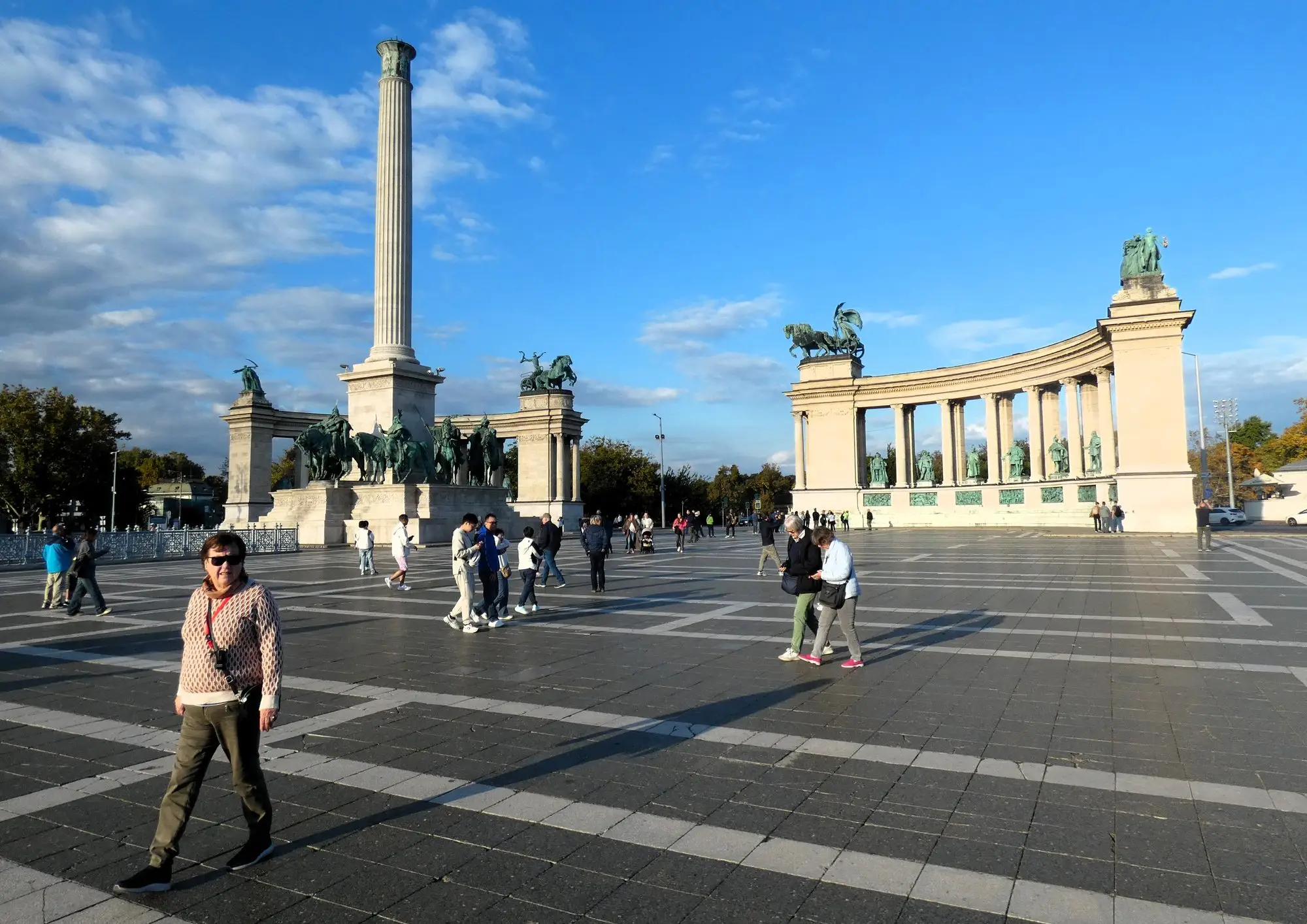
Heroes’ Square took thirty-one years to finish and has been argued over for most of the time since. The monument at its centre was ordered by an Act of Parliament, designed by two men who never entered a competition for it, and finished so slowly that the country it celebrated no longer existed in the same shape by the time it was unveiled.
Then the twentieth century got at it. The Habsburg statues came down in 1919 and went back up under Horthy; two were destroyed in the siege of Budapest; and all five Habsburgs were replaced by national heroes between 1948 and 1955.
At a glance
Timeline
- 1870
The first petition
The council of Pest asks Parliament for a national monument. Nothing comes of it for twenty years.
- 1891
Budapest asks again
The General Assembly of Budapest petitions the National Assembly for a public monument to the nation’s thousand-year history, and the end of Andrássy Road by the City Park is designated as its site.
- 1894
Schickedanz settles the design
After two earlier schemes, Albert Schickedanz arrives at a central column with two quarter-circle colonnades. The millennium committee accepts it with small changes.
- 1896
Parliament orders the monument
Act VIII of 1896 provides for it, in the year Hungary marks the thousandth anniversary of the Magyar conquest. The Műcsarnok opens on the square, and a law provides for the Museum of Fine Arts.
- 1897
The fourteen are chosen
The list of rulers for the colonnades is approved. János Hunyadi later replaces János Szapolyai, as the only figure on that list who was never a king.
- 1898
Building begins
Work starts, with György Zala as sculptor. No competition was ever held, because Prime Minister Sándor Wekerle asked Schickedanz and Zala himself.
- 1900
Gabriel wins in Paris
Before it is ever raised, the finished statue is sent to the Exposition Universelle in Paris and takes the grand prix of the Hungarian section.
- 1901
The column is crowned
Gabriel is raised on the 36-metre column, the first of the monument’s figures to be completed. A time capsule document dates it to October 1901.
- 1905
The architecture is handed over
The built parts are finished, with only five statues ready. The Great War slows the rest.
- 1919
The Habsburgs come down
Under the Hungarian Soviet Republic the Habsburg rulers’ statues are taken off the monument, and on 1 May the whole composition is draped in red. They go back up under Horthy.
- 1929
Finished, and the memorial stone laid
On 26 May the completed monument and the Heroes’ Memorial Stone are inaugurated together, in the presence of Miklós Horthy and with a speech by István Bethlen.
- 1932
The square is named
It becomes Hősök tere, Heroes’ Square.
- 1938
Park to parade ground
The trees are taken out and the square is paved for the Eucharistic World Congress. Its function changes completely.
- 1948 to 1955
Five new figures
Bocskai and Bethlen in 1948, Thököly in 1954, Rákóczi and Kossuth in 1955, in place of the Habsburg rulers.
- 1956
A new stone, and a demonstration
Béla Gebhardt’s replacement memorial stone is set in place in the spring. In December, a month after the Soviet intervention, women demonstrate on the square and at the memorial stone.
- 1989
Imre Nagy reburied
The ceremony for his reburial is held here on 16 June, and enters public memory as an icon of the peaceful change of system.
- 2001
Heroes’ Memorial Day in law
Act LXIII declares the last Sunday of every May the Hungarian Heroes’ Memorial Day, and pays tribute to those who raised the monument and the stone.
- 2002
World Heritage
Andrássy Avenue and its surroundings, Heroes’ Square among them, are added to Budapest’s World Heritage site, together with the Millennium Underground beneath the avenue.
- 2024
Gabriel comes down
The statue leaves the column at the end of the year for a full restoration in a workshop.
Key facts
- Built
- 1898 to 1929
- Inaugurated
- 26 May 1929
- Architect
- Albert Schickedanz
- Sculptor
- György Zala, with eight others
- Column
- 36 metres, Corinthian
- Figures
- 14 rulers, 7 chieftains, 4 groups
- Named
- Hősök tere, 1932
- Status
- National memorial site; World Heritage, 2002
The architects
Albert Schickedanz and Fülöp Herzog designed the Museum of Fine Arts, the Műcsarnok and the Millennium Monument between them, which is why the square works as one composition rather than three separate commissions that happen to face each other.
Schickedanz had already tried twice. His first scheme, which won a first prize and was never built, put an equestrian statue of Gyula Andrássy in front of a semicircular colonnade. The second replaced the semicircle with two quarter circles round an equestrian figure. The third, worked out by 1894, is what stands today.
György Zala carried the sculptural commission and completed the king statues with Richárd Füredi, Barnabás Holló, Miklós Köllő, György Kiss, Ede Margó, Károly Senyei, Ede Telcs and György Vastagh the younger.
The history of Heroes’ Square
Thirty years of arguing about a column
The idea of a great national monument had been circulating since the 1860s, and the council of Pest petitioned Parliament for one in 1870. It went nowhere.
What finally moved it was the millennium. Act II of 1892 ordered a national exhibition in Budapest for 1895, and by 1893 Prime Minister Sándor Wekerle was saying openly that the exhibition had to be tied to a monument marking a thousand years of the Hungarian state.
A committee formed in January 1894, and Act VIII of 1896 provided for the monument itself. There was never a competition. Wekerle asked Albert Schickedanz and György Zala directly, citing the success of their earlier work together.
Building began in 1898. The architectural parts were handed over in 1905 with only five of the statues in place, and the Great War slowed the rest so badly that the finished monument was not inaugurated until 26 May 1929.
Who got into the pantheon, and who was thrown out of it
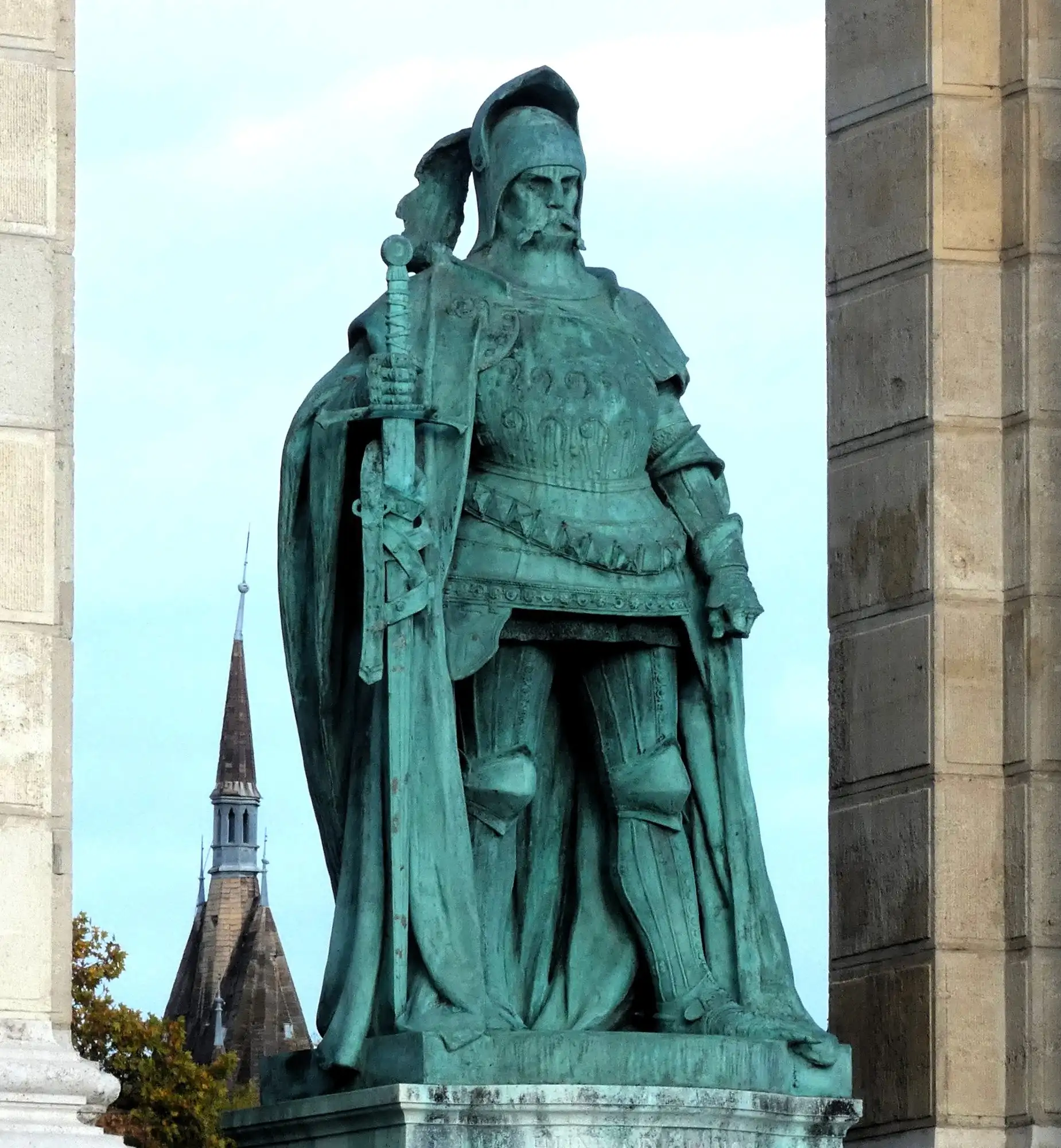
Deciding which fourteen figures of Hungarian history deserved bronze took years of fierce argument. The list approved in 1897 ran from Stephen I and Ladislaus I through Coloman, Andrew II, Béla IV, Charles I, Louis I and Matthias Corvinus to five Habsburg rulers: Ferdinand I, Charles III, Leopold II, Maria Theresa and Franz Joseph.
János Szapolyai was on it and then came off it, judged not very glorious from the point of view of the national past, and János Hunyadi took his place as the only figure on that list who was never a king.
Then the politics arrived. In 1919, under the Hungarian Soviet Republic, the Habsburg rulers were taken off the monument, and on 1 May the whole composition was wrapped in red drapery. Under Horthy they went back, and Zala remodelled the damaged Franz Joseph, this time in a coronation mantle rather than the uniform of a hussar general.
The siege of Budapest destroyed Maria Theresa and Leopold II outright. After the war the chieftains were restored and the Habsburgs replaced by the leaders of Hungary’s independence and freedom struggles. Some of those were statues Franz Joseph himself had given to the capital around the turn of the century. Bocskai and Bethlen went up in 1948, Thököly in 1954, Rákóczi and Kossuth in 1955.
The stone that stands for a grave
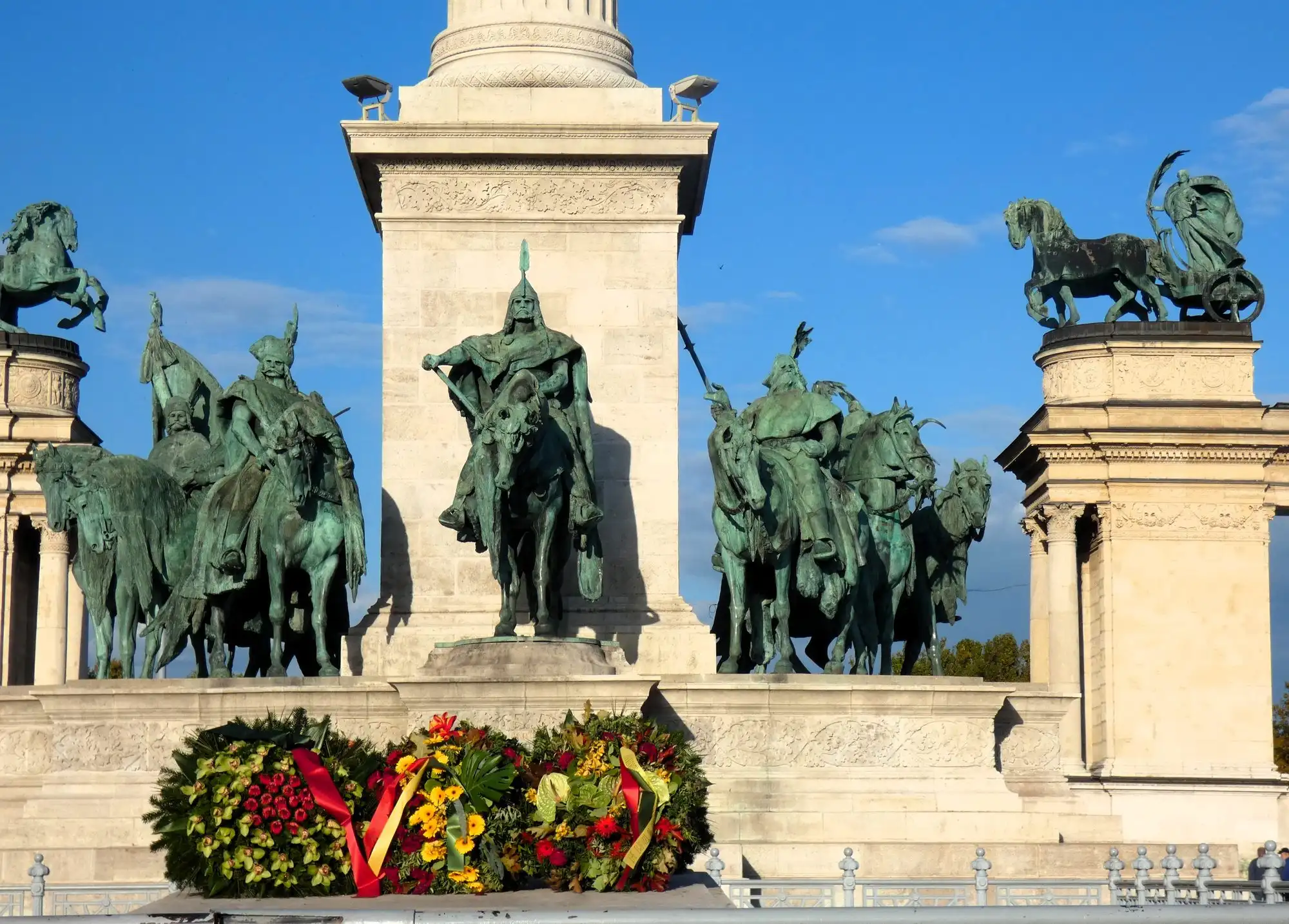
The idea came out of the First World War. A law of April 1917 provided for perpetuating the memory of the fallen, and from 1924 the last Sunday in May officially became the Heroes’ Memorial Day. Several sites were proposed for the stone itself. The press wanted it near the Millennium Monument, and that is what was decided in 1927.
Jenő Lechner made the monolith. It was laid in front of the statue of Prince Árpád and inaugurated in May 1929 alongside the finished monument, with Miklós Horthy present and István Bethlen speaking.
It holds no remains, so it is not really a grave. It does the job of Hungary’s tomb of the unknown soldier instead.
The stone was damaged in the Second World War and removed from the square during the 1950s restoration, partly for ideological reasons. Béla Gebhardt made the replacement, set in place in the spring of 1956, and that is the stone lying there now.
From park to parade ground
Until 1938 this was a park with trees, and the monument stood in it. The Eucharistic World Congress of that year ended that. The trees went and the square was paved, which made it fit for military parades, political mass rallies and state commemorations. Its function changed completely, and it has never changed back.
The square already drew big crowds in the Horthy era. The St Imre year of 1930 was its first great event, and that September the era’s most significant demonstration, in which people were killed, reached it. After the war came the May Day parades.
A month after the Soviet intervention of 4 November 1956, women demonstrated on the square and at the Heroes’ Memorial Stone in memory of the freedom fight. On 1 May 1957 János Kádár made his famous speech here to several hundred thousand people, a rally central to the legitimacy of the new system.
On 16 June 1989 the ceremony for the reburial of Imre Nagy was held on the square and around it, another of the great political gatherings that the paving of 1938 made possible.
A national memorial site, and a World Heritage site
There is a plaque on the square reading Nemzeti Emlékhely, Hősök tere, put there by the National Heritage Institute. This is one of Hungary’s designated national memorial sites.
Parliament singled the square out in Act LXIII of 2001, paying tribute to those who, by raising the Millennium Monument and the Heroes’ Memorial Stone, set a fitting memorial to the saviours, preservers and heroes of the homeland.
The same Act declared the last Sunday of every May the Hungarian Heroes’ Memorial Day, and gave the Budapest General Assembly the power to decide how the square is used, so that everyday, ceremonial, tourist and protocol use all fit with protecting it as a monument.
The other status is international. In 2002 Andrássy Avenue was added to Budapest’s World Heritage site, along with the Millennium Underground that runs the length of it beneath the pavement, and UNESCO counts Heroes’ Square and City Park among the avenue’s surroundings.
Who’s who on Heroes’ Square
Twenty-one figures from Hungarian history stand on the monument: seven chieftains round the foot of the column and fourteen rulers in the two colonnades. Left and right here mean as you face the monument from the Andrássy Avenue side, with the Museum of Fine Arts on your left and the Kunsthalle on your right. Read the two colonnades from left to right and you go through Hungarian history in order, from Stephen I to Lajos Kossuth.
The seven chieftains at the foot of the column
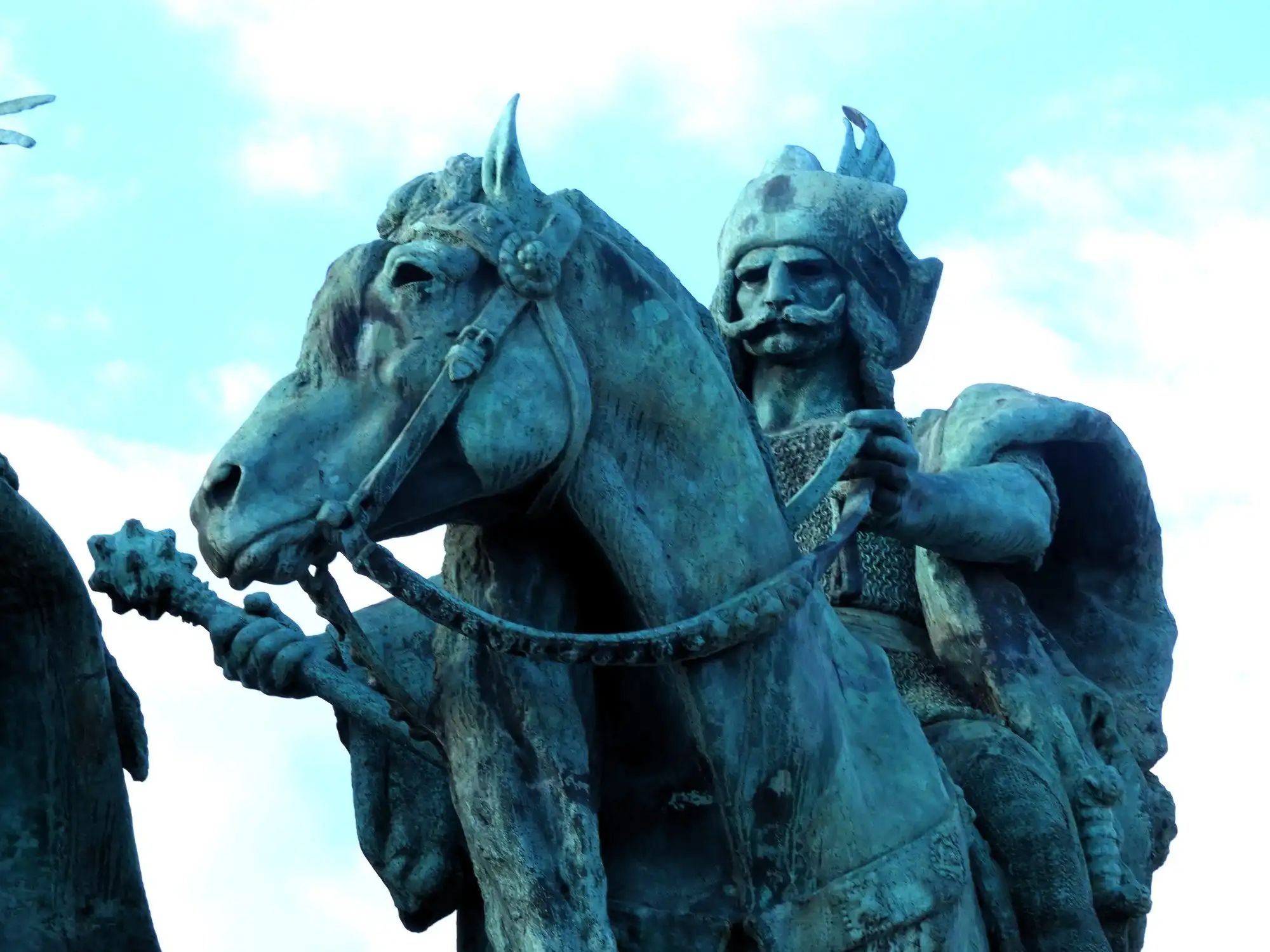
Árpád rides alone at the front of the column’s base, with a group of three horsemen on either side behind him, all by György Zala.
- Árpád (died 907), at the front. Chosen by seven Magyar tribes in 889 to lead them west from the Don, he took them over the Carpathians around 896, and the Árpád dynasty that ruled Hungary until 1301 is named after him.
- Kond, Ond and Töhötöm (Tétény), the group on your left.
- Előd, Huba and Tas, the group on your right.
The other six are named in the Gesta Hungarorum, a medieval chronicle whose seven leaders are Álmos, Árpád’s father, with Előd, Kond (Kend in the chronicle), Ond, Tas, Huba and Töhötöm, so the monument has put Árpád in his father’s place.
Its list ties each of the six to a son or a clan descended from him: Előd was the father of Szabolcs, Kond of Korcán, Ond of Ete, Tas of Lél and Töhötöm of Horka, and the Szemere clan descended from Huba.
The left-hand colonnade: seven kings, Stephen I to Louis the Great
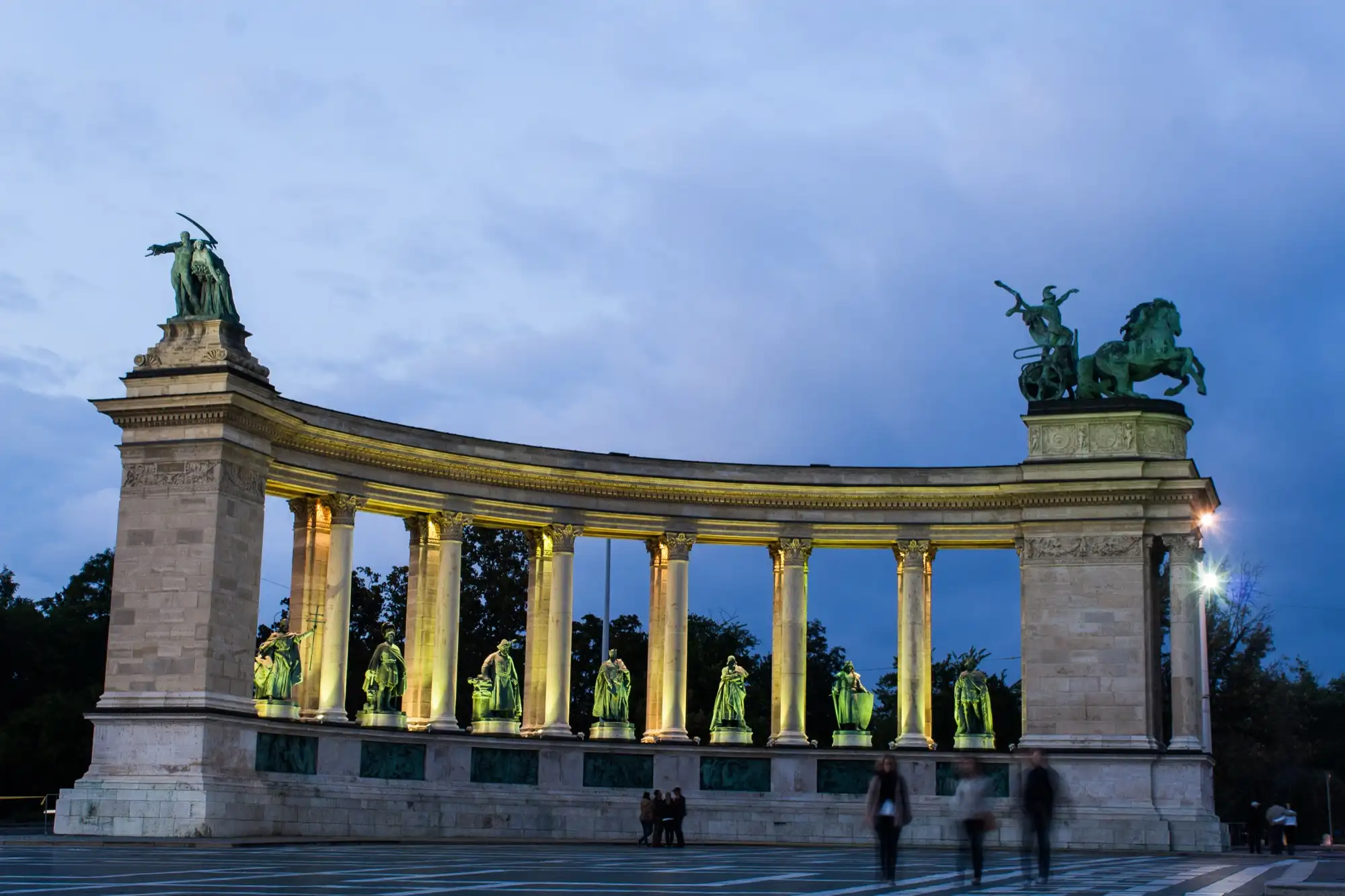
This is the colonnade on the Museum of Fine Arts side. Count from its outer end, the end furthest from the column, towards the War chariot by the column.
- Stephen I (about 970 to 1038), first, with a sword and a double cross. Hungary’s first king and the founder of the Hungarian state, made a saint in 1083.
- Ladislaus I (1040 to 1095), second, with a battle-axe and a lion at his feet. King from 1077, he greatly enlarged the kingdom, and was made a saint in 1192.
- Coloman (about 1070 to 1116), third, with books. King from 1095 and one of the most learned rulers of his age, hence his Hungarian byname, Könyves Kálmán. He also passed a law forbidding witch trials.
- Andrew II (1175 to 1235), fourth, holding the Golden Bull. King from 1205, he issued the Golden Bull of 1222, the charter that has been called the Hungarian Magna Carta.
- Béla IV (1206 to 1270), fifth. Andrew’s son, king from 1235. The Mongols routed his army in 1241, and their invasion left three-quarters of Hungary in ruins.
- Charles I (1288 to 1342), sixth, with a shield. Károly Róbert in Hungarian, of the house of Anjou, he claimed the throne when the Árpád line died out, was crowned in 1301 and made Hungary a great power again.
- Louis I, the Great (1326 to 1382), seventh, beside the War chariot. Charles’s son, king of Hungary from 1342 and of Poland from 1370.
The right-hand colonnade: the Hunyadis, then five leaders of the independence struggles
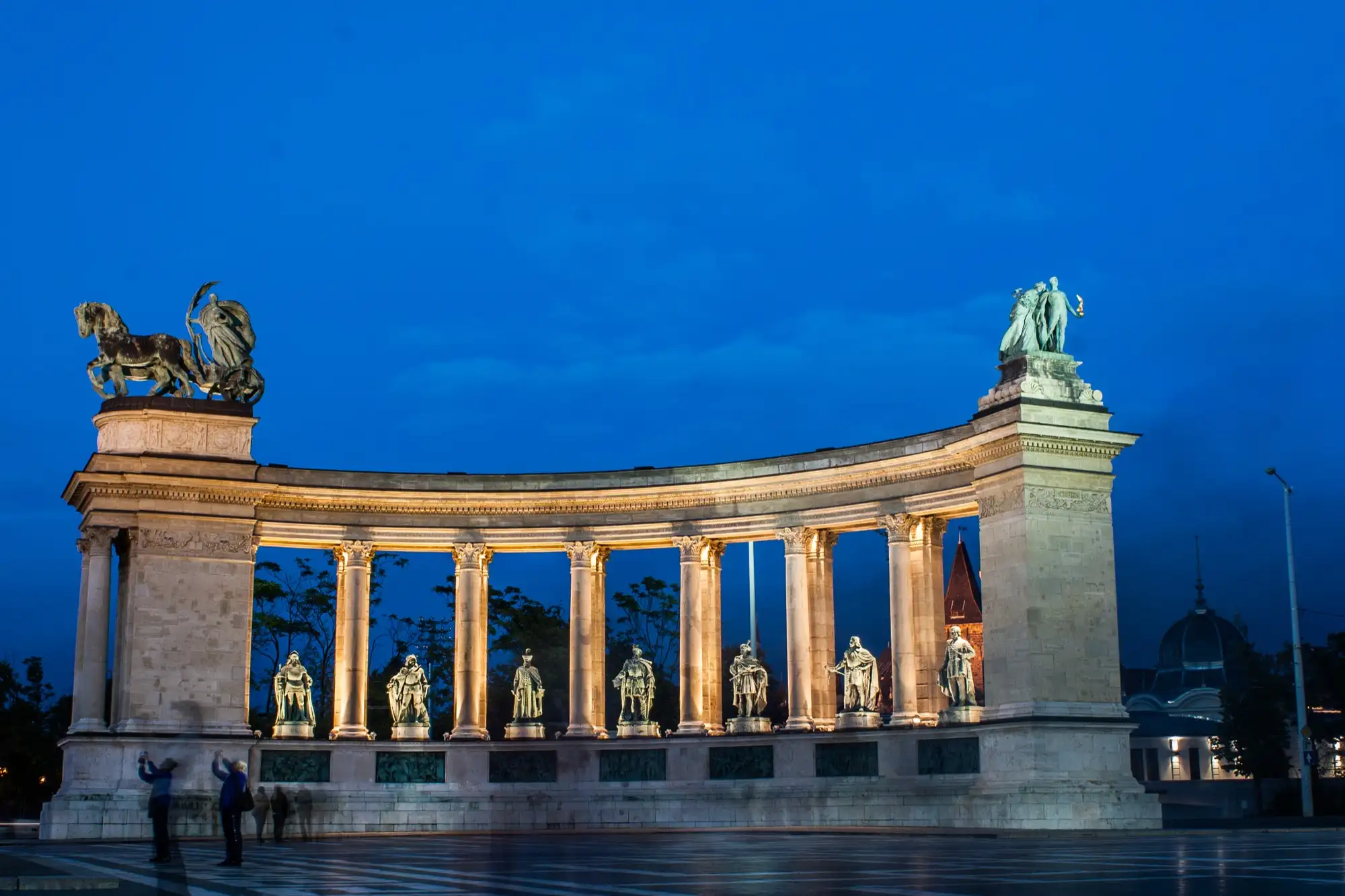
This is the colonnade on the Kunsthalle side. Count from its inner end, by the Peace chariot and the column, out towards the Kunsthalle. The last five, from Bocskai to Kossuth, stand in place of the Habsburg rulers, and how they got there is told in the history of Heroes’ Square above.
- János Hunyadi (about 1407 to 1456), first, nearest the column. A general and governor of Hungary from 1446 to 1452, and a leading commander against the Turks in the fifteenth century.
- Matthias Corvinus (1443 to 1490), second. Hunyadi’s son, king from 1458, who set out to rebuild the Hungarian state after decades of feudal anarchy, through financial, military, legal and administrative reforms. Corvinus comes from the raven on his coat of arms.
- István Bocskai (1557 to 1606), third, holding a mace. Prince of Transylvania, who defended Hungarian interests when the country was divided between the Ottomans and the Habsburgs.
- Gábor Bethlen (1580 to 1629), fourth. Calvinist prince of Transylvania and briefly titular king of Hungary, from 1620 to 1621, against the Habsburg emperor Ferdinand II. This statue stood on the Körönd on Andrássy Avenue from 1902 until it was moved here in 1948.
- Imre Thököly (1657 to 1705), fifth. Leader of the Hungarian Protestants against Habsburg rule, elected commander in chief of the rebels in 1680. He died at İzmit, in the Ottoman Empire.
- Ferenc Rákóczi II (1676 to 1735), sixth. Prince of Transylvania who led a national rising against the Habsburgs that came close to succeeding, from 1703 to 1711. The relief below shows him meeting Tamás Esze. He died at Rodosto, in Turkey.
- Lajos Kossuth (1802 to 1894), seventh, at the outer end, nearest the Kunsthalle. He led Hungary’s fight for independence from Austria in 1848 and 1849, and died in Turin. The relief below shows his recruiting speech at Cegléd.