A zoo, a thermal bath, a castle, a circus, a lake, a tethered balloon and two museums that opened in 2022 all fit inside City Park, behind Heroes’ Square. The park itself is free and never shuts.
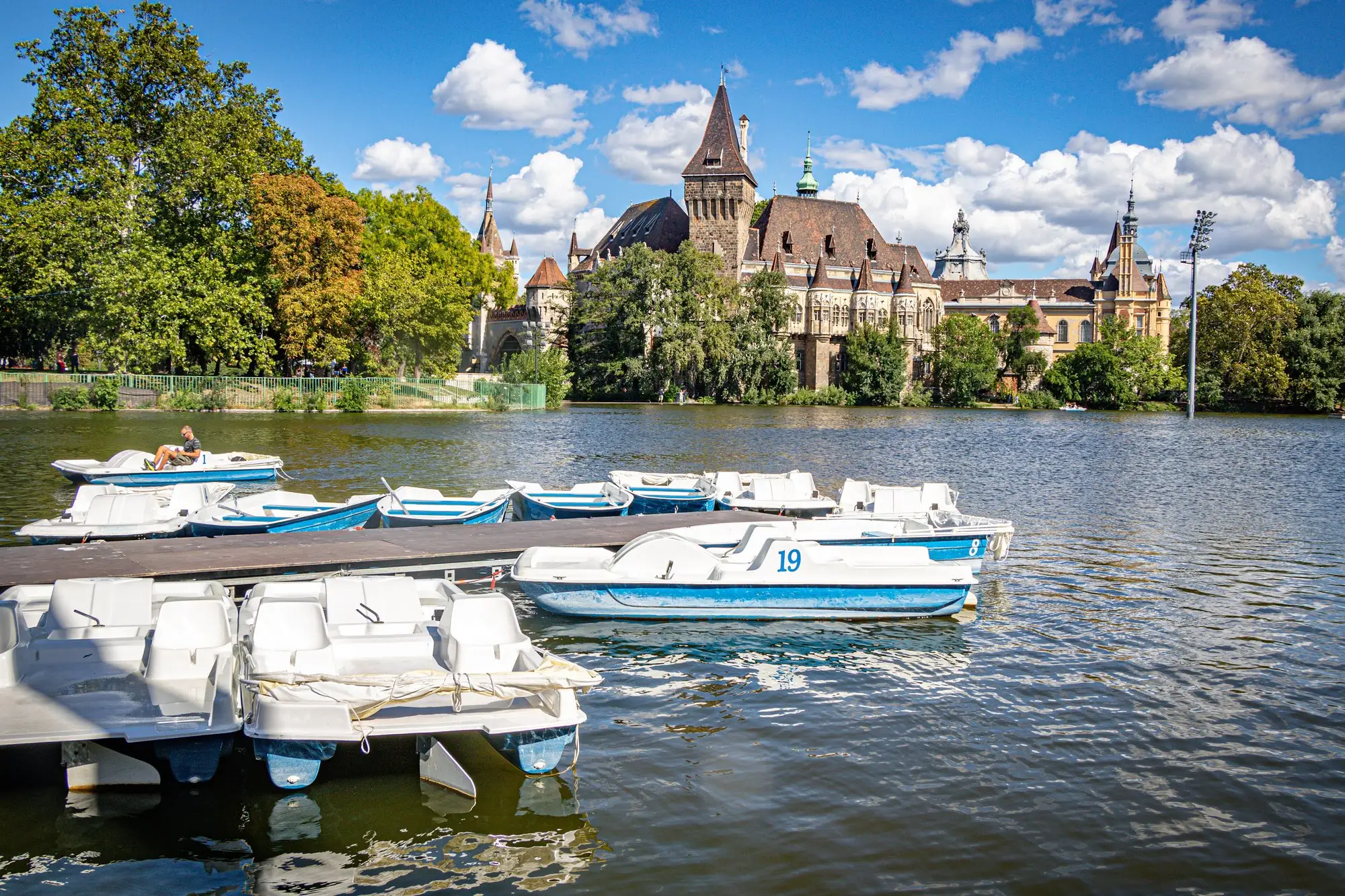
The water in front of the castle does two jobs. From about May to the middle of September it is a boating lake, with pedal boats, rowing boats and paddleboards on it. From about November to the start of March the same basin is an ice rink. In the weeks between the two it is neither, which catches out anyone who has come for the photograph.
Heroes’ Square is the park’s front door, and Budapest Zoo and Széchenyi Thermal Bath stand inside it with guides of their own.
- Visit length
- Half a day, a full day with the bath or the Zoo
- Entry
- Free, no ticket and no gate
- Book ahead
- Nothing to book for the park itself
- Best time
- Morning for quiet paths, after dark for the lit castle
- Nearest stop
- Metro M1 Hősök tereThe Heroes' Square end, for the Museum of Ethnography, the Visitor Centre and the ice rink
- Opening hours
- No closing time. Each place inside keeps its own
- Size
- About 100 hectares
- With children
- Main Playground, every day from 08:30 to dusk
- Parking
- Museum Underground Car Park, 800 spaces, open at every hour
Highlights
A castle with two towers to climb
Vajdahunyad Castle was built as a temporary pavilion in 1896 and kept because the public would not give it up. Walking up to it is free, and 150 steps take you to a 360 degree view.
Two museums you can walk into and over
The House of Music’s ground floor and the Museum of Ethnography’s roof garden are both open without a ticket, and so is the Ceramics Space inside the museum.
A playground the size of a park
Over 13,000 square metres with about fifty pieces of equipment, ten in-ground trampolines and a three-storey climbing frame shaped like a striped balloon.
Plan your visit
Opening hours
The park never closes, so the paths, the lawns and the walk up to the castle are yours at any hour.
Everything standing in it keeps its own timetable, and there are about a dozen of them. The House of Music and the Museum of Ethnography are both shut on Mondays. The Agricultural Museum at Vajdahunyad is too, although the Gatehouse Tower stays open. The Main Playground runs from 08:30 to dusk. The ice rink and the boating lake work to opposite seasons.
Every one of them, in one table: City Park opening hours.
Getting there
The M1, the little yellow underground line beneath Andrássy Avenue, has two stations at this park, and which one you want depends on which end you are going to. Hősök tere serves the Heroes’ Square end, the Museum of Ethnography and the ice rink. Széchenyi fürdő puts you in the middle, by the castle, the bath and the balloon.
Nearest stops
By car: the park is being emptied of traffic, and the place to leave a car is the Museum Underground Car Park off Dózsa György út, which has 800 spaces and is open at every hour.
Every stop, the bike stations, the walks in and the step-free routes: how to get to City Park.
Before you go
- You are encouraged onto the grass. The first thing the park asks visitors to do is sit down, lie on the grass and sunbathe on the Big Field, which is not the rule in every European city park
- Dogs are welcome in most of it, with two dog adventure parks near Ajtósi Dürer sor and Stefánia út and one on Hermina út. They are not allowed in the Main Playground, on the running circle, in the botanical garden or on the sports fields
- Toilets and Wi-Fi are free to Liget+ members, and membership costs nothing, only a registration
- The basketball, football, volleyball, badminton and foot tennis courts are free to use, as are the outdoor gym equipment and the climbing wall. School groups have priority during school hours and the park asks you to give way
- The Visitor Centre is where to start if you want tickets for events at the park’s institutions in one place. It is in the wing of the Museum of Ethnography facing Heroes’ Square
- Drinking fountains, toilets, cafés and rest areas are dotted through the park, so you do not need to leave it to eat
Accessibility
Cars are being pushed out of City Park on purpose, and what is left of the asphalt is kept for cyclists, scooters, prams and wheelchairs. That makes the ground between the attractions easier than most of central Budapest.
- The House of Music is accessible throughout, with signed routes inside and staff at the information desk to help
- The Museum of Ethnography’s roof garden is reached by steps up the sides of the building. The exhibitions below are reached by a lift from the Damjanich utca entrance, as the Heroes’ Square entrance has none
- The Apostles’ Tower at Vajdahunyad Castle is 150 steps up
- The M1 is the weak point. Neither of its stations at the park is step-free, so the buses and trolleybuses on Dózsa György út are the easier way to the Heroes’ Square end
Every stop and the step-free way in: how to get to City Park.
What to do here
Walk into the House of Music without a ticket
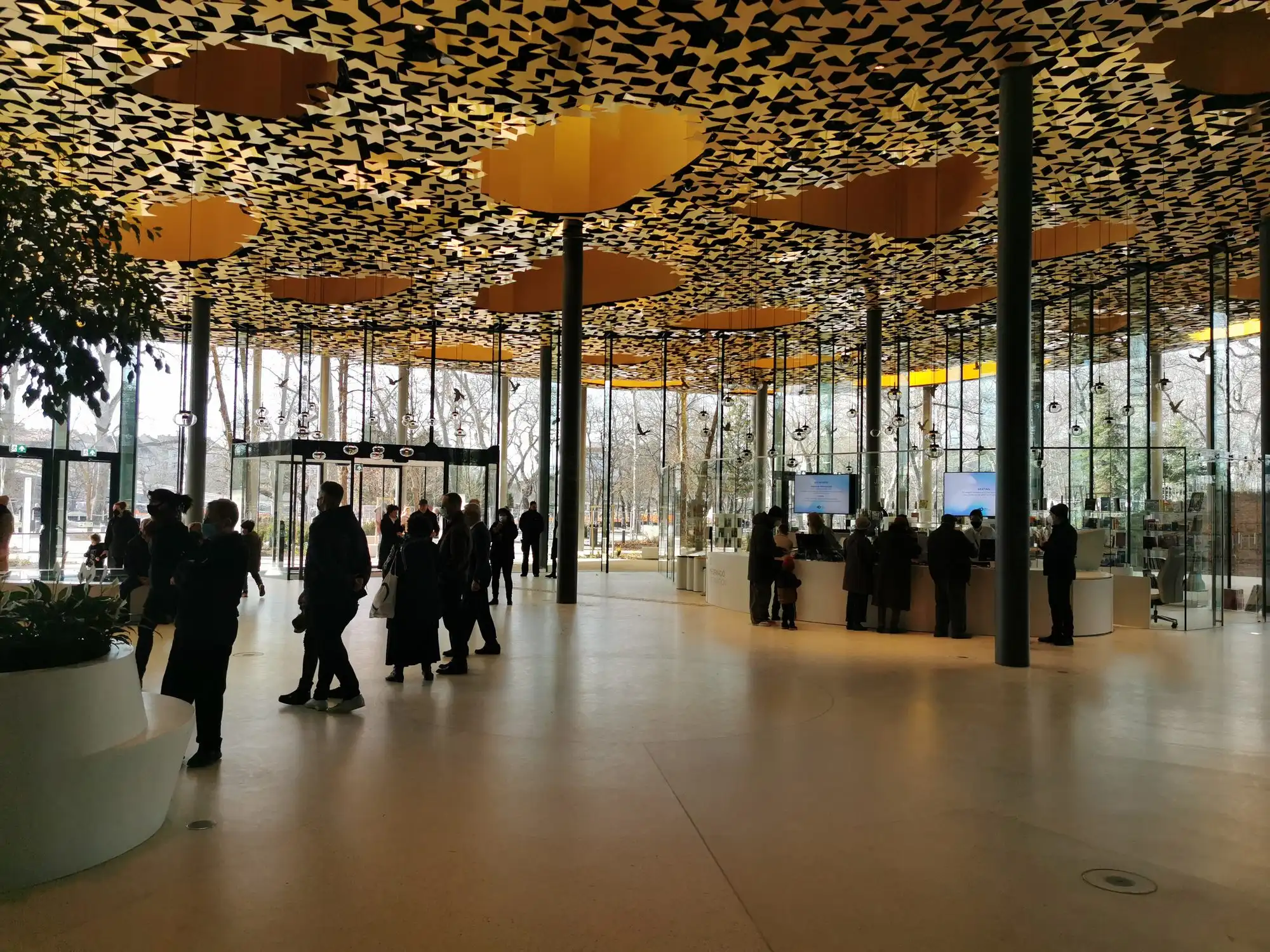
Sou Fujimoto’s building opened in January 2022 on the site of an old exhibition pavilion, and like every new building in the park it is free to explore. You only buy a ticket for concerts and exhibitions. So the ground floor is a place to walk into and sit down in, not a lobby to pass through.
The roof is the reason to go. It waves, it was designed from the idea of sound vibrating, and it is pierced by exactly 100 openings of different shapes, which drop daylight all the way down to the lowest exhibition level. Under them hangs a golden ceiling with a leaf pattern that, with the glass walls, is meant to feel like walking under the trees.
Look for the stepped wall to the right of the entrance, which is built to be sat and worked on, and take the spiral staircase down to see the ticketed half: the Sound Dome, a projection dome with 30 speakers, the permanent exhibition walked with headphones that trigger the exhibits, and eight large interactive sound installations in the Creative Sound Space.
It is shut on Mondays. The Sound Dome also closes on the first Tuesday and Wednesday of every month.
Climb the Museum of Ethnography's roof
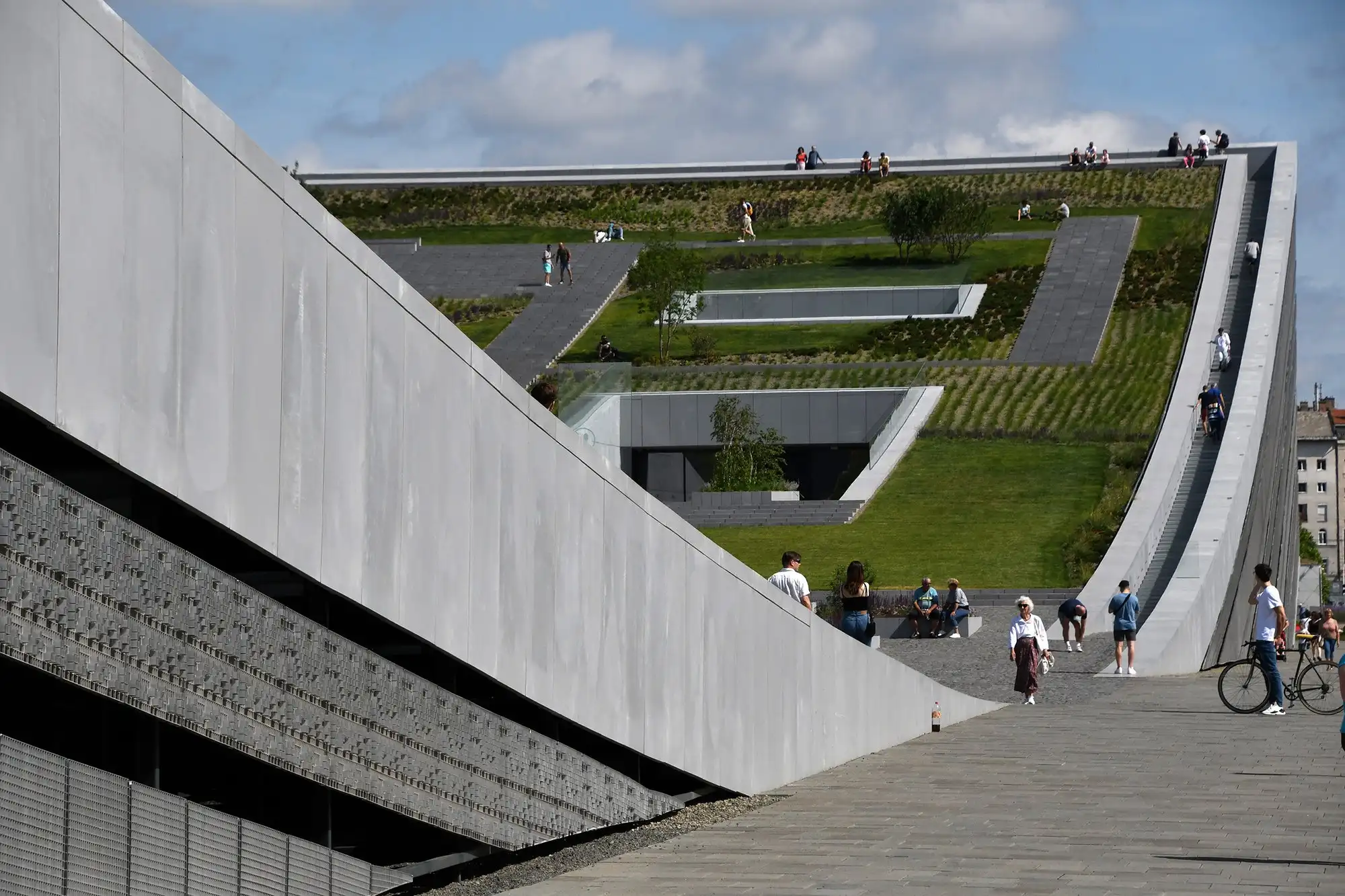
The museum opened in its new building the same year as the House of Music, and its roof is part of the park. Over 7,000 square metres of it are planted and grassed, rising to the height of the surrounding tree crowns, and the operator’s own invitation is to lie down in the grass or have a picnic on it. Walk up the steps along the perimeter and you get City Park and Heroes’ Square from above.
Look at the glass facade on the way up. It carries nearly half a million small pixels in patterns built from twenty Hungarian and twenty international ethnographic motifs, Venezuelan, Congolese, Cameroonian, Mongolian, Chinese and Melanesian among them, inserted by robot into more than 2,000 laser-cut aluminium gratings. NAPUR Architect won the competition for it over Zaha Hadid, Rem Koolhaas and BIG.
Two things inside cost nothing either. The Ceramics Space holds almost 4,000 ceramic objects from around the world along both sides of a 40 metre staircase. And the City Park Visitor Centre, in the wing facing Heroes’ Square, has a free exhibition built round a 55 square metre model of Budapest with over 6,000 3D-printed buildings on it.
The exhibitions are all below ground, to keep sunlight off the objects, and they are shut on Mondays. The entrance hall facing Heroes’ Square opens anyway, 10:00 to 18:00, which makes the Visitor Centre the Monday option.
Go up a tower at Vajdahunyad Castle
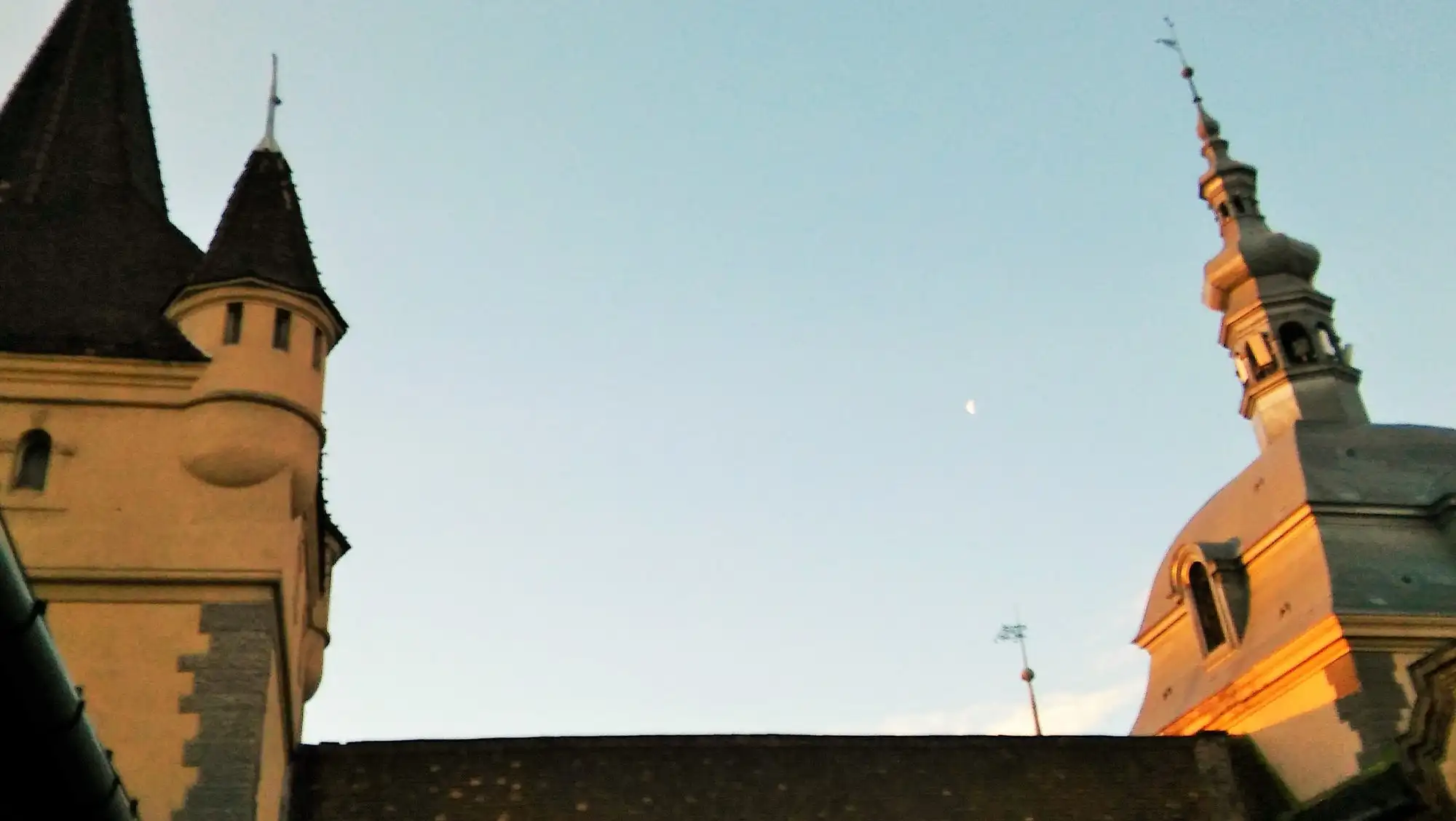
Ignác Alpár built this for the 1896 millennial celebrations as a three-dimensional catalogue of a thousand years of Hungarian architecture, in Romanesque, Gothic, Renaissance and Baroque. It was meant to be temporary. Visitors liked it so much that they gave it its popular name and the government rebuilt the whole thing in durable materials.
Look for the bits of other buildings, because Alpár copied real ones instead of inventing styles. The portal of the Church of Ják, chapel elements from Pécs Cathedral, the crenellated houses of Lőcse and Besztercebánya, St Catherine’s Gate from Brassó, the loggia of the town hall at Bártfa and the Charles Gate of Gyulafehérvár are all in here somewhere.
Cross the Bridge Gate over the stone bridge with the lion statues, Romanesque to your left and Gothic to your right, and find Miksa Róth’s rose window in the courtyard.
Two towers opened to the public in 2015. The Gatehouse is 37 metres tall, with a photo exhibition inside and then the battlements, where you can pick out the rose window and the raven with a ring in its beak. The Apostles’ Tower is 150 steps to a 360 degree panorama over Gellért Hill, Buda Castle and St Stephen’s Basilica. Tower tours start every hour, in English and Hungarian.
Walking up to the castle costs nothing. Going into the museum or up either tower needs a ticket, sold by the Hungarian Museum of Agriculture inside, and no partner sells them. The museum shuts on Mondays, but the Gatehouse Tower does not, which makes it the thing to do here at the start of the week.
Come back for the water, whichever season you are in
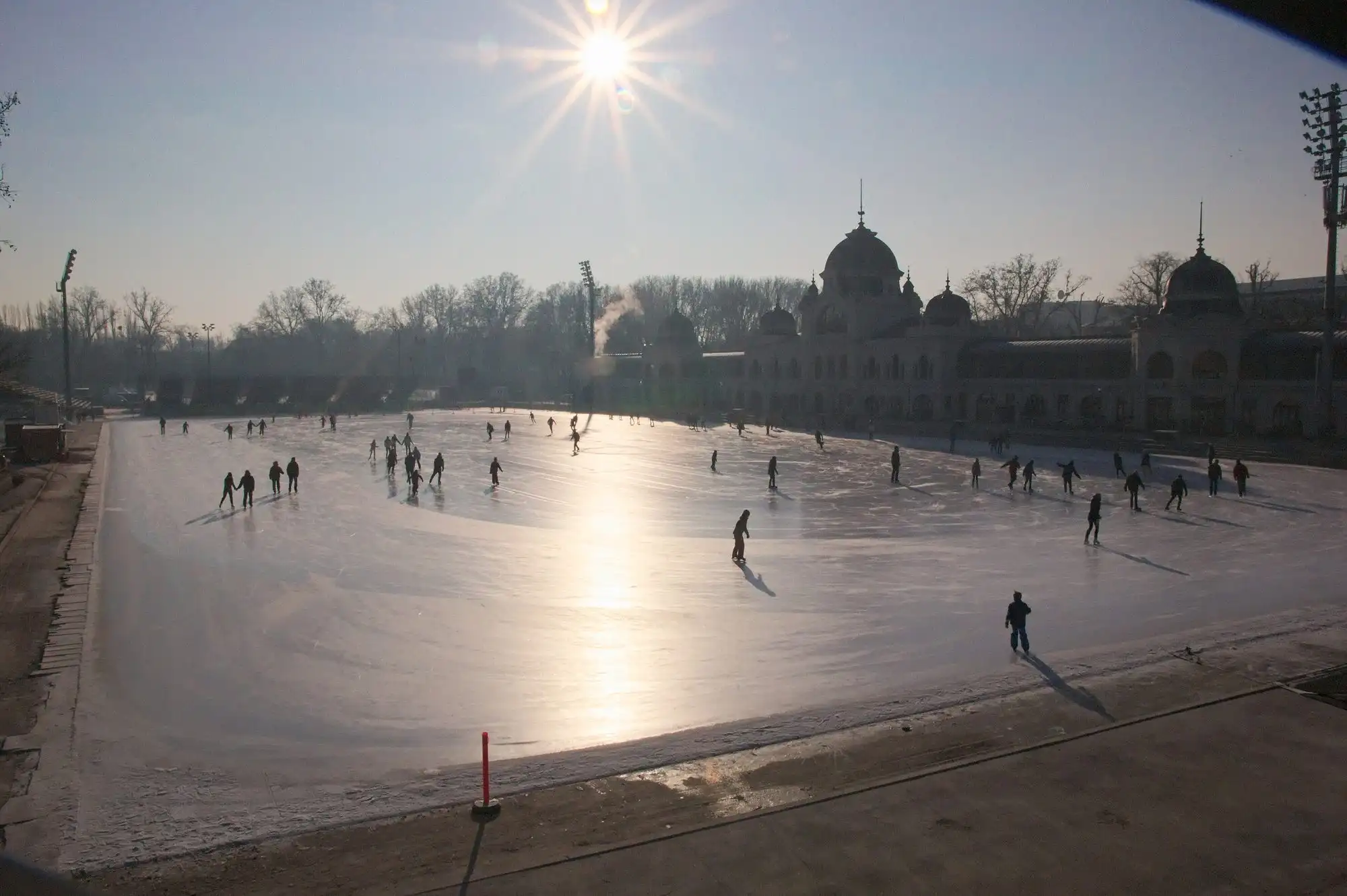
One basin, two completely different days out. In summer the ice rink becomes a boating lake: the same water in front of the castle, the same building behind it and the same operator.
In winter the Városligeti Műjégpálya, a listed monument and the city’s skating ground since the 1870s, lays 12,070 square metres of ice here, the largest outdoor artificial ice surface in Europe by its operator’s own count. The season runs from about November to the start of March, and tickets are sold only by the rink itself. Our City Park Ice Rink guide has the hours, how tickets and skate hire work, and the rules for children.
In summer, from about May to the middle of September, the same water carries 32 pedal boats, 10 rowing boats and 10 paddleboards. Hire is by the half hour, tickets are sold at the lakeside, and the reason to take a boat is the view back at the castle from the water. It is not a lake for swimming, and the operator would rather you did not feed the ducks bread.
Between the two seasons there is neither boating nor skating. If you are here in late autumn or early spring, plan the castle and the museums instead and treat the water as scenery.
Check the balloon is flying before you walk over
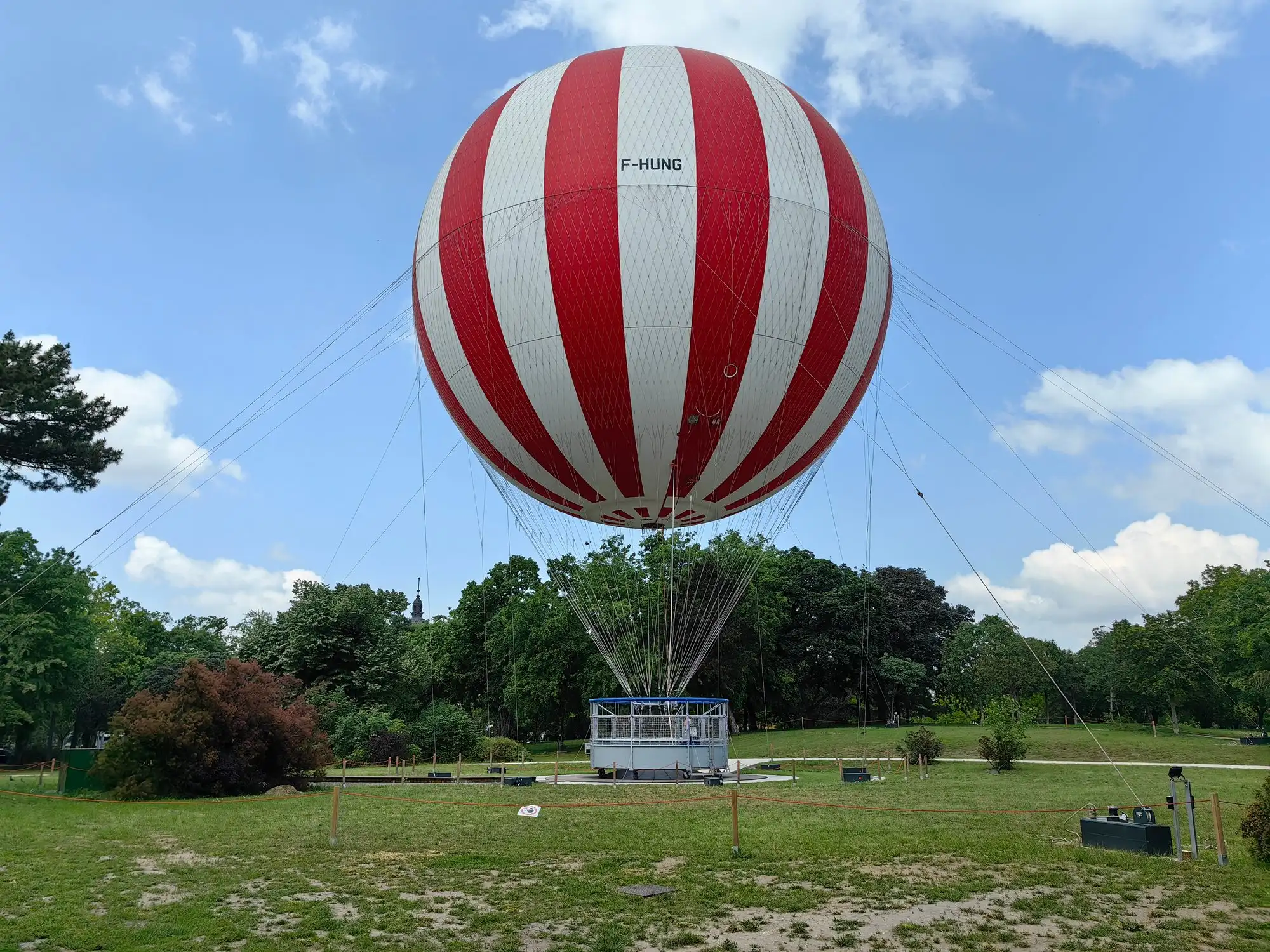
The BalloonFly is a tethered helium balloon on Mimosa Hill, next to the thermal bath, held by a steel cable and carrying up to 30 passengers at a time 150 metres up. It is not a hot air balloon and it does not go anywhere.
A loudspeaker names the sights in Hungarian and English, the crew move people round the basket so everybody gets the full circle, and from up there you see the whole shape of the Museum of Ethnography’s roof garden and the House of Music’s pierced roof.
It all comes down to the weather. The balloon depends on it, and the operator publishes a forecast for today and the next two days, slot by slot, each marked as ideal, uncertain or down. Check that forecast on the morning of your visit, and don’t walk over on spec. People do turn up on clear days and find it down, and the queue when it is busy can run to an hour or more.
Tickets are sold at the balloon and on its own website, and an online ticket still has to be swapped for a numbered one at the cash desk, so it does not skip the queue. A flight lasts 10 to 15 minutes, and children under 6 or shorter than 120 centimetres cannot go up. Treat it as something to do if it happens rather than something to build a day around, and go early in the day if the forecast is good.
Mimosa Hill was raised as a lookout point by the park’s own designer, and the balloon is not a new idea. A Ballon Captif run by the Paris balloon captain Louis Godard carried a dozen passengers at a time from this park during the 1896 exhibition, dozens of times a day.
Give the children the playground that is a park of its own
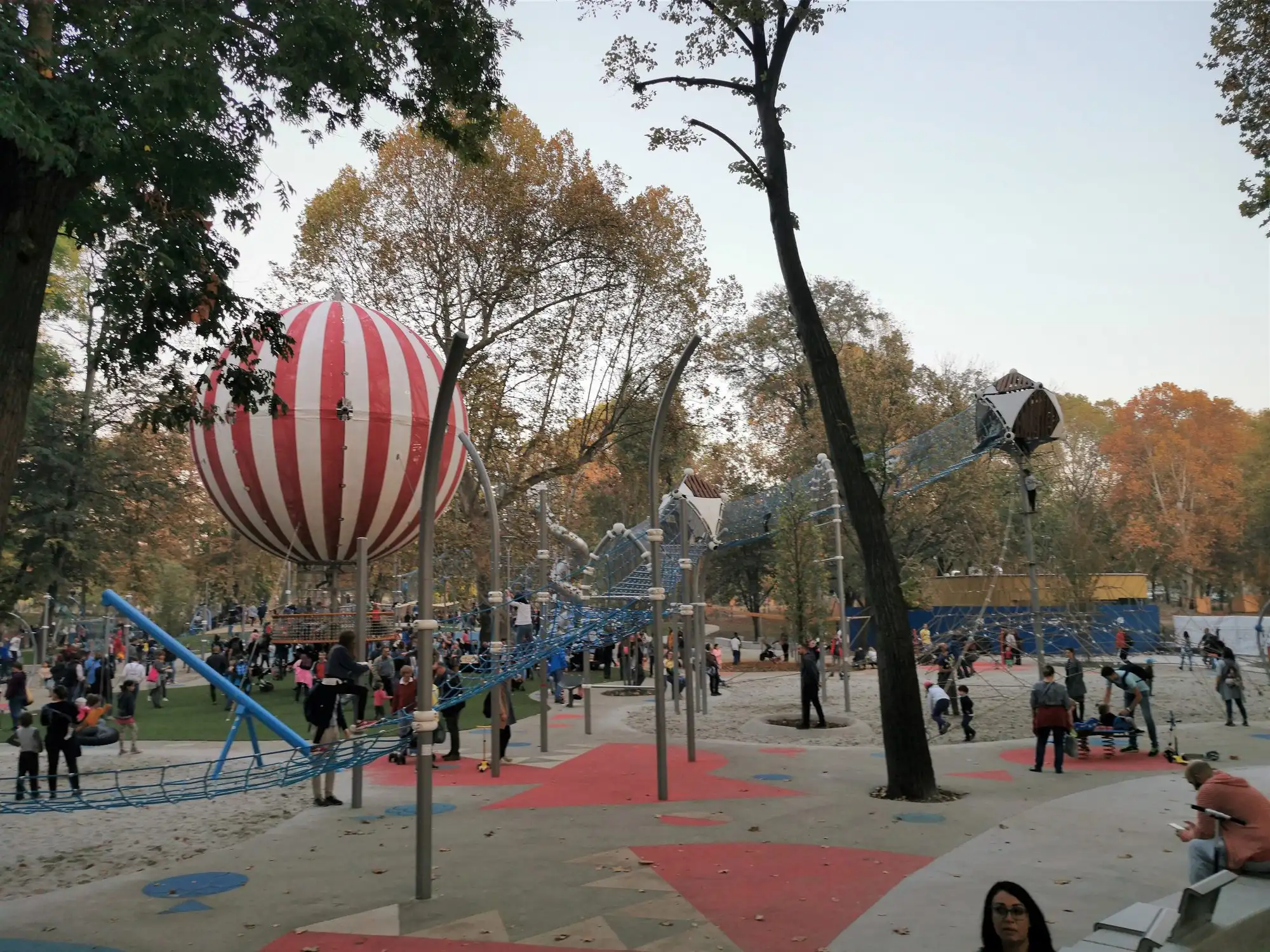
The Main Playground runs to over 13,000 square metres and about fifty pieces of equipment: six kinds of slide, ten kinds of swing and roundabout, four kinds of spinner, three sandpits, seven spring toys, two big rope climbs and ten in-ground trampolines. It is in the south-eastern corner near the Dózsa György út and Ajtósi Dürer sor crossing, fenced to a metre and a half with five ways in, and open every day from 08:30 to dusk.
The centrepiece is a three-storey climbing frame built in the shape of the balloon in Pál Szinyei Merse’s painting, with a reproduction of the painting beside it. Stand inside the frame and look up and the red and white stripes appear. In summer the draw is a long winding stream with locks, wells and water toys along it. There is a statue of the poet Sándor Kányádi under one of the trees.
The second playground is as big and quite different. The Children’s Traffic Park, near the House of the Hungarian Millennium, is a miniature city with working traffic lights, zebra crossings, road signs, railway barriers, roundabouts and junctions, plus a station and an airport with a play security scanner, and children ride through it on bikes, scooters and pedal cars. There is a music playground beside the House of Music as well.
Toilets with baby-changing are free to Liget+ members. Dogs are not allowed in the Main Playground.
Insider tips
Monday is Gatehouse Tower day
Both new museums and the Agricultural Museum are shut on Mondays, which strips the park of most of its indoor options. The Gatehouse Tower at Vajdahunyad Castle opens every day, including Monday, from 9am, with the last ticket sold fifteen minutes before it closes.
The Museum of Ethnography’s entrance hall facing Heroes’ Square is open on Mondays too, from 10:00 to 18:00, and the free Visitor Centre exhibition is in that wing.
Weekdays are the quiet ice
In season, a weekday session at the ice rink is quieter than a Friday or Saturday evening, and after dark the castle is lit behind it. Our ice rink guide has the best times to skate and what to bring.
Three free things to duck into if the weather turns
The Ceramics Space, the Visitor Centre exhibition and the ground floor of the House of Music are all indoors and all free, and none of them needs planning for.
Between them they fill an hour or two of a wet afternoon without a ticket.
Walk the Promenade for the fountain on the hour
The Promenade runs from Heroes’ Square along the park side of Dózsa György út, on ground that used to be the largest free cobbled car park in Budapest and now holds more than 10,000 square metres of new planting. The Musical Fountain on it plays from 07:00 to 23:00 weather permitting, with music on the hour from 13:00, and is lit in the evening.
Further along there is a bench, given by the Polish Institute, that plays Chopin and Liszt on an interactive display and charges a phone wirelessly through the seat.
Nearby attractions
Two of these four stand inside the park itself and a third is its front door, so the walks between them are short.
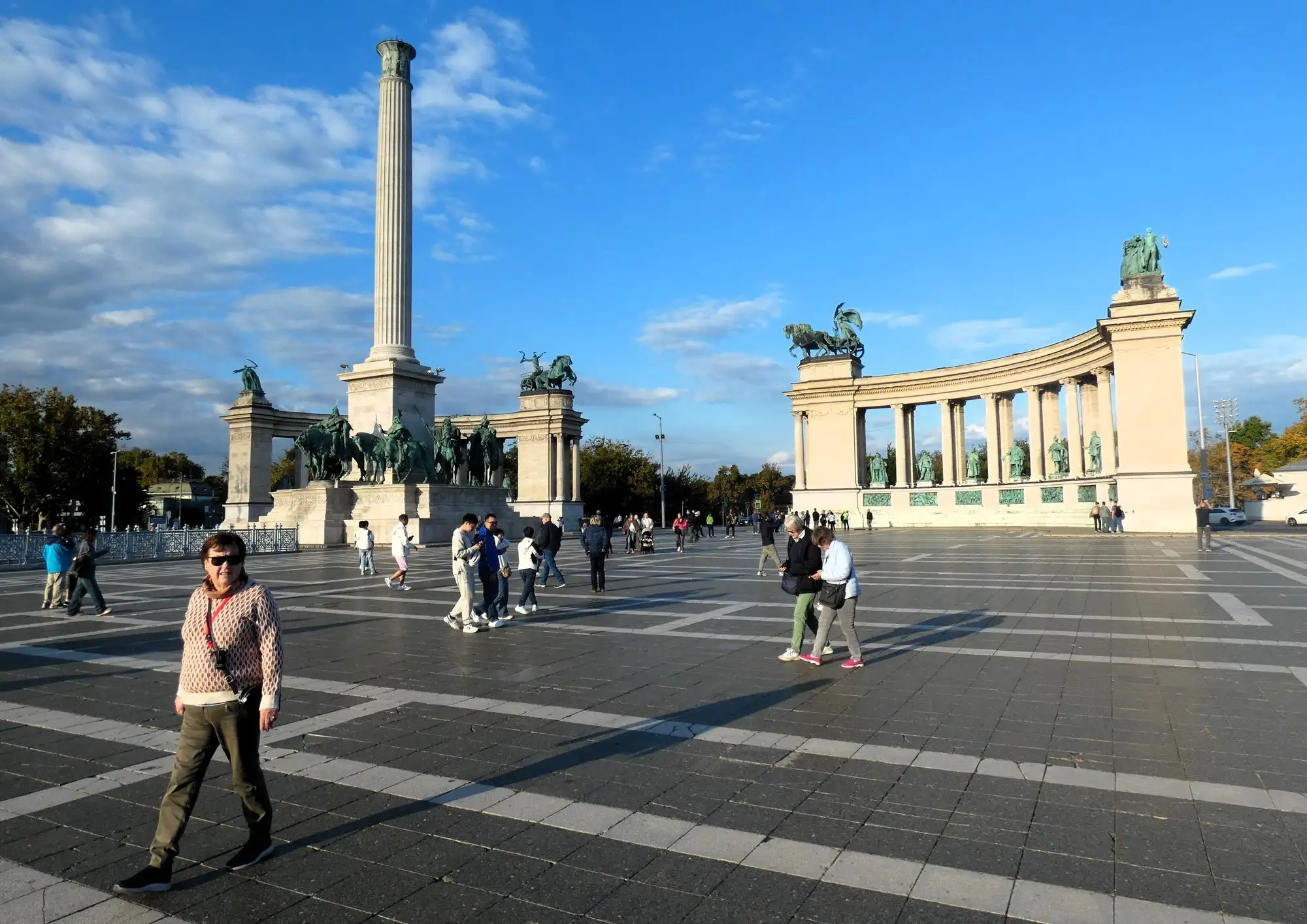
Heroes' Square
The park’s front door, at its western end. Vajdahunyad Castle is about 8 minutes across the park from the square.
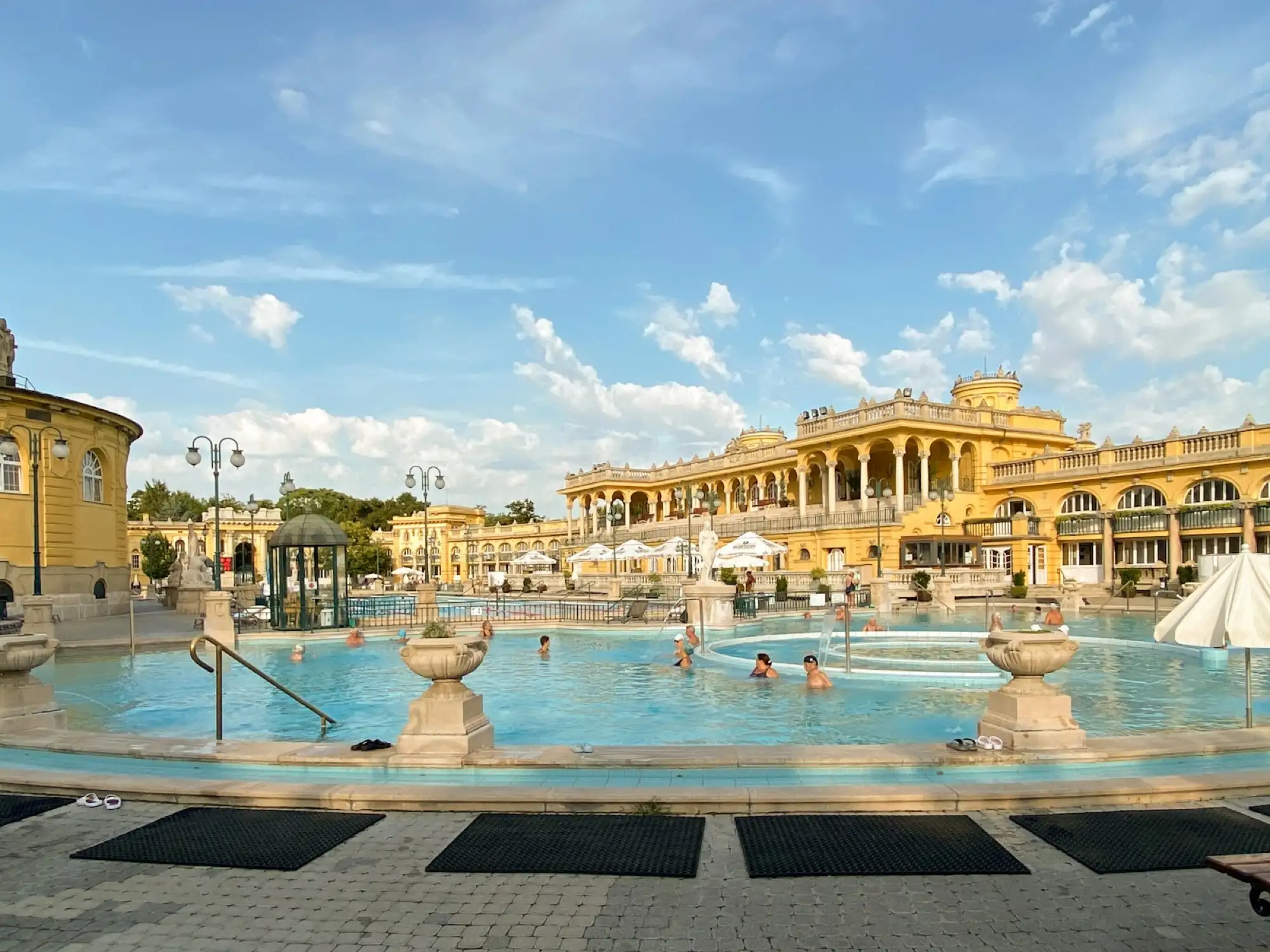
Széchenyi Thermal Bath
Inside the park, about 7 minutes north-east of Heroes’ Square, past the Zoo. M1 Széchenyi fürdő is at the door.
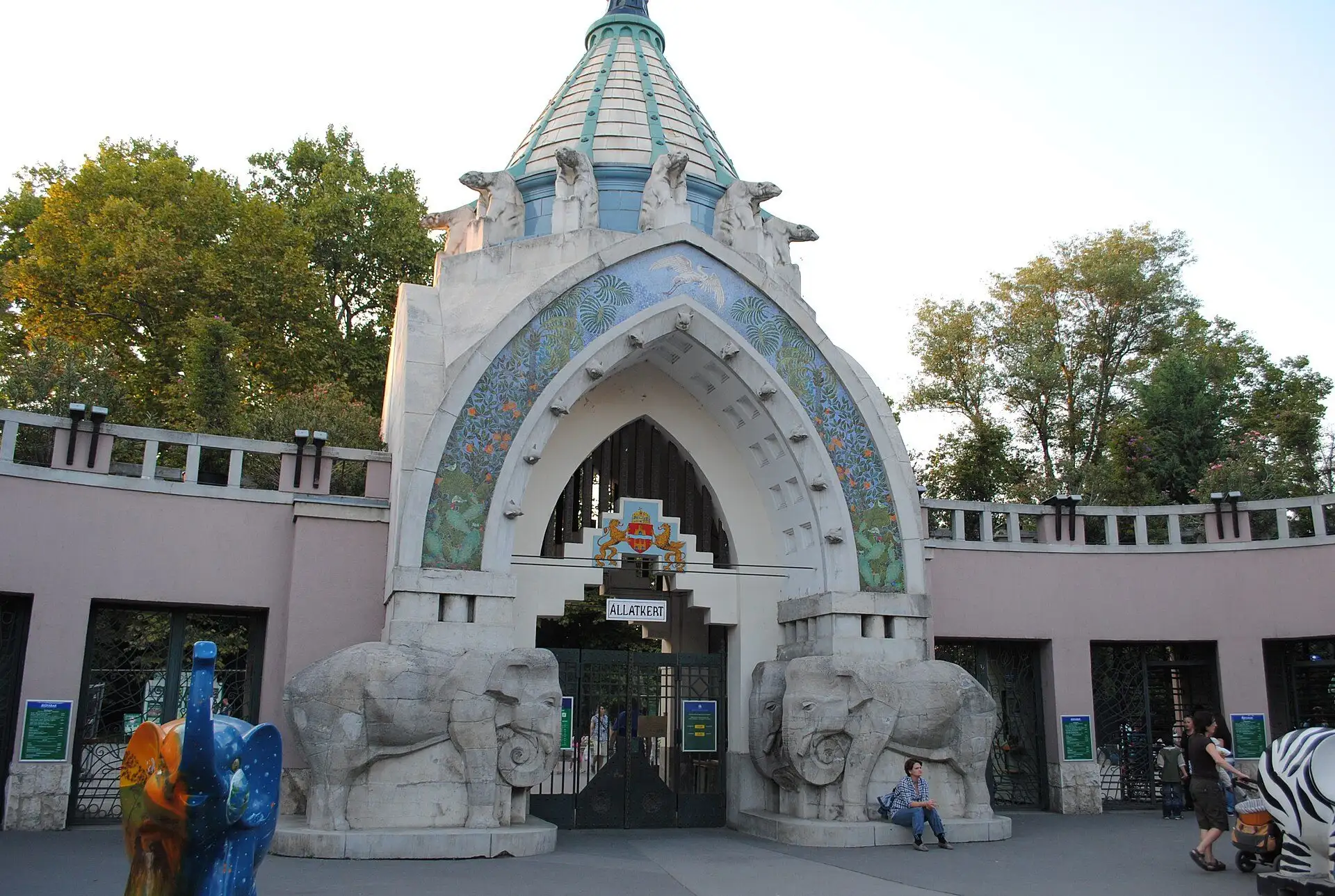
Budapest Zoo & Botanical Garden
Inside the park too, about 6 minutes north of Heroes’ Square, where Állatkerti körút meets it. The Capital Circus is next door.
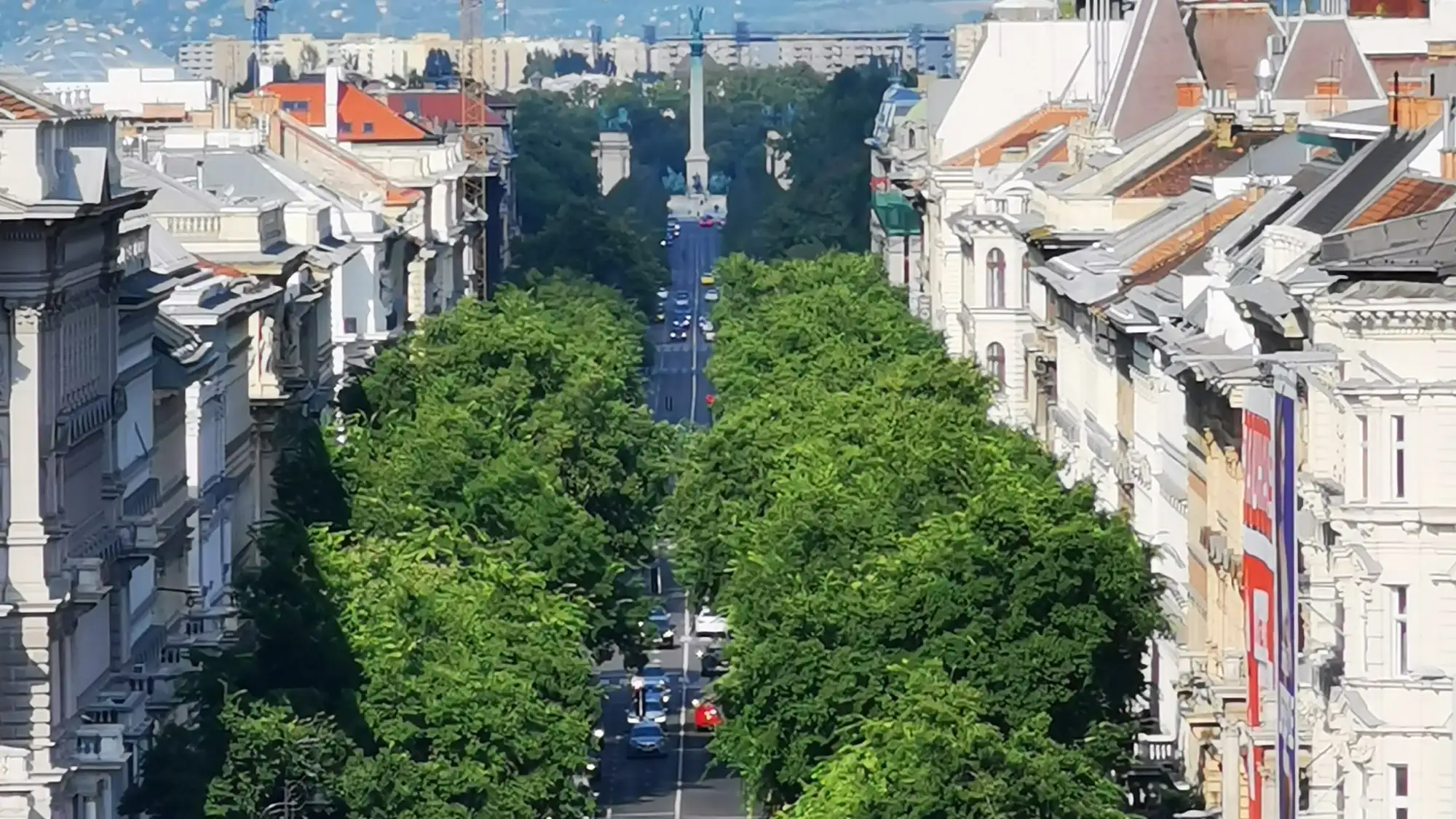
Andrássy Avenue
The avenue that runs into Heroes’ Square from central Pest, with the M1 underneath it the whole way.
Did you know?
- The House of Music’s roof has exactly 100 holes, counted by the people who built it, and they are there to bring daylight down to the lowest level underground.
- The park’s botanical garden has a Kneipp trail you walk barefoot, over changing textures, among 335 species and 35,000 plants, in a garden restored from its original drawings of 1967.
- The glass front of the Museum of Ethnography carries nearly half a million small pixels, set by robot into more than 2,000 laser-cut aluminium gratings.
- Maria Theresa ordered the marshy common planted with trees, and the oxen grazing on it ate the saplings. Grazing was banned before the park could take root.
- Pest’s first omnibus service ran in July 1832, and this park was one end of the route.
History
City Park began as marsh and ox pasture on the edge of Pest, and, unusually, it was designed from the start as a park for everybody. An archbishop drained the marsh into a lake in the 1790s, and a gardener from Lübeck won a competition in 1813 with a plan for a park that would pay for itself and be open to all.
When the money ran out, the city asked the public for it. The two great exhibitions of 1885 and 1896 left behind the park’s oldest building and its castle.
- 1794
An archbishop takes it on
Archbishop József Batthyány takes a 24-year lease on the marshy common, paying no rent but agreeing to drain and lay it out. The water is regulated into a lake with two islands.
- 1813
A competition for a people's park
The Embellishment Commission runs a design competition. Christian Heinrich Nebbien, a gardener from Lübeck, wins it with a self-funding park open to everyone.
- 1818
Pest asks the public to pay
Work has begun and the money has run out, so on 14 January the city appeals for donations. By the end of the year it has them, from Palatine Joseph and 26 other Pest noblemen.
- 1866
The Zoo opens
Budapest Zoo opens in the park on 9 August, and is still on the same ground.
- 1870
Skating on the lake
The Pest Skating Association’s rink on the lake opens on 29 January, with Crown Prince Rudolf doing the honours.
- 1885
The National General Exhibition
It leaves behind the art hall that is now the House of the Hungarian Millennium, the oldest building in the park.
- 1896
The Millennium Exhibition
It leaves Vajdahunyad Castle and the first underground railway on the Continent.
- 2022
Two new museums
The House of Music Hungary opens in January, and the Museum of Ethnography opens in its new building the same year.