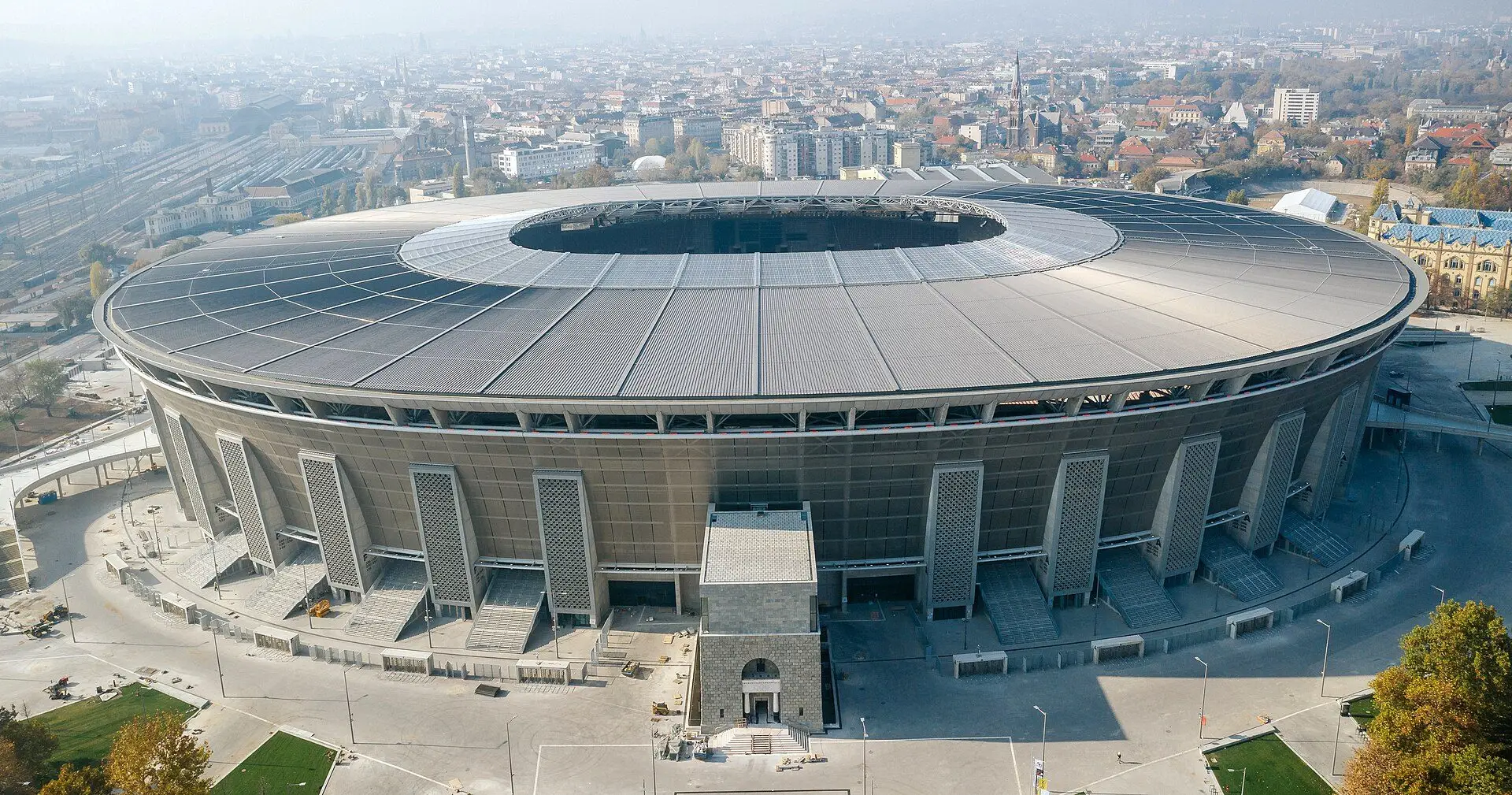
The stadium on this patch of Zugló has had three names. It opened in 1953 as the Népstadion, the People’s Stadium, and was renamed the Puskás Ferenc Stadion in 2002 for Hungary’s greatest footballer. Demolition began in 2016, and by 2019 it had been rebuilt as the Puskás Aréna.
The building has only stood in its present form since 2019, but its story runs back to the Golden Team era.
At a glance
Timeline
- 1913
A national stadium is drawn
Alfréd Hajós, Olympic swimming champion turned architect, plans a national stadium for the land between Dózsa György út, Thököly út and Stefánia út. The war stops it.
- 1948
Work begins
Ground is broken on 13 July on Károly Dávid Jr’s design. Athletes and footballers, the Golden Team among them, put in volunteer shifts on the site.
- 1953
Népstadion opens
The People’s Stadium opens on 20 August with an athletics meeting and Honvéd’s 3-2 win over Spartak Moscow, in front of a crowd of about 100,000 on temporary stands.
- 1954
Hungary 7-1 England
On 23 May the Golden Team beat England 7-1 in front of 92,000, six months after the 6-3 at Wembley.
- 2002
Renamed for Puskás
The Népstadion takes Ferenc Puskás’s name in the year of his 75th birthday, and Hungary play Spain under the new name on 21 August with Puskás in the stands.
- 2006
Farewell to Puskás
Puskás dies on 17 November. On 9 December the nation says goodbye to him in the stadium, and the cortege leaves along Istvánmezei út and Dózsa György út towards Heroes’ Square.
- 2016
Demolition begins
The old stadium starts to come down in February. Only the Tower survives, and crushed concrete from the rest goes into the new building.
- 2017
Construction starts
Work on the new arena begins in March to György Skardelli’s design.
- 2019
Puskás Aréna opens
Hungary 1-2 Uruguay on 15 November, in front of 65,114.
- 2020
UEFA Super Cup
Bayern Munich beat Sevilla 2-1 after extra time on 24 September, in front of 15,180 under pandemic limits.
- 2021
The European Championship comes to town
Four matches of the delayed Euro 2020 tournament, including Hungary’s 1-1 draw with France.
- 2023
Europa League final
Sevilla beat Roma on penalties after a 1-1 draw on 31 May, their seventh title in the competition.
- 2026
Champions League final
Paris Saint-Germain beat Arsenal on penalties after a 1-1 draw on 30 May, and become only the second club to retain the trophy in the Champions League era.
Key facts
- Opened
- 15 November 2019
- Capacity
- More than 67,000; up to 80,000 for a concert
- Lead designer
- György Skardelli
- UEFA category
- 4, the top category
- Size
- 52 m high, 316 m long, 260 m wide
- Roof
- More than 57,000 m² of steel; every seat covered
- Inside
- 27 lifts, 38 stairwells, 80 skyboxes
- Predecessor
- Népstadion, 1953 to 2016
Ferenc Puskás
Ferenc Puskás was born in Budapest on 1 April 1927 and grew up in Kispest, whose club became Honvéd. For Hungary he scored 84 goals in 85 games, captained the side to Olympic gold in Helsinki in 1952, scored twice in the 6-3 at Wembley in November 1953, and played in the World Cup final of 1954, which Hungary lost 3-2 to West Germany after leading.
When the Soviet tanks rolled into Budapest in November 1956, Honvéd were abroad on a European tour. Puskás did not go back. He joined Real Madrid in 1958, at 31, and won three European Cups with them, scoring four goals in the 1960 final. He later managed Panathinaikos to the 1971 European Cup final.
He died in Budapest on 17 November 2006. In December the nation said goodbye to him in the stadium that already carried his name, and in 2009 FIFA created the Puskás Award for the best goal scored anywhere in the world each year.
The Népstadion
The idea of a national stadium on this land is older than the Népstadion: Alfréd Hajós drew one for the site in 1913, and the First World War buried it.
After the Second World War, with Budapest’s sports grounds in ruins, work began on 13 July 1948 to Károly Dávid Jr’s design, a modern stadium carried on rows of concrete pylons and planned for 70,000. Athletes put in volunteer shifts on the site, the Golden Team included, and Puskás among them.
It opened on 20 August 1953, and the official capacity of 78,000 was routinely exceeded: about 100,000 came to the opening on temporary stands, 92,000 saw the 7-1 against England in 1954, and 104,000 got in for Hungary against Austria in 1955.
Only one piece of it stands today. The Tower, now the Puskás Museum, is the last building of the Népstadion, and the new arena’s centre circle sits exactly where the old one did.
The history of Puskás Aréna
The Golden Team and the Népstadion, 1952 to 1956
Hungary’s national side of the early 1950s, the Aranycsapat, was built around Puskás, Sándor Kocsis, Nándor Hidegkuti, József Bozsik and Zoltán Czibor. They won Olympic gold in 1952, and in November 1953 they beat England 6-3 at Wembley.
The return match was the Népstadion’s finest afternoon. On 23 May 1954, in front of 92,000 and with more than a million ticket requests, Hungary won 7-1: Lantos, Puskás twice, Kocsis twice, Tóth and Hidegkuti. That summer the same team lost the World Cup final in Bern, and two years after that the revolution ended the team, with Puskás among those who did not come back.
Demolition and rebuild, 2016 to 2019
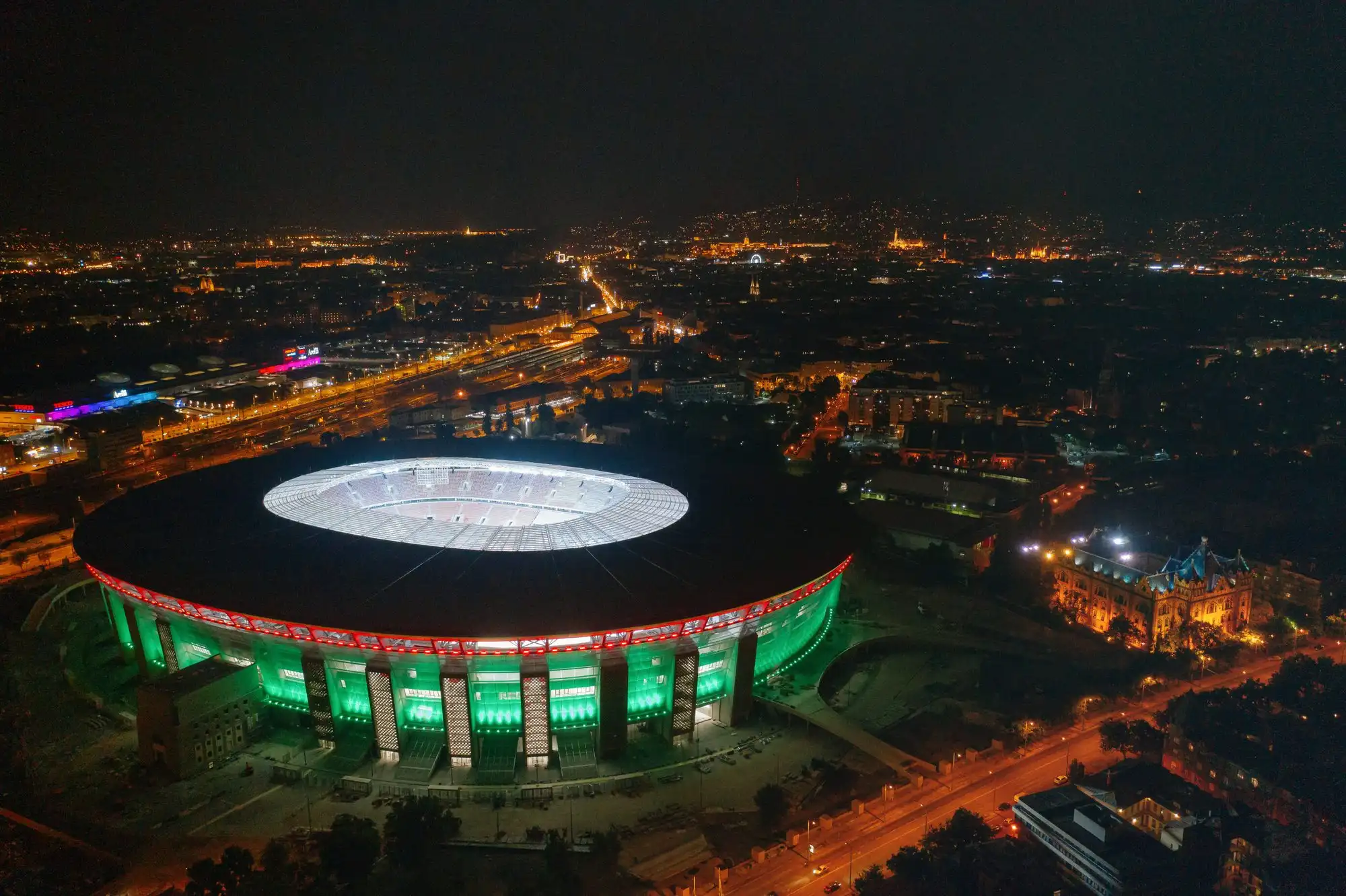
By the 2010s the old stadium was in poor condition and Hungary chose to replace it. Demolition began in February 2016, the Tower was kept, and construction of the new arena started in March 2017 under lead designer György Skardelli. The arena calls itself a wholly Hungarian piece of work, and it recycled its predecessor: crushed concrete from the Népstadion went into the new structure.
More than 57,000 square metres of steel roof, lifted into place with a 1,250-tonne crawler crane and 16 tower cranes, cover every one of the more than 67,000 seats.
There are 27 lifts, 38 stairwells, 80 skyboxes and a hybrid pitch of natural grass reinforced with synthetic fibres. It opened on 15 November 2019, Hungary lost 1-2 to Uruguay in front of 65,114, and the public voted it Stadium of the Year for 2019.
The UEFA finals, 2020 to 2026
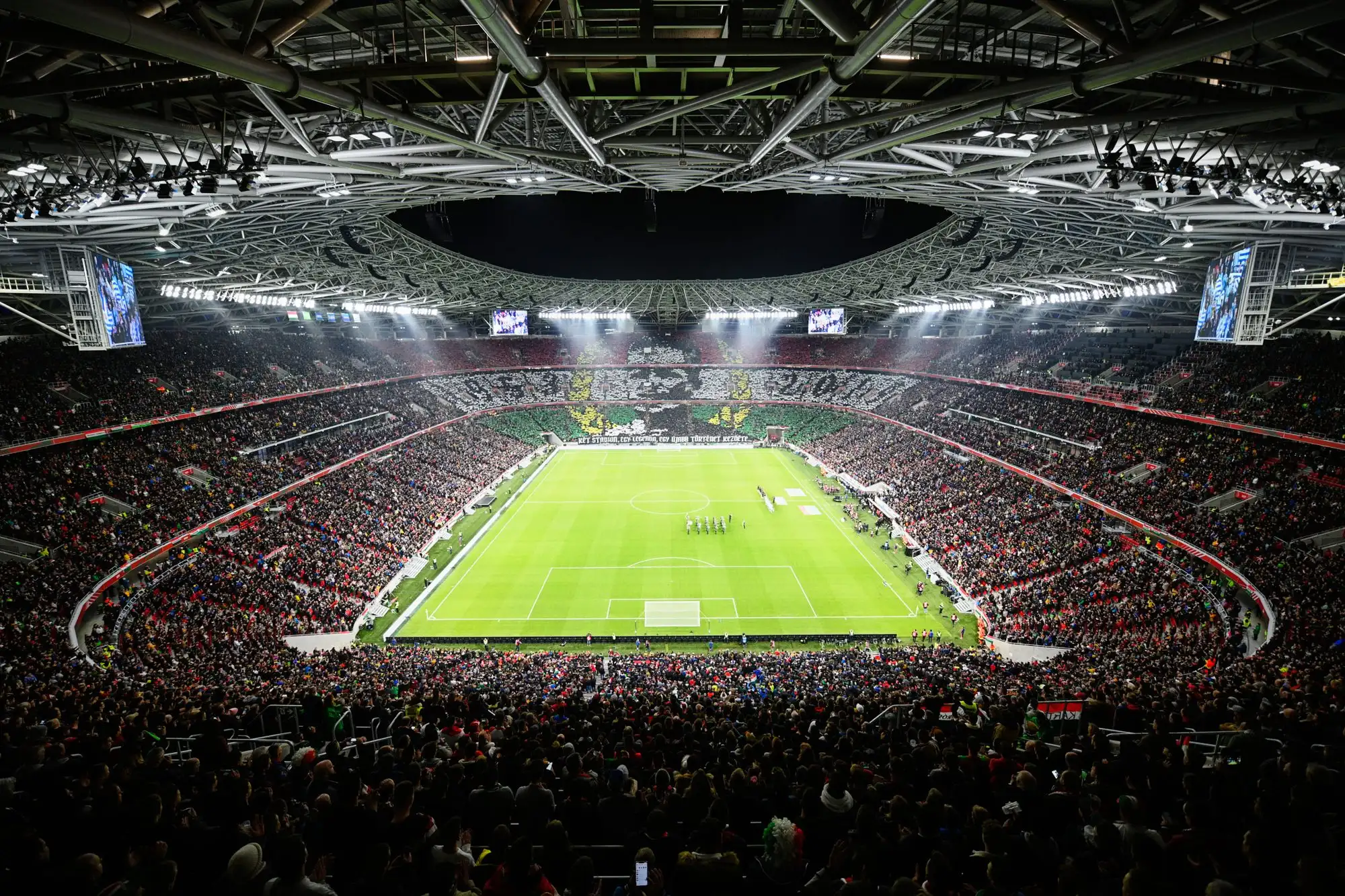
UEFA came quickly. The 2020 Super Cup was played here on 24 September 2020, Bayern Munich beating Sevilla 2-1 after extra time in front of 15,180 spectators under pandemic limits. The following summer the arena staged four matches of the delayed EURO 2020, including Hungary’s 1-1 draw with France.
On 31 May 2023 Sevilla beat Roma on penalties after a 1-1 draw to win their seventh Europa League, and on 30 May 2026 the Champions League final came to Budapest: Paris Saint-Germain 1-1 Arsenal, Paris winning on penalties to become only the second club to retain the trophy in the Champions League era.
Renaming the stadium for Puskás in 2002
The renaming in 2002 was the work of a lobby of former champions, who wrote to the president, the prime minister and the sports minister asking that the Népstadion be named for Puskás on his 75th birthday. The government agreed.
On 2 April 2002 Puskás walked out through a guard of honour of 75 children to unveil the new name above the players’ exit, watched by two Real Madrid greats, Alfredo Di Stéfano and Emilio Butragueño, and on 21 August Hungary played Spain in the first international under the new name, with Puskás as the guest of honour.
Beside the museum today stands the Statue of Hungarian Football, unveiled in 2001 for the federation’s centenary, with the name of every man who has played for Hungary on the slabs at its foot. Find his name in the stone, then look up: it is on the building too.
Visiting today
The Puskás Museum in the Tower is open Tuesday to Sunday, and three Arena Tours a day leave from it on days when the stadium has no event. The park round the stadium, the statue and the restored 1950s dromosz are free to walk any day from 06:00 to 22:00.