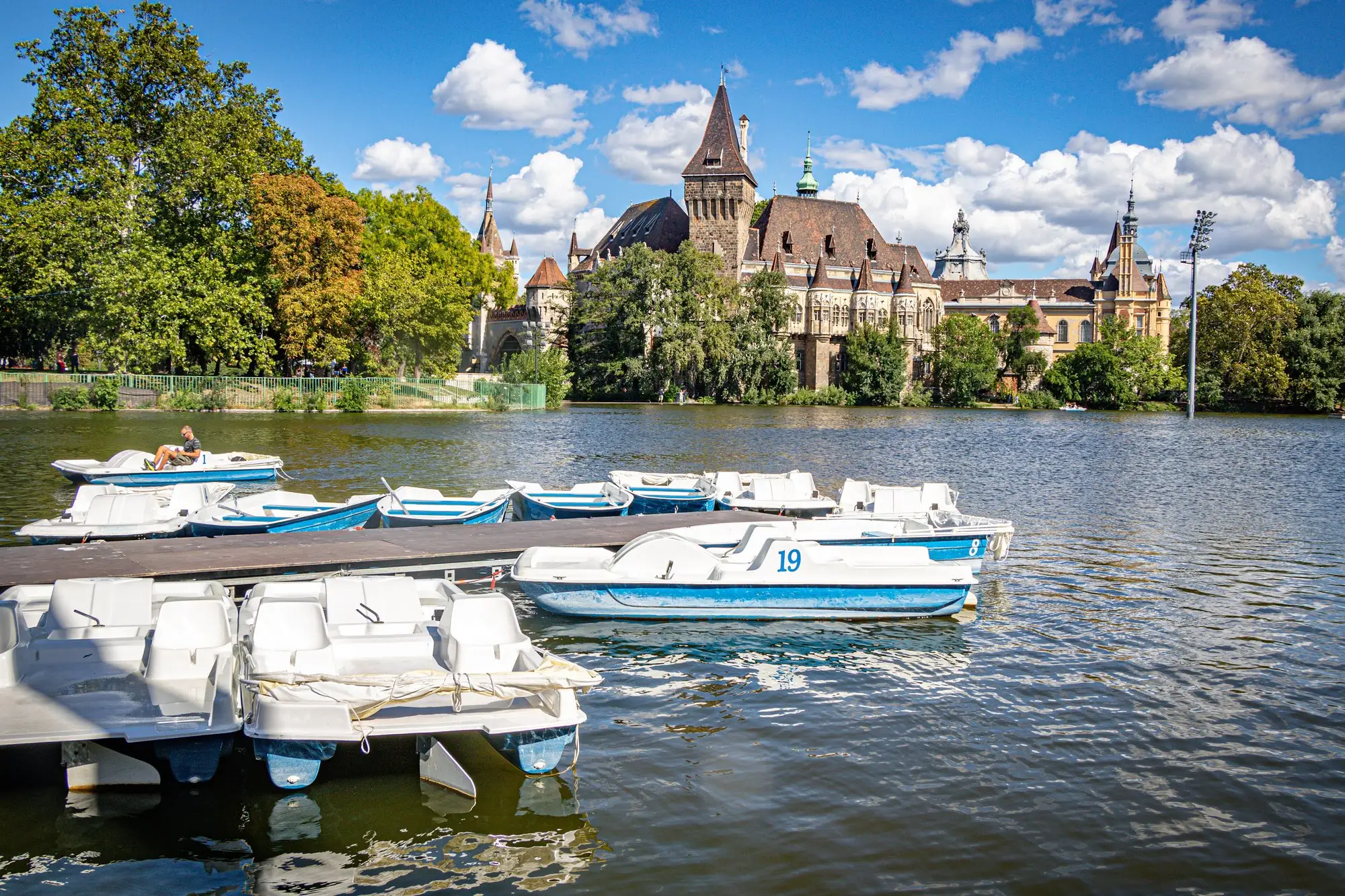
For most of its history this was not a park but a marsh with oxen on it, on the far edge of Pest, and nobody much wanted to go there. A design competition changed that, and the winner drew a park open to everybody that would pay for its own upkeep, an unusual idea in 1813.
The rest of the park came in two bursts, both of them exhibitions. The National General Exhibition of 1885 and the Millennium Exhibition of 1896 built on this ground, packed up, and left their best buildings standing.
At a glance
Timeline
- 1794
An archbishop takes the lease
Archbishop József Batthyány takes a 24-year lease on the marshy common. He pays no rent and agrees instead to drain it and lay it out, regulating the water into a lake with two islands. He dies five years later.
- 1805
The city takes it back
Batthyány’s heir does not carry on the work, so Pest takes the land back, and the question of what to do with it is open again.
- 1813
The competition
The Embellishment Commission runs a design competition. Christian Heinrich Nebbien, a gardener from Lübeck, wins with a self-funding park open to everyone.
- 1817
Planting begins
Work starts, with trees from Palatine Joseph’s estate at Alcsút and a nursery set up inside the park itself.
- 1818
A public appeal
On 14 January the city of Pest asks the public to pay for the work. Palatine Joseph and 26 other Pest noblemen answer it before the year is out.
- 1830
Firewood for the poor
In a hard winter the Palatine has the avenue into the park felled to give the poor fuel, and has the trees replaced afterwards.
- 1832
Pest's first omnibus
A horse omnibus service begins in July, with the park as one end of the route.
- 1866
The Zoo opens
Budapest Zoo opens in the park on 9 August.
- 1870
Skating on the lake
The Pest Skating Association’s rink opens on 29 January, with Crown Prince Rudolf doing the honours.
- 1885
The National General Exhibition
It leaves behind the art hall that is now the House of the Hungarian Millennium.
- 1896
The Millennium Exhibition
It leaves Vajdahunyad Castle and the first underground railway on the Continent.
- 1926
Artificial ice
A refrigeration plant is installed at the rink, making it the second artificial rink in Europe fit for competition.
- 2022
Two new museums
The House of Music Hungary opens in January, and the Museum of Ethnography opens in its new building the same year.
Key facts
- Size
- About 100 hectares
- Designed
- 1813, by competition
- Designer
- Christian Heinrich Nebbien, of Lübeck
- Planting began
- 1817
- Oldest building
- House of the Hungarian Millennium, 1885
- Vajdahunyad Castle
- Ignác Alpár, 1896
- Skating since
- 1870
- Newest buildings
- Two museums, 2022
Nebbien's plan
What won Nebbien the competition in 1813 was not a garden design but a scheme for running a park. He then spent three years on the plans, studying the soil and the plants that already grew on the ground, and the result was meant to be open to everyone and to pay for its own upkeep by selling the hay off the meadows and renting out the pleasure grounds.
The full plan was too expensive for Pest and was cut back to less than half of what he had drawn. Nebbien ran the work almost without payment and put his prize money back into it.
What he built included new roads, tree avenues, a model farm, a cable bridge out to one of the islands, and a nursery inside the park in 1817 so that it could grow its own stock.
The history of City Park
Marsh, oxen and an archbishop
The ground was common land on the edge of Pest: part marsh, part pasture, and grazed. Maria Theresa ordered it planted with trees, and the oxen ate the saplings as fast as they went in. Joseph II banned the grazing and ordered the marsh drained, and Pest’s mayor Tóbiás Lechner carried it out, putting in mulberry and acacia and laying out a walk.
The serious work began in 1794, when Archbishop József Batthyány took a 24-year lease on the whole thing. He paid no rent. Instead he agreed to drain and lay out the land, and he regulated the standing water into a lake with two islands, which is the lake the boats and the ice rink still use.
He died in 1799, five years into the lease, his heir did not carry on the work, and the city took the land back in 1805. He left a drained site with water in the right place and not much else on it, and the competition of 1813 was called to decide what to do with it.
Nebbien's people's park
The Embellishment Commission was set up in 1808 to improve Pest, and in 1813 it put the park out to competition. The winner was Christian Heinrich Nebbien, a gardener from Lübeck, and what made his entry stand out was the idea behind it, not the look of it: a park for everyone that paid for itself.
Planting began in 1817 with trees from Palatine Joseph’s estate at Alcsút and a nursery established inside the park. New roads went in, along with tree avenues, a model farm and a cable bridge out to one of the islands.
Then the money ran out. On 14 January 1818 the city of Pest appealed to the public to fund the rest, and by the end of the year the Palatine and 26 other Pest noblemen had answered.
In the hard winter of 1830 the Palatine had the avenue into the park felled so the poor could have the firewood, and replaced the trees afterwards. And in July 1832 Pest’s first omnibus service began running, with the park as one end of the route, which made it somewhere ordinary people could actually get to.
The two exhibitions that built the park
The National General Exhibition of 1885 was the first, and the building it left is the one most visitors walk straight past. Ferenc Pfaff’s art hall, now the House of the Hungarian Millennium, is the oldest building in the park, and its facade is covered in Zsolnay ceramics: Renaissance motifs, faun heads, Egyptian and Greek figures, Persian winged lions, and portraits of Leonardo, Raphael and Michelangelo hidden in the scrollwork.
Eleven years later the Millennium Exhibition marked a thousand years since the Magyar conquest, and it was the one that made the park look the way it does. It left Vajdahunyad Castle and the first underground railway on the European continent, which still runs beneath Andrássy Avenue, and it began the Millennium Monument on Heroes’ Square, at the park’s western end, whose column and archangel went up in 1901.
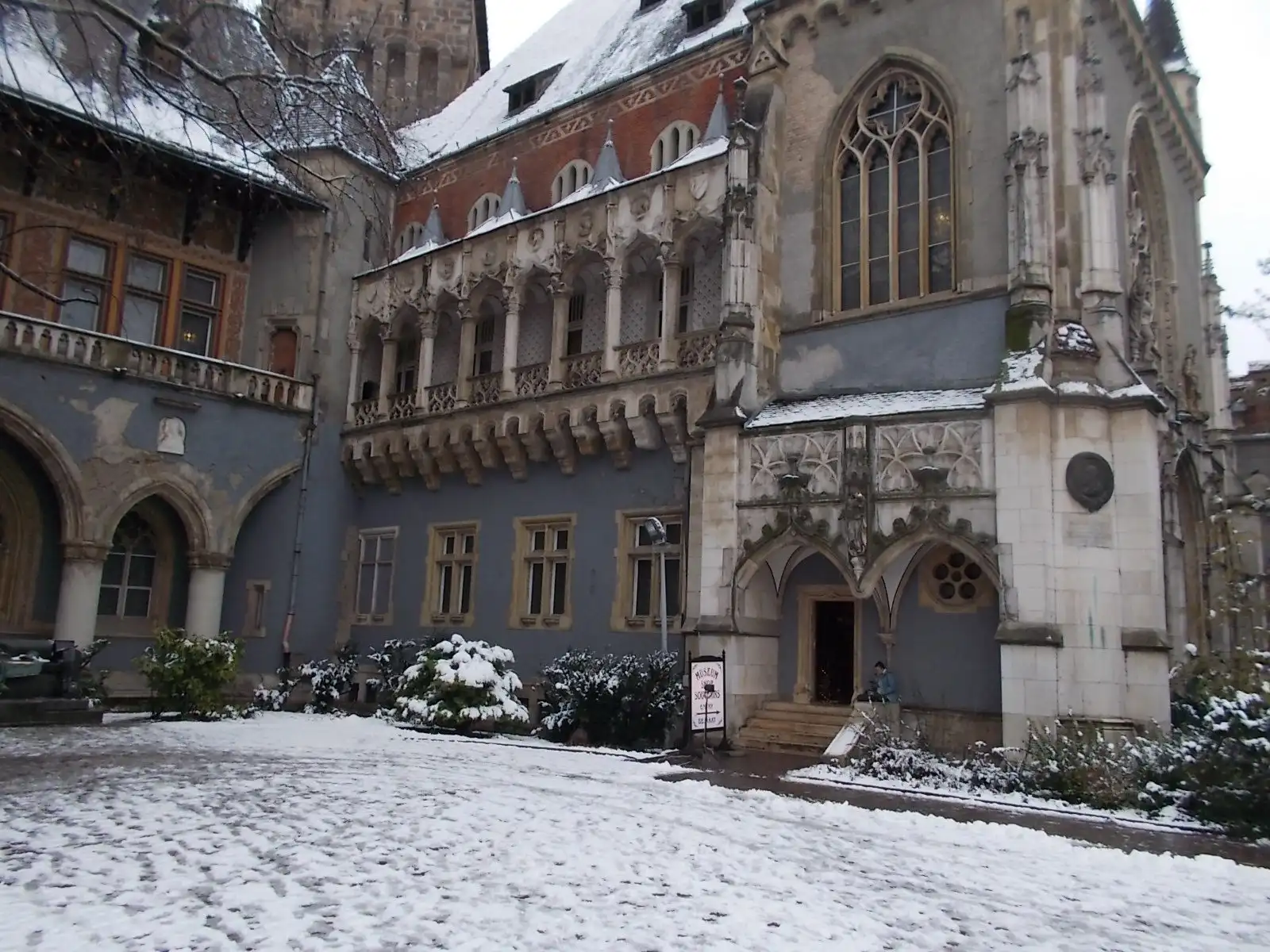
Ignác Alpár’s castle was the cleverest thing in it and was never meant to survive. He built a walk-through catalogue of Hungarian architecture in Romanesque, Gothic, Renaissance and Baroque, quoting real buildings rather than inventing styles: the portal of the Church of Ják, chapel elements from Pécs Cathedral, the crenellated houses of Lőcse and Besztercebánya, St Catherine’s Gate from Brassó.
The public named it themselves, after the Transylvanian castle at Hunedoara that its best-known wing copies, and liked it enough that the government rebuilt the whole thing in durable materials once the celebrations were over. Bomb damage from the war was made good by 1959, and the castle has been a listed building since 1991.
A hundred and fifty years of ice
The Pest Skating Association was founded on 12 November 1869 in the card room of the Steingasser coffee house, and it asked the city for permission to freeze part of the lake each winter, free of charge for the ladies and gentlemen of Pest. Permission was given. The rink opened on 29 January 1870 and Crown Prince Rudolf did the honours.
The buildings came afterwards and kept burning down or being outgrown. A wooden skating hut went up and burned in 1874, Ödön Lechner replaced it in 1875, and Imre Francsek’s neo-Baroque building of 1895 was raised while the lake itself was being regulated. A regulation speed-skating race was held here in February 1893.
The change that mattered most was the refrigeration plant of 1926, which made this the second artificial rink in Europe fit for competition and ended the rink’s dependence on the weather. The war left the building unusable. It was enlarged in 1968, rebuilt in 1986, and a long reconstruction reopened it in 2011 and finished in 2015, putting back the wing that had been bombed.
That history is why its operator calls it the cradle of Hungarian ice hockey, and why the rink is a listed monument.
Did you know?
The skating club was founded in a card room
Not a clubhouse or a sports hall: the Pest Skating Association was set up on 12 November 1869 in the card room of the Steingasser coffee house, and went from there to asking the city for a piece of the lake.
The oldest building was restored piece by piece
The Zsolnay ceramic facade of the House of the Hungarian Millennium took dozens of restorers nearly two years. Two thousand pieces were restored where they stood, 2,500 more went to a workshop, and over 2,000 had to be replaced using Zsolnay’s original technique and the firm’s own sample books.
The designer worked for almost nothing
Nebbien spent three years on the plans, ran the work almost without payment, and put his competition prize money back into the park. The scheme as drawn was cut to less than half its intended cost before it was built.
The avenue was cut down to keep people warm
In the hard winter of 1830 Palatine Joseph had the avenue into the park felled so the firewood could go to the poor of Pest. He had the trees replanted afterwards.
The castle was named by its visitors
Vajdahunyad is not an architect’s name for the building. The public called it after the Transylvanian castle its best-known wing copies, and the name stuck so firmly that it is the official one now.