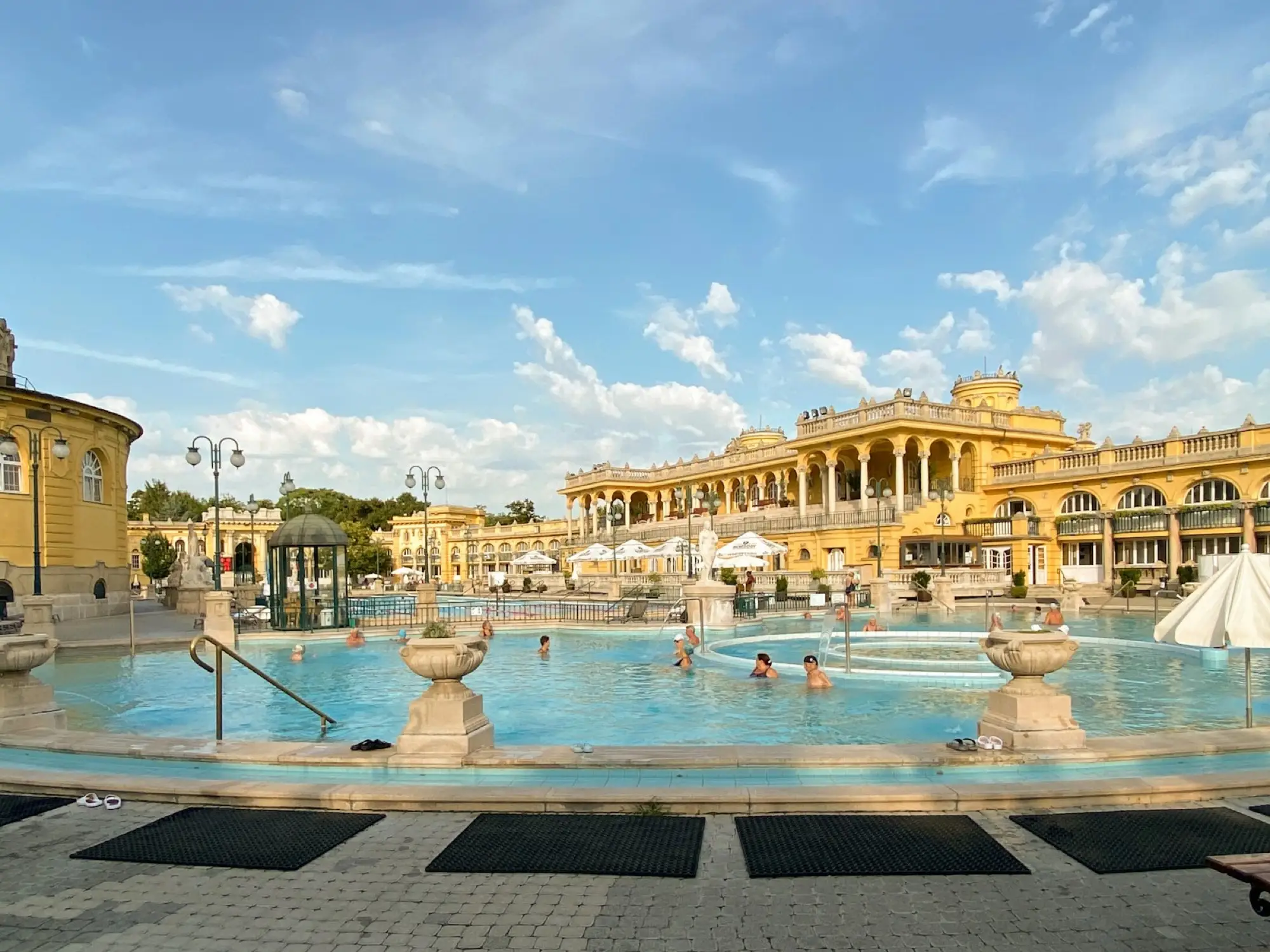
Pest got its first thermal bath because a mining engineer was sure there was hot water under City Park if somebody drilled deep enough. It took him more than nine years to prove it.
This page follows the bath from that well to the yellow palace of 1913, the outdoor pools of 1927 and the hotter spring that has fed it since 1938.
At a glance
Timeline
- 4 March 1868
The council says yes
Pest’s city council accepts Vilmos Zsigmondy’s proposal to drill an artesian well in City Park.
- November 1868
Drilling starts
Work begins on a spot that is now part of Heroes’ Square, in front of the statue of Árpád.
- January 1878
Hot water
The well is finished at a depth of about 970 metres, producing water at 74°C.
- 1881
The Artesian Bath
A temporary bath is operating on the new spring, on what was then Nádor Island in the park.
- 1896
Czigler’s plans
Győző Czigler exhibits his designs for a permanent bath at the millennial exhibition.
- May 1909
Building begins
Construction starts to Czigler’s plans. He does not live to see it finished.
- June 1913
Opening
The new bath opens under the name Széchenyi, with 51 private baths and separate steam and public baths for men and women.
- 1919
A victim of its success
More than 890,000 guests in a single year.
- August 1927
The outdoor pools
An extension by Imre Francsek the younger adds new wings and a beach bath with three outdoor pools.
- 1938
The St Stephen spring
A second well, more than 1,200 metres deep, brings up water at 77°C.
- 1963
Open all winter
The changing rooms are winterised, and the outdoor pools have run through the cold months ever since.
- 1998 to 2006
Renovation
Every pool is renewed, with water circulation for the outdoor pools and modern hydraulics for the medicinal ones.
Key facts
- Opened
- June 1913
- Architect
- Győző Czigler
- Pools
- 18, 3 outdoor and 15 indoor
- Spring
- 77°C, from the 1938 well
- First well
- Drilled 1868 to 1878
- Outdoor pools
- Added in 1927
- Guests in 1919
- More than 890,000
- Open in winter
- Since 1963
The two wells
The first well was Zsigmondy’s. After studying the ground he concluded that City Park was the likeliest place in Pest to strike an artesian spring, and the council backed him in March 1868. Drilling started that November and did not finish until January 1878, at about 970 metres, with water coming up at 74°C.
A second, deeper bore was finished in 1938 and named the St Stephen spring. It goes down more than 1,200 metres, delivers water at 77°C and was rated at around 6,000 cubic metres a day. It has supplied the bath since.
The history of Széchenyi Thermal Bath
Zsigmondy’s thermal well, 1868 to 1878
Vilmos Zsigmondy was a renowned mining engineer when he told Pest’s council that hot water could be found under City Park. The site chosen is now part of Heroes’ Square, in front of the statue of Árpád.
The work started in November 1868 and the well was declared finished in January 1878. Within three years its water was feeding a temporary bathhouse on Nádor Island in the park, known simply as the Artesian Bath.
Czigler’s bath opens in 1913
The temporary bath met the demands of the age less and less. Győző Czigler drew up a permanent replacement and showed the plans at the millennial exhibition of 1896. Building did not start until May 1909, and Czigler did not live to see the result.
The bath that opened in June 1913 cost 3.9 million gold crowns and took the name Széchenyi. There was nowhere to swim. Visitors got 51 private baths, plus separate steam baths and public baths for men and for women.
The 1927 outdoor pools and beach bath
By 1919 the bath was taking more than 890,000 guests a year, and bathing outdoors had gone from a fad to something the public expected.
A design competition was held in 1926, and by August 1927 Imre Francsek the younger had extended the public bath wings and added a beach bath with a 50 by 18 metre swimming pool and two more outdoor pools, set in 2,800 square metres of sand.
It was the first swimming pool on the Pest side of the city. The courtyard that most visitors now think of as Széchenyi dates from this extension, not from 1913.
Winter bathing and the 1998 to 2006 renovation
The bath was damaged in the Second World War, but the well was not, which kept part of it running. In 1963 the beach bath’s changing rooms were made fit for winter, and the outdoor pools have stayed open all year ever since. A further thermal section and a day hospital were added in the mid-1960s, and a full balneotherapy department followed in 1982.
Between 1998 and 2006 every pool was renewed. The outdoor pools got water circulation, and the medicinal pools got modern hydraulic equipment.