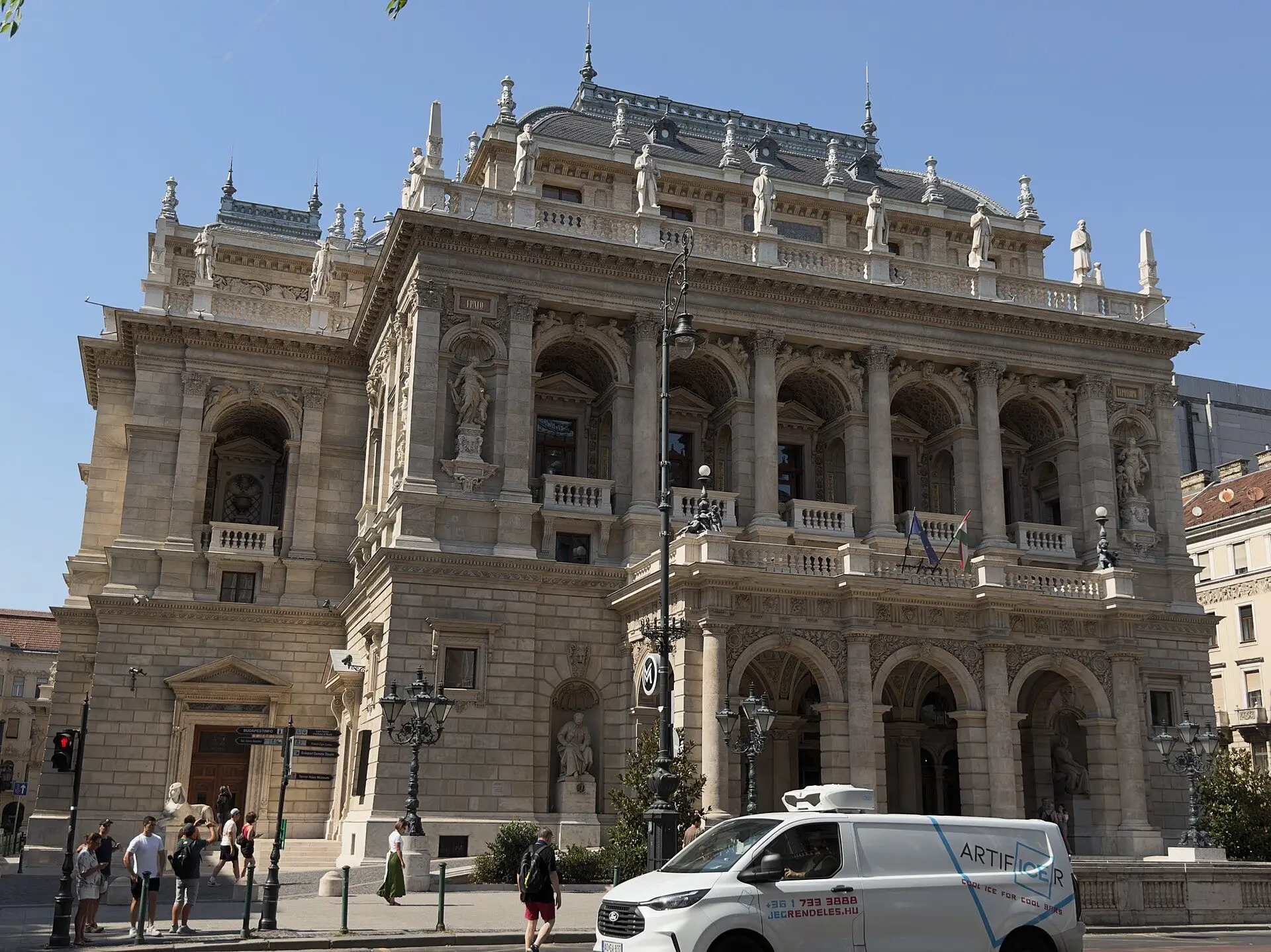
Franz Joseph put his weight behind the Hungarian State Opera House, and he attached a condition to it. The Pest opera was not to be bigger than the opera house in Vienna. Ybl took out the top row of boxes, shrank the lobby, and produced a building whose proportions are better for the cut.
It happened again in the restoration that finished in 2022, which deliberately removed two hundred seats to improve the sound.
At a glance
Timeline
- 1872
The case is made
Bódog Orczy, director of the National Theatre, submits plans at the urging of Prime Minister Menyhért Lónyay. The National Theatre can no longer stage drama and opera in one building.
- 1873
A competition, not a commission
The Budapest Public Works Council and Franz Joseph I back the project. Six architects are invited to tender, including Imre Steindl and two foreigners. The jury votes overwhelmingly for Miklós Ybl.
- 1875
The permit, and the condition
Permission comes only after the plans are reworked repeatedly, because the king will allow no Pest opera house larger than Vienna’s.
- 27 Sept 1884
Opening night
Nine years of building against a four-year plan. Franz Joseph attends. Ferenc Erkel and his son Sándor conduct.
- 1895
Wired for electricity
Electrical cabling is drawn through the chandelier’s gas pipes. The building is connected to the grid in three stages around the turn of the century.
- 1912
Medgyaszay's rebuild
István Medgyaszay adds two rows of seats at ground level on a new iron substructure, deepens the orchestra pit towards the stage, and creates the ground floor cloakroom.
- 1965
New composers on the parapet
The sixteen original facade statues, taken down in the 1930s after decaying, are replaced in a different style, with a partly different cast of composers.
- 1980 to 1984
The second reconstruction
Mária Siklósi’s renovation swaps the Asphaleia stage machinery for East German equipment and raises the ten-storey administrative building on Hajós utca.
- 2020
The workshops move out
The Eiffel Art Studios open on the site of the old Northern Railway works, taking the scenery, the costume store and the workshops off the Ybl palace.
- 2022
Reopened
Work completes on 10 March and the house reopens with a gala on 12 March, with a smaller, better sounding auditorium.
Key facts
- Built
- 1875 to 1884
- Opened
- 27 September 1884
- Architect
- Miklós Ybl (1814 to 1891)
- Style
- Neo-Renaissance
- Address
- Andrássy út 22
- Capacity
- About 1,000, once 1,200
- Ceiling fresco
- Károly Lotz, 45 m round
- Reconstructions
- 1912, 1980 to 1984, 2017 to 2022
Hungarian by law
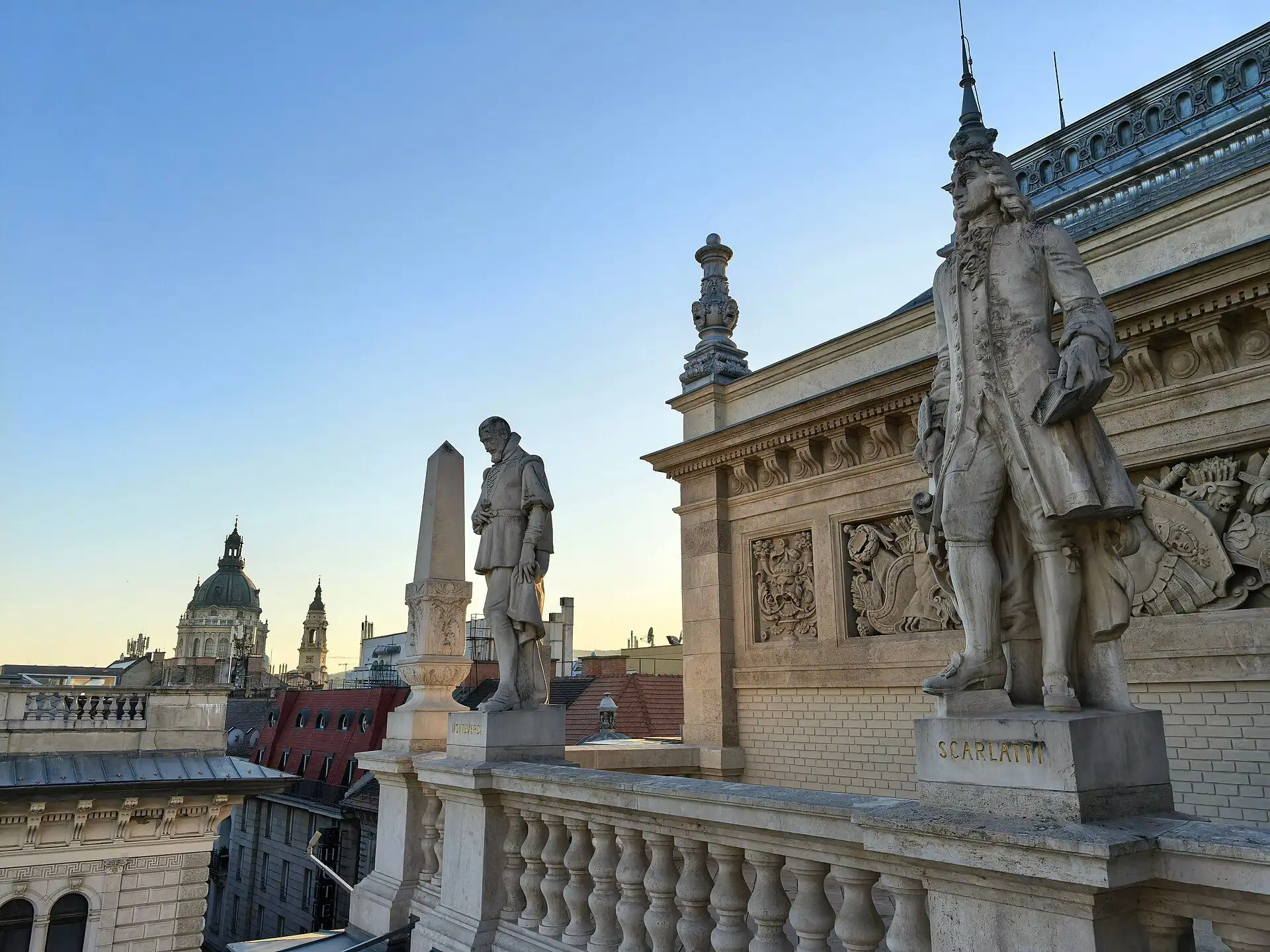
The brief carried a rule that would be unthinkable on a public building now. Every piece of work had to be done by Hungarian craftsmen, and only Hungarian materials could be used. The Opera House was to be a demonstration of what the country could make on its own.
Ybl met it with five exceptions, and the Opera still lists them. The marble facings came from Carrara, the granite columns from Austria, the oak and cedar from Italy, the stage machinery from Vienna and the chandelier from Mainz.
Everything else, from the frescoes to the ironwork, was Hungarian. So were all the painters and sculptors, which is why the same handful of names, Lotz, Than, Székely, Strobl, keep coming round as you walk through the building.
Opening night
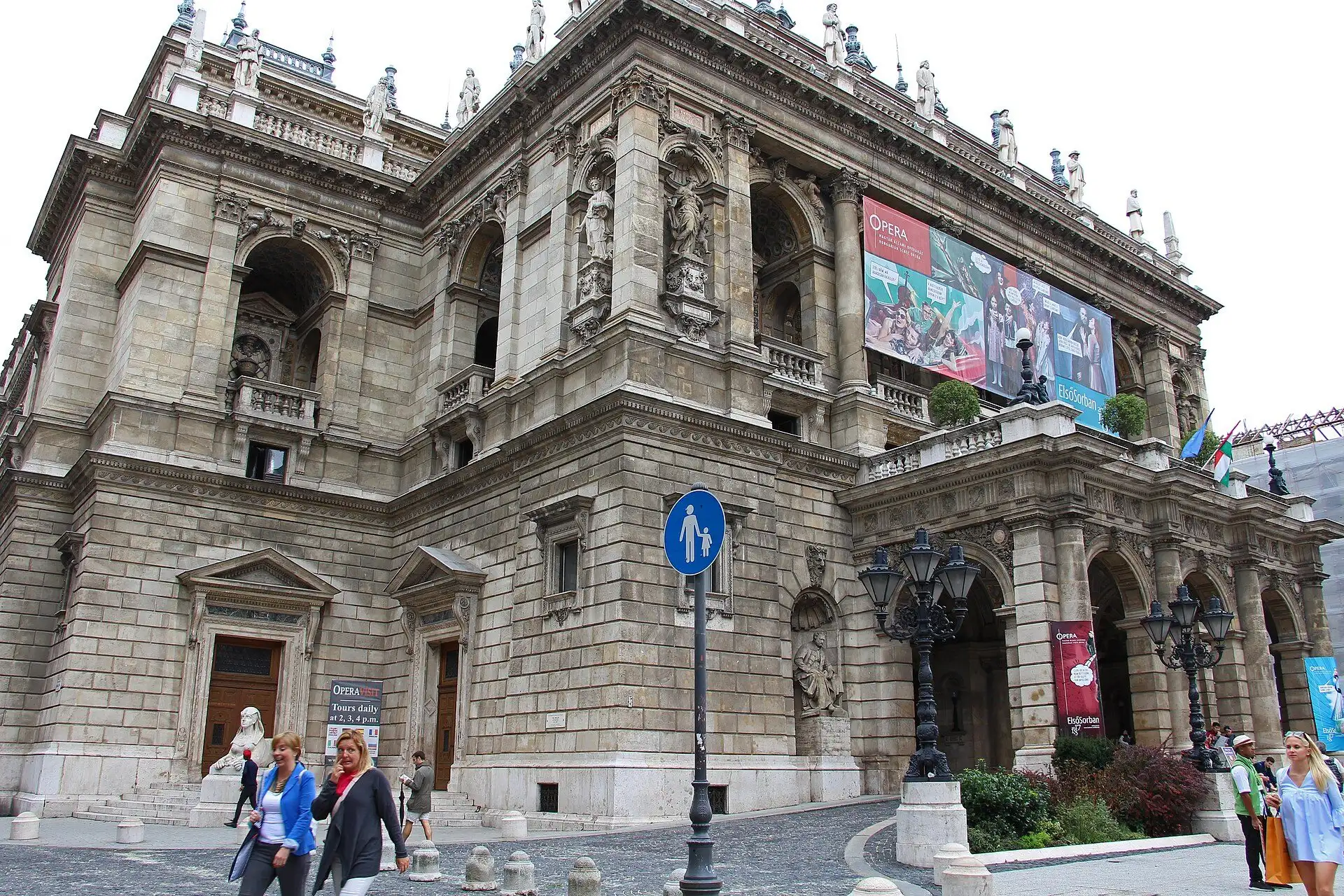
The evening of 27 September 1884 was not the unqualified triumph the building deserved. The work had been planned for four years and had taken nine, it had cost a great deal of public money, and the city knew both facts.
People went anyway, and went in force. The inside of the building had been gold, marble and fresco behind hoardings for the better part of a decade, and nobody expected a second chance to look at it. Entry to the opening cost roughly what two horses cost.
They heard the first act of Erkel’s Bánk bán, the overture to his Hunyadi László and the first act of Lohengrin, with Erkel himself and his son Sándor on the podium. Franz Joseph, whose condition had shaped the room they were sitting in, was in the audience.
The history of the Hungarian State Opera House
Why Pest needed an opera house
By the 1870s the National Theatre was being asked to do two jobs badly. It staged drama and it staged opera, and the building could not meet the demands of both. At the same time Andrássy Avenue, then called Sugár Avenue, was being driven through Pest, and a new boulevard wanted a monument on it.
Bódog Orczy, who ran the National Theatre, put the case in writing in 1872 at the urging of the prime minister, Menyhért Lónyay. Within a year the Public Works Council and the king had backed it.
Ybl was not handed the job. What followed was a competition, and six architects were invited: Ybl, Imre Steindl, Antal Skalnitzky, István Linczbauer, and two foreign entrants, Ferdinand Felmer and Ludwig Bohnstedt. The jury chose Ybl overwhelmingly. Steindl went on to build the Parliament.
Why it is smaller than the Vienna opera
Franz Joseph’s stipulation, that the Pest opera should not exceed the size of the Vienna opera, is usually told as an insult, and it may well have been meant as one. The building permit was held up from 1873 to 1875 while the plans were reworked to satisfy it.
Ybl’s solution was to remove the highest level of boxes and reduce the size of the lobby. The Opera’s own account is blunt about the outcome. The cuts gave the building better proportions, and left it very nearly symmetrical in both directions.
The artistic scheme did not change at all. Architecture and decoration were both meant to express the power of music, using stories from classical mythology to do it, which is why Apollo and Dionysus are argued over on the facade, the foyer ceiling, the staircase and the auditorium roof in turn.
The 1912 and 1980 rebuilds
István Medgyaszay’s 1912 work was the first serious intervention. He added two rows of seats at ground level, replaced the wooden substructure under them with iron, deepened the orchestra pit and pushed it towards the stage, which left some players sitting under it, and built the ground floor cloakroom.
The second came in 1980, to Mária Siklósi’s plans, and ran to 1984. The Asphaleia stage system, then almost a hundred years old, was replaced with technology from East Germany that was itself about twenty years old. The orchestra pit parapet was rebuilt in reinforced concrete, the audience areas were modernised, and a ten-storey administrative building went up at 11 Hajós Street with a tunnel running to the Opera House.
Between and around those two came the patching. The gas lighting gave way to electricity in three stages. Five of Árpád Feszty’s nine murals were replaced with paintings by Ignác Újváry after a leak in the first floor lounge. The war did comparatively little damage and what it did was repaired after 1945, then the audience rooms were redone in the 1950s and 1970s in whatever materials the decade could supply. Much of it was never properly documented.
Why the Opera House closed for five years
By 2011, when Szilveszter Ókovács was appointed government commissioner, the list was long. The stage machinery was noisy and obsolete and had been causing trouble since the 1990s. There were no proper dressing rooms for the orchestra, no fire alarm system, no climate control, an electrical network below the standard of the day and water in the basement. Nothing comprehensive had been done to the working parts of the house since 1984.
The government decided to act in 2016 and the company left at the end of that season. In late 2018 the brief was widened from a modernisation to a historically accurate reconstruction, based on what the restorers found once the building was empty. ZDA, Zoboki Design and Architecture, drew the programme; Bosch Rexroth built the new stage machinery.
The auditorium came out smaller. Capacity fell from 1,200 to 1,000, the boxes went from six seats to four, the rows moved apart, and the two rows Medgyaszay had added in 1912 were taken out.
The stalls went back to a single horseshoe block, the wooden dividers between ground floor boxes became wickerwork, and a sound passage was opened between the air chamber beneath the stalls and the orchestra pit. All of it was done to the acoustics, and losing the seats was the price.
What the restoration put back
The restoration was an exercise in undoing as much as building. Original colours and materials were reinstated from what the restorers uncovered and from archive documents. Light fittings resembling the originals went back into the sconces and the grand chandelier, and new two-tiered chandeliers were hung over the main stairway to light the ground floor properly.
The peroxided oak panelling in the Red Salon went back to its first colour. The Feszty Bar counters were moved to the Andrássy side of the room, evoking the original arrangement. A new ornate curtain was made, along with an imitation bronze cover for the iron curtain, worked up from a sketch drawn at the time of the opening that had never been built, and a laminated tin curtain that, unlike the old velvet house curtain, does not swallow the sound.
The Opera has also listed work it had not yet reached: the royal stairs, the Bertalan Székely Room, and the restoration and replacement of the statues along the cornice. No date is published for any of it, so if you find a room shut on your visit, that is the likely reason.