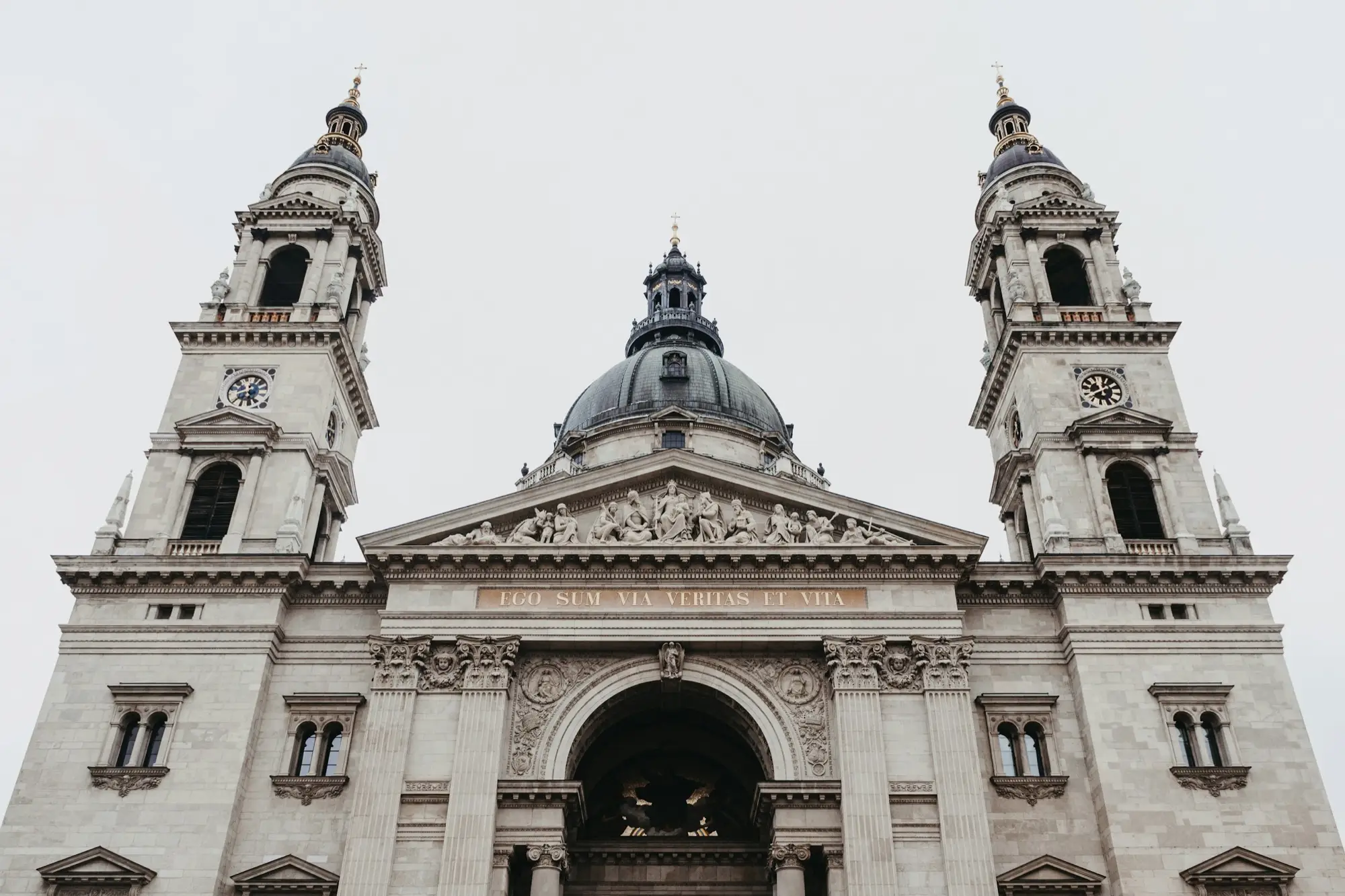
St. Stephen’s Basilica took 54 years, three architects, and one collapsed dome to finish. By the time it was consecrated in 1905, Budapest finally had a Catholic church to match its newly unified capital city. This page tells that story, and the much longer one of the relic the church now guards.
The story of the Basilica is the story of modern Budapest. Collections for a church in Lipótváros began in the 1810s. By the time the building was finished nearly nine decades later, Pest and Buda had merged into a single city, Hungary had become the equal half of the Austro-Hungarian Empire, and the Basilica’s 96-metre dome stood level with the new Parliament as the tallest thing in the capital.
At a glance
Timeline
- 1810s
Collections begin
Fundraising starts for a parish church in Lipótváros.
- 1838
Great Flood of Pest
The site, a little higher than its surroundings, stays dry and shelters people from the water. Survivors’ offerings go towards the planned church.
- 1845
Hild gets the commission
Pest city council commissions József Hild to design the church.
- 1851
Construction begins
Work begins on 14 August on Hild’s classicist design.
- 1867
Ybl takes over
Hild dies on 6 March with the church still far from finished. Miklós Ybl, one of the leading architects of the Austro-Hungarian era, takes over.
- 1868
Dome collapses
On 22 January the partially completed dome comes down. The cause is faulty workmanship and materials. The rubble is cleared and the faulty parts rebuilt by 1871.
- 1875
Work resumes to Ybl’s plans
Building restarts on Ybl’s neo-Renaissance redesign. The structure is complete by 1890.
- 1891
Kauser finishes the interior
Ybl dies. József Kauser is brought in to complete the interior, mosaics, and sculpture, working with the parish priest Lénárd Lollok.
- 1897
Named for St Stephen
The church takes the name of Hungary’s first king.
- 1905
Consecrated
The finished church is consecrated in November. On 8 December 1906 the keystone is laid in the presence of Emperor Franz Joseph I.
- 1931
Elevated to basilica minor
Pope Pius XI elevates the church to basilica minor status, the rank it holds today.
- 1938
Eucharistic Congress
Budapest hosts the 34th International Eucharistic Congress, with the Basilica as a host site.
- 1944 to 1947
War damage and fire
The siege of Budapest damages the roof, the towers and the outer walls. In 1947 a fire during the roof repairs damages the dome’s timber frame.
- 1950
The Holy Right arrives
The relic of St Stephen’s right hand is entrusted to the Basilica’s parish.
- 1983 to 2003
Twenty-year restoration
After a storm damages the dome’s covering in 1982, the whole building is renovated. Lifts to the Panorama Terrace are installed in 2003.
- 1993
Co-cathedral
Pope John Paul II makes the Basilica co-cathedral of the Archdiocese of Esztergom-Budapest.
Key facts
- Built
- 1851 to 1905
- Consecrated
- November 1905
- Architects
- Hild, Ybl, Kauser
- Height
- 96 metres
- Size
- 87.4 m long, 55 m wide
- Style
- Classicist plan, neo-Renaissance finish
- Status
- Basilica minor (1931), Co-cathedral (1993)
- Organ
- Angster, 1905, 7,544 pipes
The site
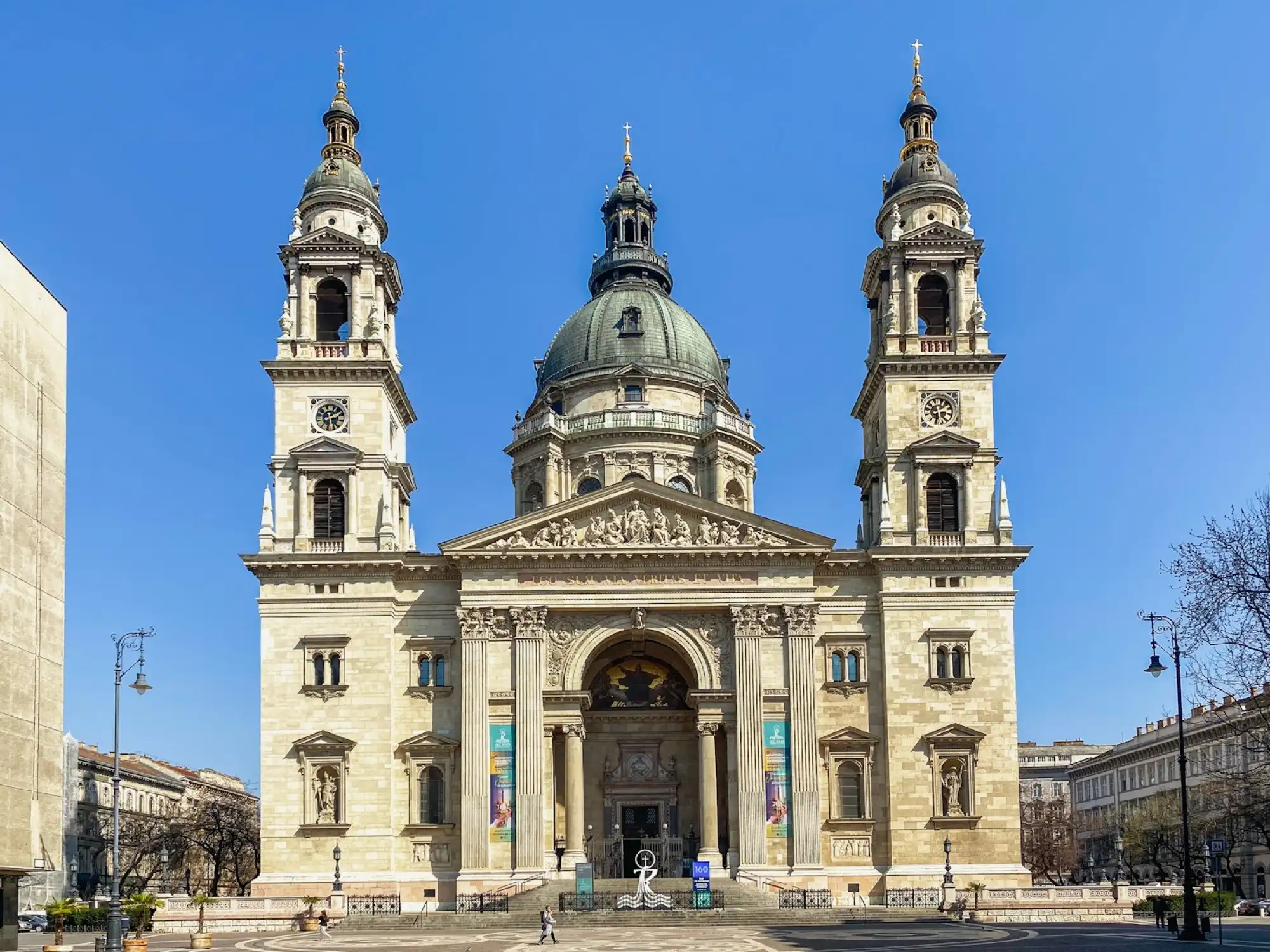
In the late 18th century the spot held an arena for animal fights, a long way from a cathedral. What changed its fate was the Great Flood of 1838. The ground here is slightly higher than the streets around it, so it stayed dry, and people took refuge on it.
Survivors made offerings towards a new church, and a small, modest church served the parish while the money was raised. By 1851 there was enough to start building.
Naming
Stephen I, who received his crown from Pope Sylvester II at the turn of the first millennium, is the founder of the Christian Hungarian state and the most important figure in Hungary’s founding story. The church has carried his name only since 1897, when the building was nearly finished.
By then Hungary had spent centuries under Ottoman occupation and Habsburg rule and had lived through a failed revolution in 1848. A great church dedicated to Stephen reasserted a thousand years of Christian identity in stone and gold.
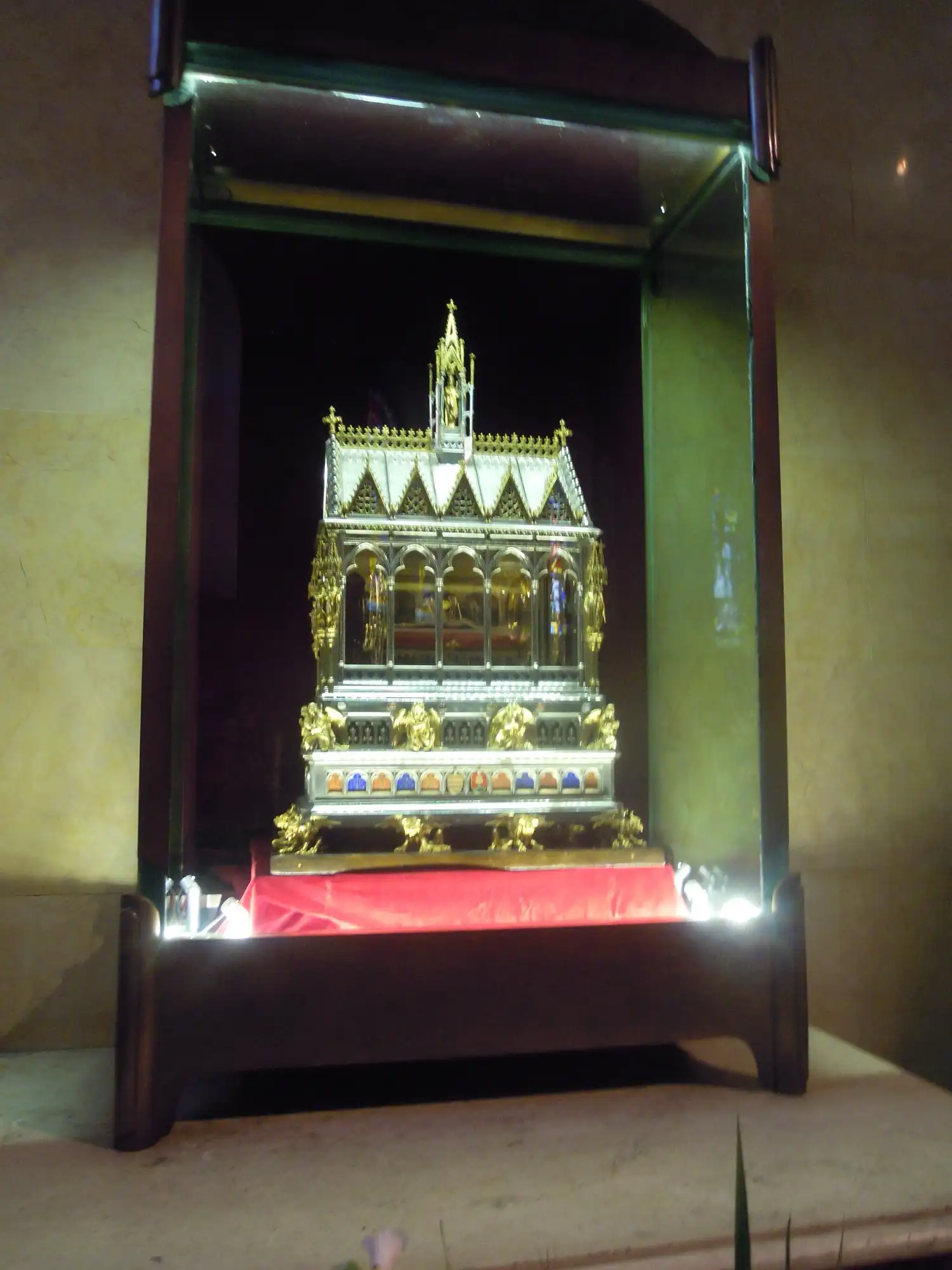
The Holy Right, the relic venerated as his actual right hand, came into the Basilica’s care in 1950 and remains its spiritual anchor.
The history of St. Stephen’s Basilica
The construction story alone fills most of the Basilica’s 19th-century history, but there are other threads worth pulling on if you want to understand what the building means to Hungarians today.
Hild, Ybl and Kauser
József Hild began the church in 1851 in a strict classicist style. When he died in 1867, Miklós Ybl took over. Ybl was one of the architects shaping modern Budapest, the man who would go on to design the Hungarian State Opera House, and he shifted the design toward neo-Renaissance.
After the 1868 dome collapse he corrected the faults in Hild’s design and reworked the whole church. József Kauser finished the work after Ybl’s death in 1891, designing the interior, its furnishings and its decoration with the parish priest, Lénárd Lollok, to a single scheme. Only Hungarian sculptors and painters were invited to contribute.
The result is a building with three architectural voices layered on top of each other. Hild’s footprint defines the ground plan, Ybl’s vision gives the building its height and proportion, and Kauser’s decorative programme sets the tone inside.
The dome collapse of 1868
On 22 January 1868 the unfinished dome came down. The cause was not the weather but faulty workmanship and poor materials, and Ybl, who had only just taken over from Hild, had design errors to correct as well.
Clearing the rubble and rebuilding the faulty sections took until 1871, and work on Ybl’s new design did not resume until 1875. It is the main reason construction stretched so long.
The story goes that at the keystone ceremony in 1906, Emperor Franz Joseph kept glancing up at the dome.
Why 96 metres
Both St. Stephen’s Basilica and the Hungarian Parliament, completed a year earlier, stand exactly 96 metres tall. The number is not accidental. It commemorates the year 896, the traditional date of the Magyar settlement of the Carpathian Basin. It is hard not to read the matching heights as a statement too, one building for the church and one for the state, neither taller than the other.
For more than a century planning rules kept everything else in the city below the pair, which is why the skyline remains so flat and why the Panorama Terrace view is so open.
The journey of the Holy Right
King Stephen died on 15 August 1038. When the chapter at Székesfehérvár later hid his body in a burial chamber to protect it, the right hand, which had survived intact and was believed to have miraculous power, was separated and kept as a relic.
Over the following centuries it was held at Székesfehérvár, in Bosnia and in Ragusa, today’s Dubrovnik, until Maria Theresa had it brought to Buda in 1771 and ordered 20 August to be kept as St Stephen’s Day.
In the early 1900s it was kept in the Sigismund Chapel of the Buda Castle palace. It was taken west in 1944 to keep it from the war and came back to Hungary on 19 August 1945.
The Basilica’s parish has looked after it since 1950. It went on display in a side chapel in 1987, and since 2018 it has stood in the church itself, inside a neo-Gothic reliquary made in Vienna in 1862.
War, fire and the restoration to 2003
The Basilica did not come through the siege of Budapest in 1944 to 1945 unscathed. The roof, the towers and the outer walls were all damaged, and in 1947 a fire during the roof repairs damaged the timber frame of the dome.
A storm in 1982 tore at the dome’s metal covering, and the following year a complete renovation began that lasted until 2003. The lifts that now carry visitors towards the Panorama Terrace date from the end of that work.
All but one of the bells were lost to wartime requisition. The survivor, the Holy Virgin bell of 1863, was spared on a plea of clemency for its unusual sound. The others were replaced between 1990 and 1993, a gift of German Catholics and the Rotary Club, among them the 9,250-kilogram St Stephen bell, the largest in Hungary.
The co-cathedral and Saint Stephen’s Day
The Basilica has been the co-cathedral of the Archdiocese of Esztergom-Budapest since 1993. Major liturgical events and commemorations of Saint Stephen’s Day on 20 August are still held here. Hungarian Catholic identity remains tightly bound to Saint Stephen and to this building; you can see it in the crowds that follow the Holy Right procession every 20 August.
Visiting today
For all the grandeur of its history, the Basilica remains an active parish church rather than a museum. Mass is said every day, the Holy Right still leaves the church once a year, and you can still climb or ride up to the Panorama Terrace for the view from Ybl’s dome.