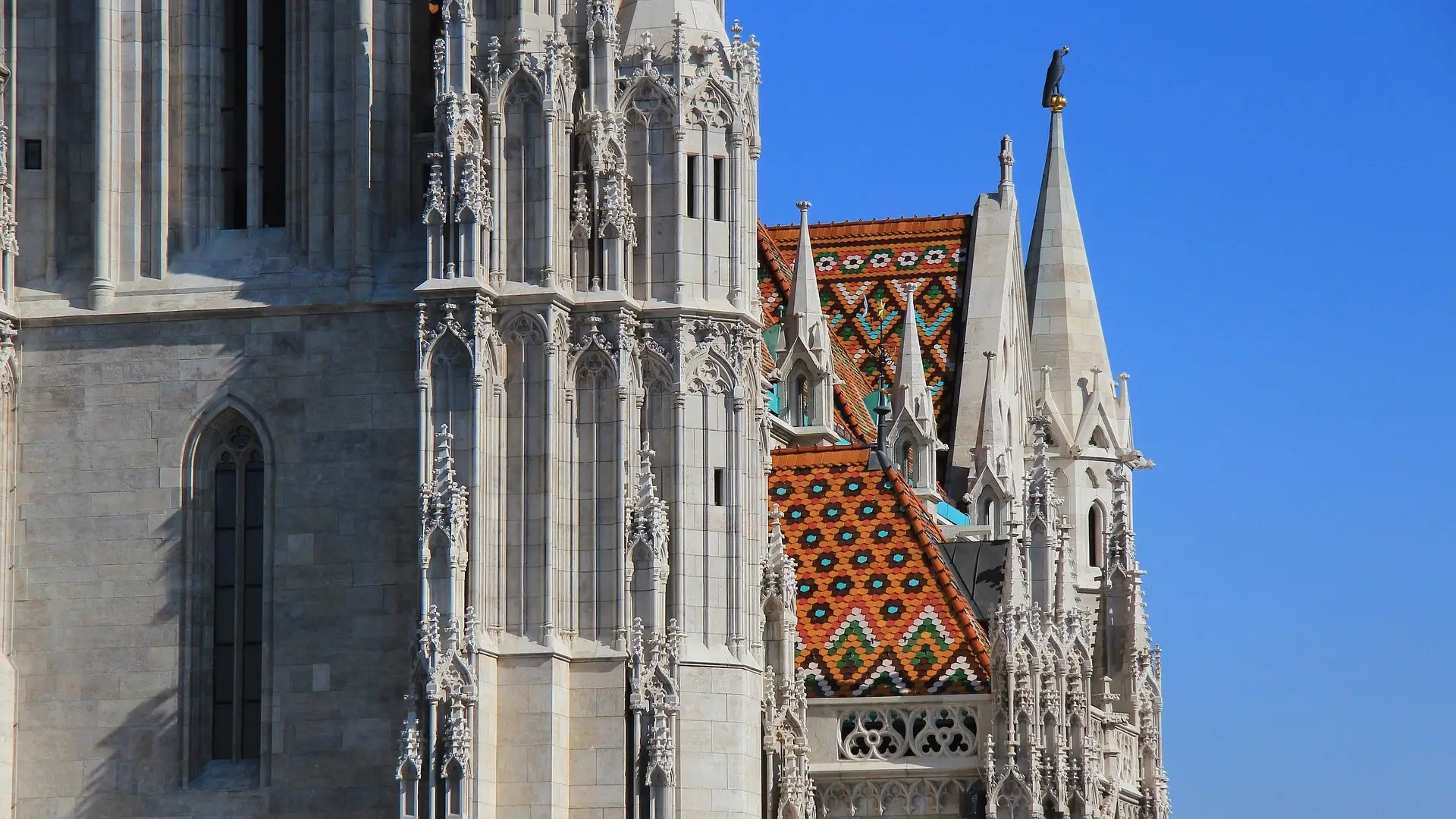
Matthias Church has stood on the highest point of Castle Hill for nearly 800 years. Tradition and the church itself date its founding to 1246, when Béla IV moved the city of Buda onto the hill after the Mongol invasion, but the building visitors see today is essentially a late-19th-century reinvention by Frigyes Schulek, raised on medieval foundations and stamped with the raven of King Matthias, whose name the church has carried, by accident, since the 1800s.
It is the church where Franz Joseph and Elisabeth were crowned in 1867, to Liszt’s Coronation Mass, and where Charles IV became the last king of Hungary in 1916. In between it spent 145 years as a mosque, burned in 1723, was reinvented by Schulek in the 1870s and 1880s, and was wrecked again in the siege of 1944 and 1945 before its long postwar restoration.
This is the full story of how the church came to be, what survived from each era, and why almost every detail you see today, the diamond-tiled roof, the painted interior, the spire, is the result of decisions made by Schulek and his painters for the 1896 Millennium.
At a glance
Timeline
- 1247
First mention
A charter of the Veszprém chapter records the church of the Virgin under construction on the new hilltop town of Buda, founded by Béla IV after the Mongol invasion. The parish is for the German townspeople.
- 1309
A coronation with a borrowed crown
Charles Robert of Anjou is crowned in the church on 15 June with a provisional crown, the Holy Crown being out of his reach.
- 1384
The south tower collapses
On 14 February the tower falls during Mass. Nobody is hurt. The church is rebuilt as a hall church over the following decades, and the Mary Gate is carved on the south side.
- 1463 and 1476
Matthias’s weddings
King Matthias marries Catherine of Poděbrady here on 1 May 1463 and Beatrice of Aragon in December 1476. In 1470 the rebuilt tower is finished and his coat of arms set on it.
- 1541
Buda falls to the Ottomans
Suleiman has the altars and pews cleared and says his Friday prayer here. The church serves as a mosque until 1686.
- 1686
Buda retaken
The Christian armies take the city on 2 September. The Franciscans, then the Jesuits, take over the church and build a college and a seminary against its sides.
- 1723
The great fire of Buda
The church and the buildings round it are badly damaged; much of the west front comes down with part of the vault. A Baroque interior follows.
- 1785
The treasures sold
On 15 November the church’s medieval and Jesuit treasures are auctioned on the orders of Joseph II.
- 1867
Coronation of Franz Joseph and Elisabeth
On 8 June, after the Compromise with Austria, the emperor and empress are crowned king and queen of Hungary here. Liszt’s Coronation Mass is heard for the first time.
- 1874 to 1896
Schulek rebuilds the church
Frigyes Schulek strips away the Baroque and most of the medieval fabric and rebuilds the church to his own reading of its 13th-century form. Prince Primate Kolos Vaszary consecrates it on 15 August 1896.
- 1898
Béla III comes home
The remains of King Béla III and Anne of Antioch, found at Székesfehérvár in 1848, are reburied in the Holy Trinity Chapel.
- 1916
The last coronation
Charles IV and Zita are crowned on 30 December, the last king and queen of Hungary.
- 1944 to 1945
The siege of Budapest
The roof burns and the southern vaults partly collapse. Restoration runs from 1954 into the 1970s.
- 1994
A bomb at the crypt
An explosion at the east entrance to the crypt on 23 July. The repairs are paid for by public donations.
- 2004 to 2013
Full refurbishment
The church is fully restored, and four new bells are cast in 2010 and 2011 to join the two historic ones.
Key facts
- Founded
- 1246, first recorded 1247
- Dedication
- The Assumption of the Virgin
- Rebuilt
- Frigyes Schulek, 1874 to 1896
- Painted by
- Bertalan Székely and Károly Lotz
- Coronations
- 1309, 1867 and 1916
- Mosque
- 1541 to 1686
- Tower
- 197 steps to the lookout
- Choir
- Singing here since 1688
The building
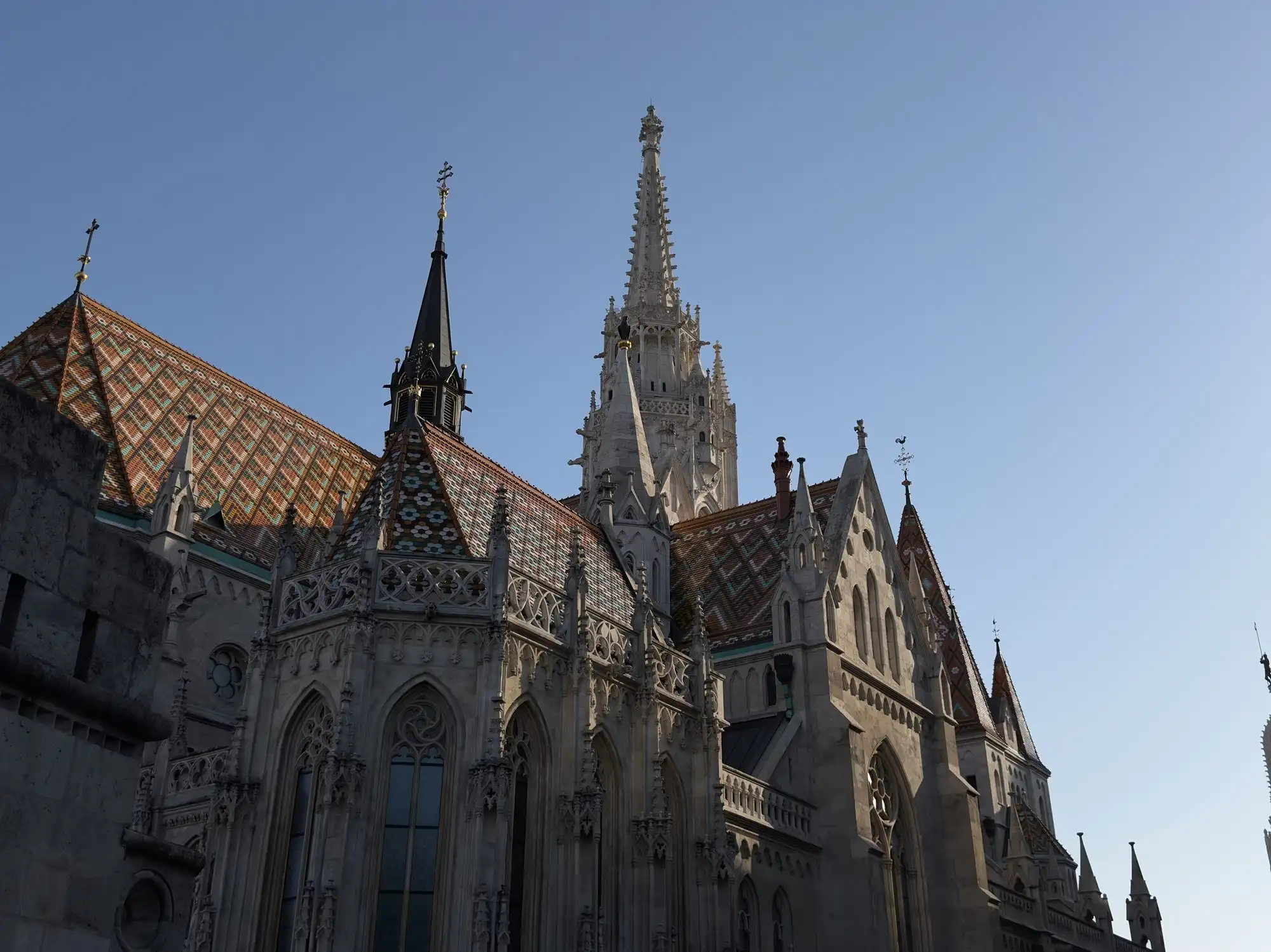
Three churches lie under the one you see. The first, of the 1250s and 1260s, was a Gothic basilica with a transept and a pair of west towers, the earliest and most complete work of classic Gothic church building in Hungary.
The second was the early-15th-century rebuilding after the tower fell, which raised the side walls to make a hall church, lengthened the side chancels and added the Mary Gate. The third was the Jesuits’ Baroque church of the 18th century, squeezed between their college and their seminary.
Schulek kept the ground plan and the foundations, the cores of the nave piers, part of the Mary Gate and a little of the west door. Everything else, the vaults, the towers’ upper storeys, the spire, the glazed roof, the painted walls, is his and his painters’ work of 1874 to 1896.
The name
The name is a 19th-century mistake that stuck. The church was founded as the parish church of the Virgin for Buda’s German townspeople, and its formal name is still the Church of the Assumption of Buda Castle, Budavári Nagyboldogasszony-templom in Hungarian.
King Matthias did not build it, but he did rebuild the south tower after its collapse and set his coat of arms on it in 1470, and he held both his weddings here.
When the arms, with the raven of the Hunyadi family, were found on the tower in the 19th century, the romantic name took hold. The repainted original stone is now inside the church, by the stairs, with a copy in its old place outside.
The history of Matthias Church
Five threads run through the church’s history that are worth pulling on if you want to understand what the building means today.
Three coronations, 1309 to 1916
Hungarian kings were crowned at Székesfehérvár in the Middle Ages, and after the Turkish wars at Pozsony, today’s Bratislava. Buda’s church of the Virgin saw one medieval coronation, Charles Robert’s in 1309, with a provisional crown because the Holy Crown was in other hands.
Its real coronation era came late. In 1867 the Compromise turned the Habsburg empire into Austria-Hungary, and on 8 June Franz Joseph and Elisabeth were crowned king and queen of Hungary here, with Liszt’s Coronation Mass written for the day.
The church was in poor repair, and the ceremony exposed it; the decision to restore followed. On 30 December 1916 Charles IV and Zita were crowned in Schulek’s finished church, the last coronation in Hungarian history. The empire collapsed two years later.
145 years as a mosque
When Suleiman took Buda in 1541 he had the church’s altars and pews cleared away and said his Friday prayer in the building, a public sign that the city was his. The main church of Buda became its main mosque, known as the Great mosque, the Old mosque or the Süleyman Khan mosque.
The Turks destroyed the fittings and the decoration but changed the building itself surprisingly little, beyond rebuilding some damaged Gothic windows to their own taste. Thanks to its position it was the one Christian church to come through the sieges in reasonable shape, and when the Christian armies retook Buda on 2 September 1686 the Franciscans moved in with them.
Tradition adds a miracle. In the mosque’s last days a walled-up medieval Madonna is said to have been exposed by an earthquake, foretelling the Christian victory. The Madonna in the Loreto chapel under the south tower, made at the end of the 17th century, stands in for the one in the story.
Why it is called Matthias Church
King Matthias, who reigned from 1458 to 1490, attended a Mass of thanksgiving here after his election and was married here twice, to Catherine of Poděbrady in 1463 and to Beatrice of Aragon in 1476. He rebuilt the south tower, which had fallen in 1384, and finished it in 1470 with his coat of arms on the wall, a raven with a ring in its beak at its heart.
The tower you see is Schulek’s restored copy of it, with a lace-like stone spire of his own invention on top. The arms are what gave the church its everyday name four centuries later.
Schulek’s rebuilding, 1874 to 1896
Frigyes Schulek won the commission after the 1867 coronation showed how far the church had decayed. He surveyed it, judged the 13th-century fragments the most valuable, and set out to bring that first church back.
To get the effect he wanted he demolished late medieval, Turkish and Baroque work alike, had most of the carved stones lifted out and recut, and filled the gaps with new work in what he considered the right style: the stone spire on the south tower, the four-pinnacled cap on the north one, the porch in front of the Mary Gate.
The work ran from 1874 to 1896 and the church was consecrated on 15 August 1896, in the Millennium year. In its present form it is regarded as a work of the late 19th century, and Schulek went straight on to build Fisherman’s Bastion behind it, on the old town wall.
Székely, Lotz and the painted interior
Almost every surface inside is painted, and almost all of it is the work of Bertalan Székely and Károly Lotz, working to Schulek’s scheme and using what survived of the medieval wall painting.
The programme runs from ornament on the pillars and vaults to whole cycles: scenes from the life of Christ and the Virgin in the nave, St László in the north side-chancel, St Stephen in his chapel, St Imre in his. The stained glass was made by Ede Kratzmann to their designs, and Ferenc Mikula of Debrecen carved the sculpture, including the tomb of Béla III to Schulek’s design.
The 2004 to 2013 refurbishment cleaned it all. On a bright day the reds, blues and golds are extraordinary; on a dull one, give your eyes a minute.
Visiting today
Knowing the history changes the visit. Once you recognise that the tiled roof, the spire and the painted walls are Schulek’s late-19th-century reinvention rather than medieval originals, you can see the building for what it is: a Hungarian national monument built on a working medieval parish church, with the medieval kingdom present in person only at the tomb of Béla III.