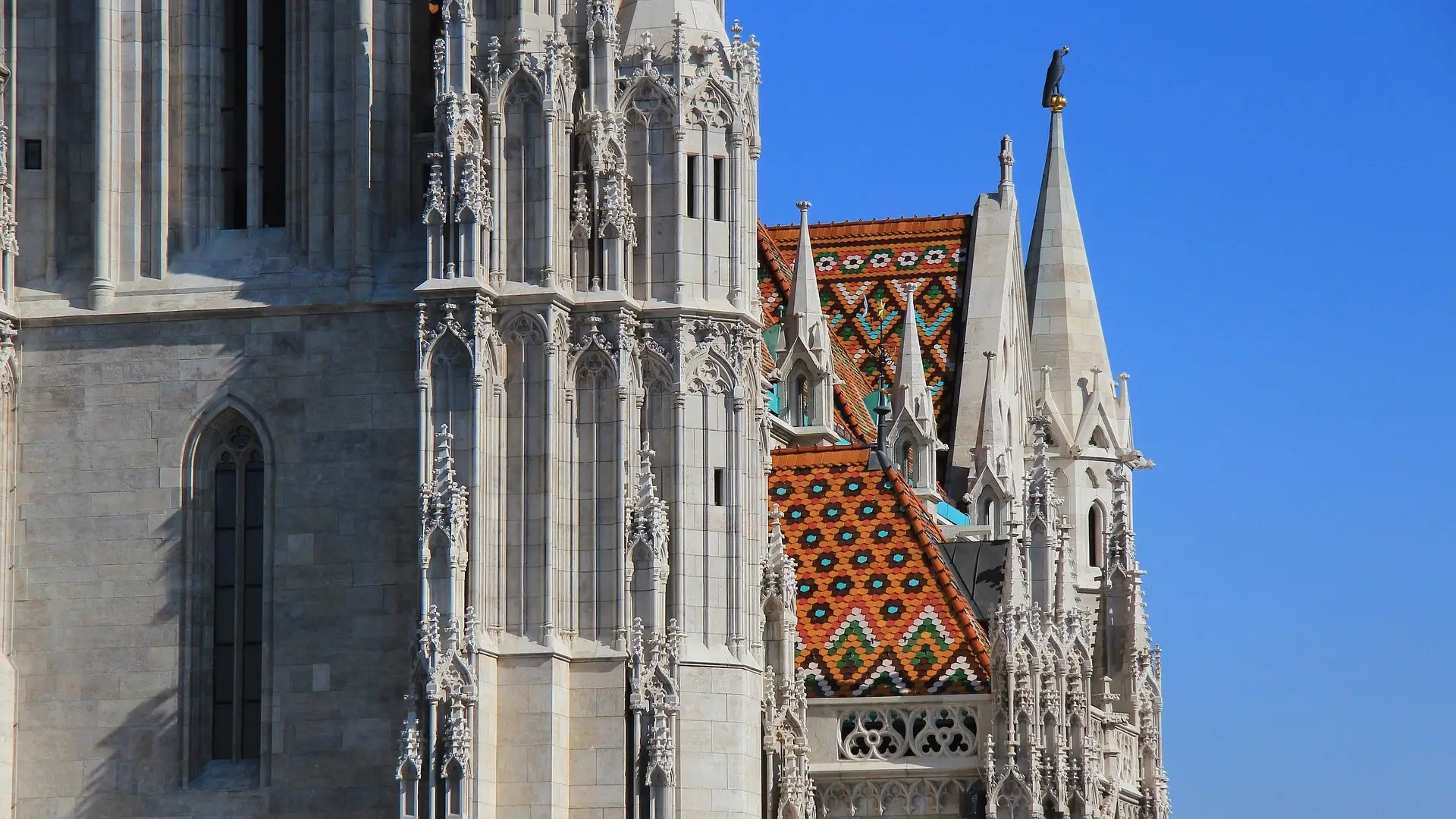
Matthias Church is the Catholic parish church on Holy Trinity Square at the heart of Buda’s Castle District, immediately in front of Fisherman’s Bastion. The building on the site dates from the 13th century and was rebuilt in its present form between 1874 and 1896 by Frigyes Schulek, with interior painting by Bertalan Székely and Károly Lotz, stained glass by Ede Kratzmann and sculpture by Ferenc Mikula.
It is a working parish that charges for sightseeing. One ticket covers the church and the museum in its upper galleries; the tower is a separate timed ticket that only the church sells.
Both of the dual monarchy’s coronations happened here, Franz Joseph and Elisabeth in 1867 and Charles IV and Zita in 1916, and the diamond-pattern Zsolnay roof and Schulek’s stone spire are the view the Castle District is known for.
- Visit length
- 45 to 60 minutes, plus 30 for the tower
- Entry
- Ticket for the church and museum. The tower is a separate timed ticket
- Book ahead
- For the tower, which has fixed half-hour slots
- Opening hours
- Mon to Fri 09:00 to 17:00, Sat 09:00 to 12:15, Sun 13:15 to 17:00
- Best time
- Weekday morning at 09:00
- Nearest stop
- Bus 16 / 16A / 116 Szentháromság térAbout 80 m away, on the level
- Accessibility
- Step-free into the church by the south gate, stairs to the museum and tower
- Dress code
- Shoulders and knees covered
- Tower climb
- 197 steps, no lift, sold only by the church
Tickets
Matthias Church is an active Catholic parish, so visitor access is structured around the services. A church ticket covers the nave, the chapels and the museum upstairs; the tower is a separate ticket for a fixed half-hour slot, sold only by the church. Our partners sell a guided walk that includes admission, an entry ticket for the church, and evening concerts.
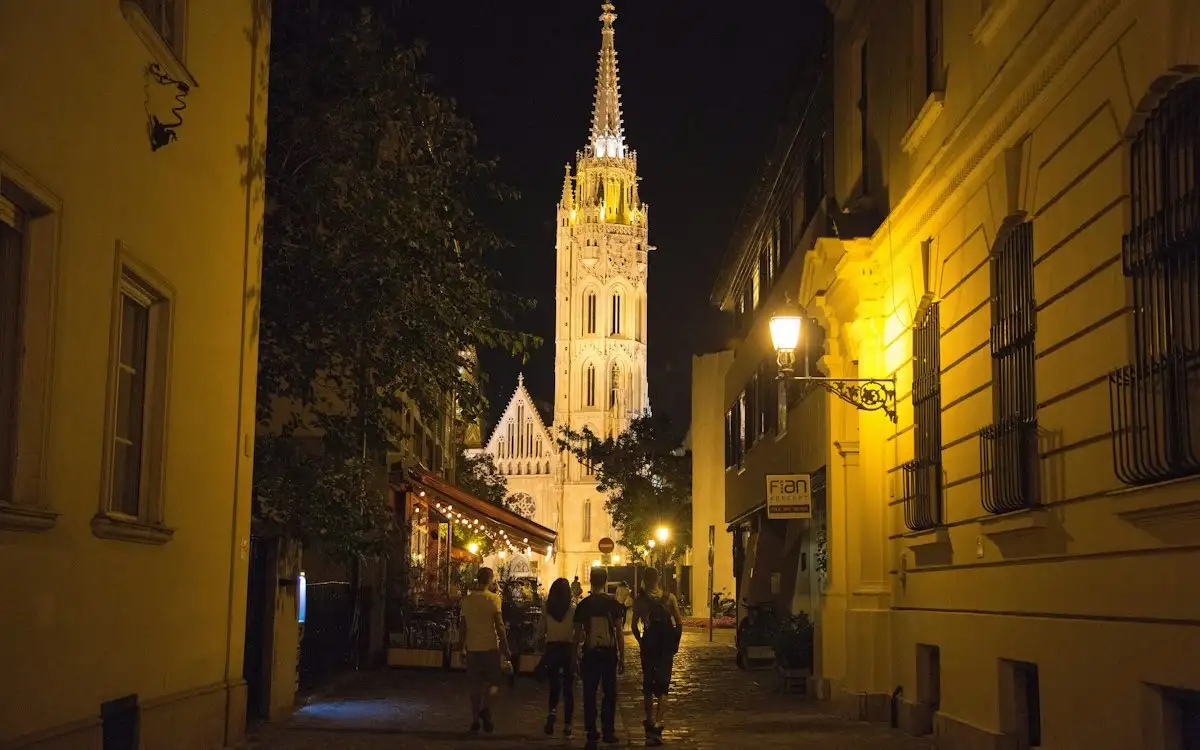
Matthias Church: Fools and Kings Tour
Best for: A story-led walk of the hill, with Matthias Church inside and a coffee stop
- 2.5 hours
- Live guide in English
- Free cancellation up to 24 hours ahead
What’s included and more details
What’s included
- Guided walk of the Castle District
- Admission to Matthias Church
- Coffee and a traditional cake in a local café
- Maps and tips for the rest of your stay
- Meeting point
- The Holy Trinity Statue, Szentháromság tér 2. The guide holds a Tiqets sign
- On arrival
- Swap the phone voucher for a paper ticket at the meeting point
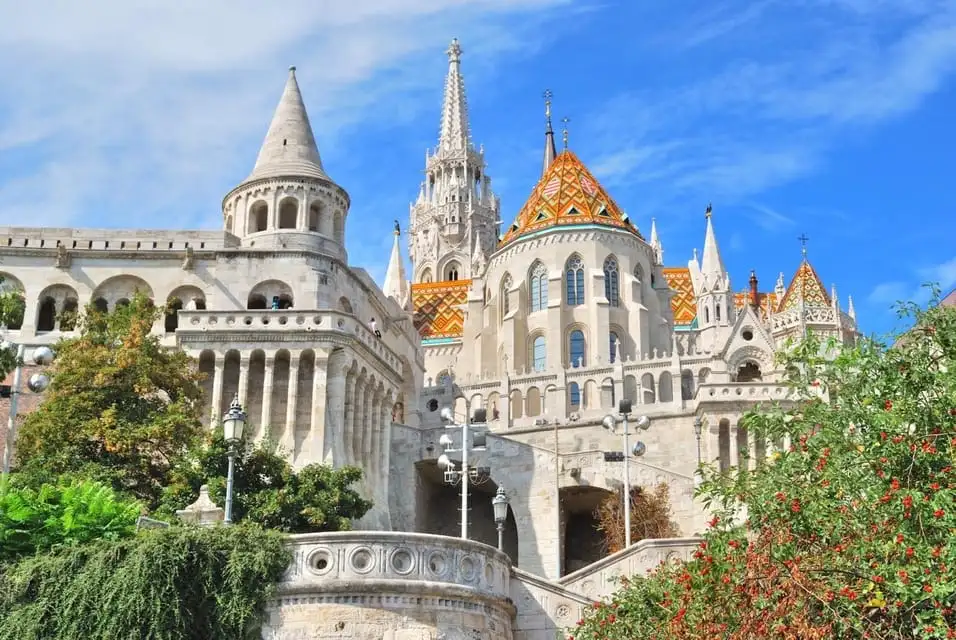
Matthias Church Entry Ticket
Best for: Seeing inside the church on your own, on any day that suits
- Church ticket valid on any day in the calendar year
- Free cancellation up to 24 hours ahead
What’s included and more details
What’s included
- Entry to Matthias Church
- Not included
- The tower
- Your ticket
- Emailed the day before. The GetYourGuide voucher alone does not get you in
- Bring
- Passport or ID card
- Not allowed
- Luggage or large bags
Classical Music Concerts in Matthias Church
Best for: An evening of classical music inside the church
- 70 minutes
- Free cancellation up to 24 hours ahead
What’s included and more details
What’s included
- Concert ticket
- Choose
- One of three seat categories
- Not included
- Hotel pick-up, food and drinks
- Also
- Reserve now and pay later
- Every ticket is a single entry on the day. Church tickets bought from the church itself can be used on any day of that calendar year; tower tickets are for their slot only
- The tower runs in small groups at fixed times, with a 10-minute guided introduction, and is closed in strong wind or storms
- Children under 6 go in free, and reduced tickets for students and pensioners are sold by the church with ID
For a full breakdown of every ticket type, including the tower, see our Matthias Church tickets guide. The guided options, from a Castle District walk to the church tour with the royal oratory, are compared in our Matthias Church tours guide.
Highlights
Schulek’s painted interior
Every surface inside is painted, in ornament and figures by Bertalan Székely and Károly Lotz, under vaults that make a Gothic church feel like a Hungarian fairytale palace.
Climb the 197-step tower
A narrow spiral staircase past the bells to a lookout above the Zsolnay-tiled roof, with Fisherman’s Bastion, the Danube and the Parliament below.
Stand in Liszt’s coronation church
Walk into the church where Liszt’s Coronation Mass was first heard, at the 1867 crowning of Franz Joseph and Elisabeth.
Plan your visit
Opening hours
The church is open to sightseers Monday to Friday from 09:00 to 17:00, on Saturday mornings, and on Sunday afternoons after the midday Mass. Saturdays are the wedding day and are often cut short, so check the church’s website for the day’s hours before a weekend visit.
Mon to Fri 09:00 to 17:00, Sat 09:00 to 12:15, Sun 13:15 to 17:00Check our detailed opening hours guide for Mass times, the tower slots, the closed days and the best times to avoid crowds.
Getting there
Matthias Church sits at the top of Buda Castle Hill. The closest direct option is the Castle bus (line 16 from Deák Ferenc tér in Pest or Széll Kálmán tér in Buda), which stops at Szentháromság tér about 80 m from the church. The Buda Castle Funicular from Clark Ádám tér is the scenic alternative, with a level walk through the Castle District at the top.
Nearest stops
By car: not recommended. The Castle District is a protected zone behind traffic barriers, and you pay for the time you spend inside.
See our complete guide on how to get there for each bus, the funicular, the stairs up from the river and accessibility notes.
Before you go
- Dress code: shoulders and knees covered, for men and women. A shawl over a sleeveless top is accepted. Men take hats off. Costumes and wedding clothes are not allowed
- Your ticket is a single entry on the day, and non-refundable. Keep it until you leave
- Photos are fine, with flash in the church itself, without flash in the museum rooms upstairs. Filming or photographing for a purpose needs written permission
- Keep phones silent and voices down. It is a working church, and staff can ask anyone who ignores the rules to leave
- No eating, drinking or smoking, no sharp objects, and no animals other than certified guide dogs
- Services and weddings come first. The church can shorten the visiting hours at short notice and posts the change at the entrance
- Weather: in strong wind or a storm the tower closes and the lights and organ go off
Accessibility
The church can be visited in a wheelchair. The museum route and the tower cannot.
- The way in for wheelchair users is the south gate, which has a ramp on the Fisherman’s Bastion side. If it is closed, ask staff at the entrance to open it
- Entry is free for a wheelchair user and one companion
- The museum is reached down into the crypt and up to the galleries by stairs, so do not count on it
- The tower is 197 steps with no lift
- Guide dogs with an identification card are allowed, and their owner enters free
- Getting up the hill: the Castle buses are low-floor and the Szentháromság tér stop is on the level with the square. Details are in our how to get there guide
- Toilets: we know of no wheelchair-accessible toilet on Castle Hill
What to see and do
Start under the painted vaults
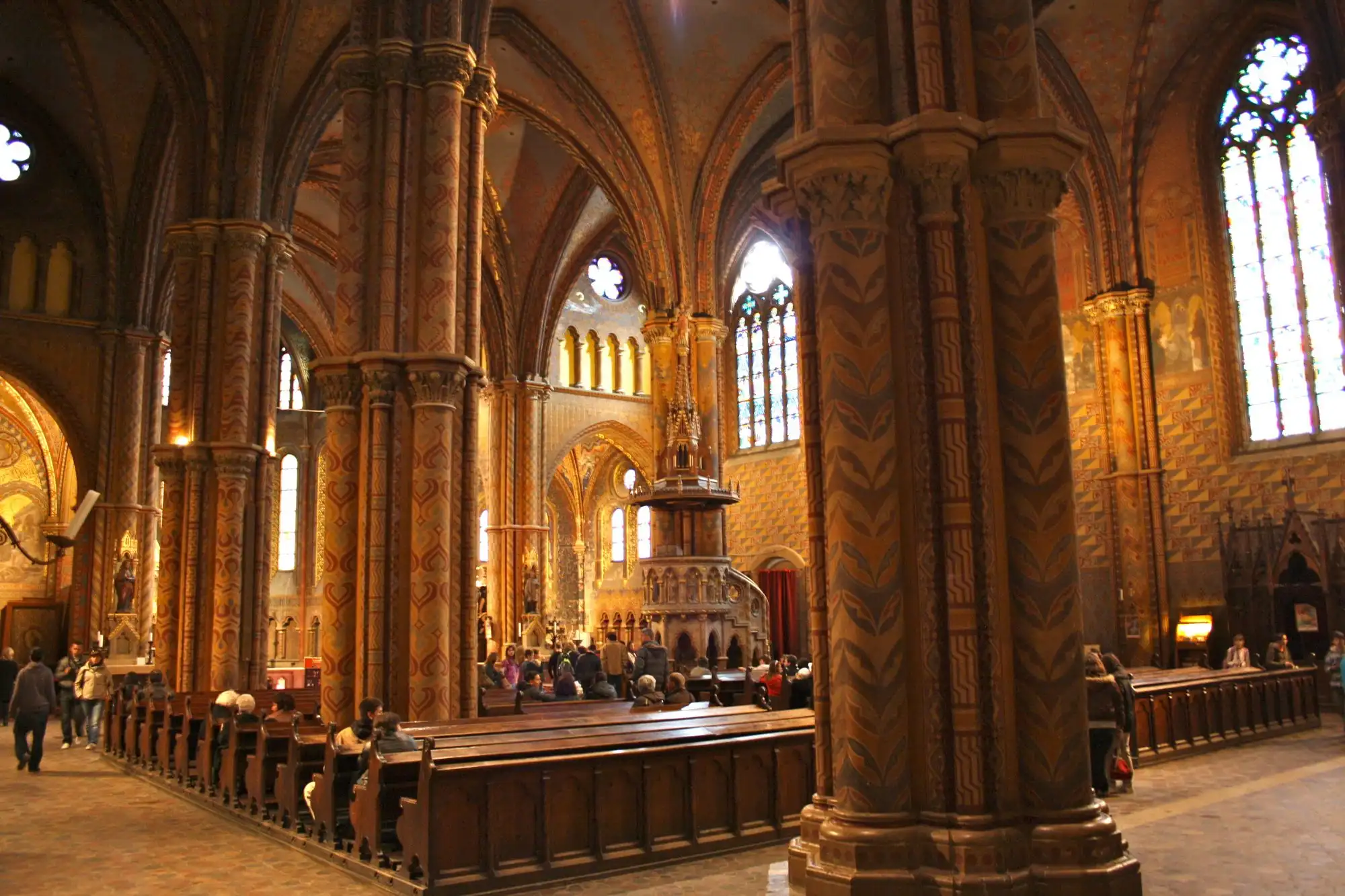
The interior is the most surprising part of the visit. Schulek’s restoration team, with the painters Bertalan Székely and Károly Lotz, covered every available surface with figures and pattern, working the remains of the medieval wall painting into a new scheme, and the coloured windows were made by Ede Kratzmann to their designs.
The result is far closer to a Hungarian fairytale palace than a typical Catholic parish church; some visitors find it overwhelming, others can’t stop photographing.
Look at the pillars first, each one painted differently, then up at the vaults. The keystone where the nave meets the crossing is an eight-petalled rose, the symbol of Mary, to whom the church is dedicated. The altars are Schulek’s too, assembled from Romanesque and Gothic elements.
It is dark inside on a dull day. Give your eyes a minute before you start, and use flash if you want to, because the church allows it in the nave and the chapels.
Walk up to the main altar
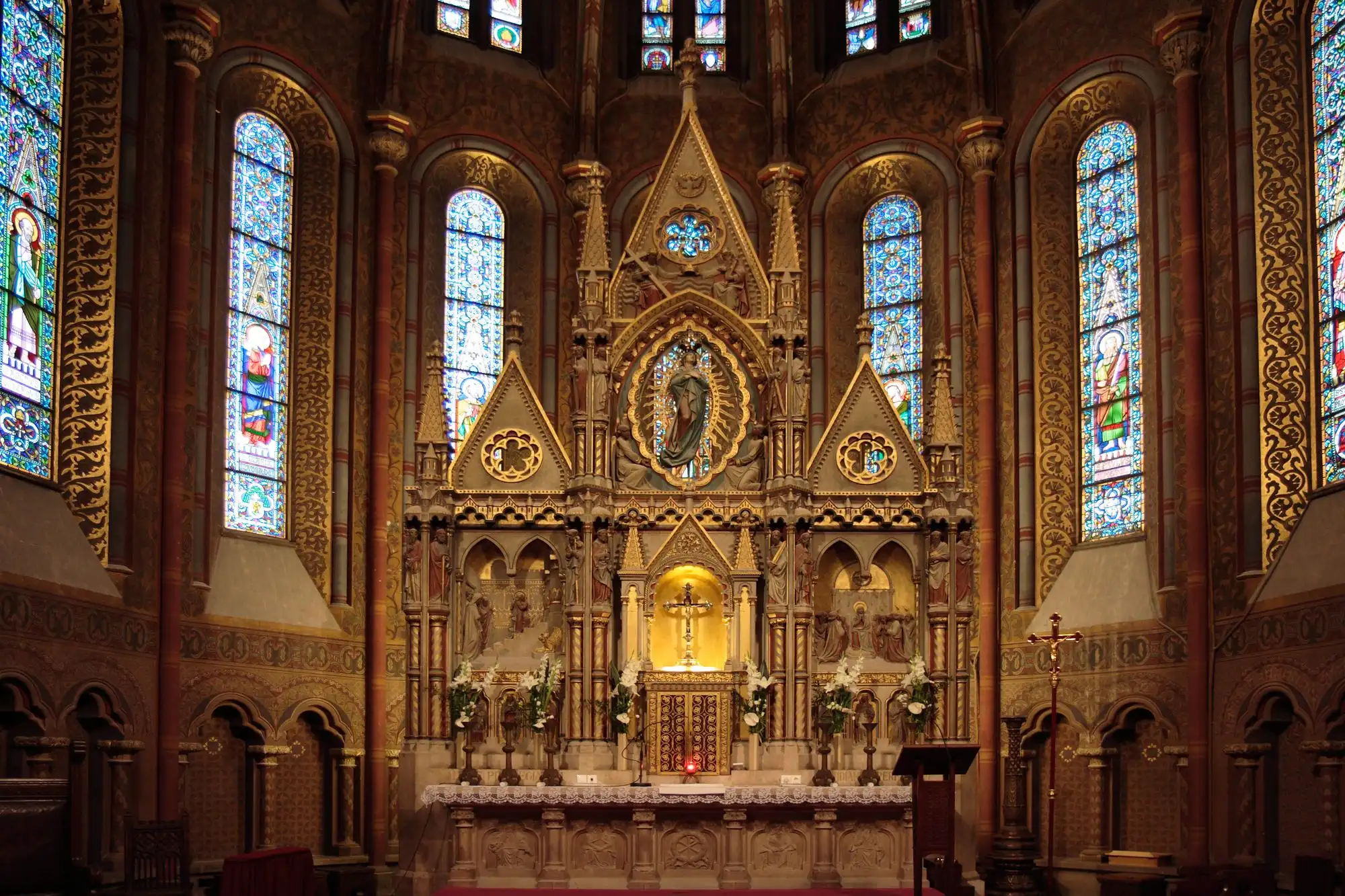
Schulek threw out the Baroque high altar and designed a new one in the manner of the early Gothic. The figure at its centre is the Virgin, and the crown she wears is a replica of the Holy Crown of Hungary, blessed by John Paul II and carried from Rome to Buda on foot by members of the parish, who crowned the statue with it on 15 August 2000.
To the left of the chancel, in the north side-chancel, Károly Lotz painted scenes from the life of St László, and above that altar is a copy of the king’s head reliquary kept at Győr. The royal oratory, where the coronation parties sat, opens onto the chancel from the same side; you reach it from the museum route upstairs.
This is the photograph everyone takes, so come here first if you arrive at opening time.
Find the tomb of Béla III
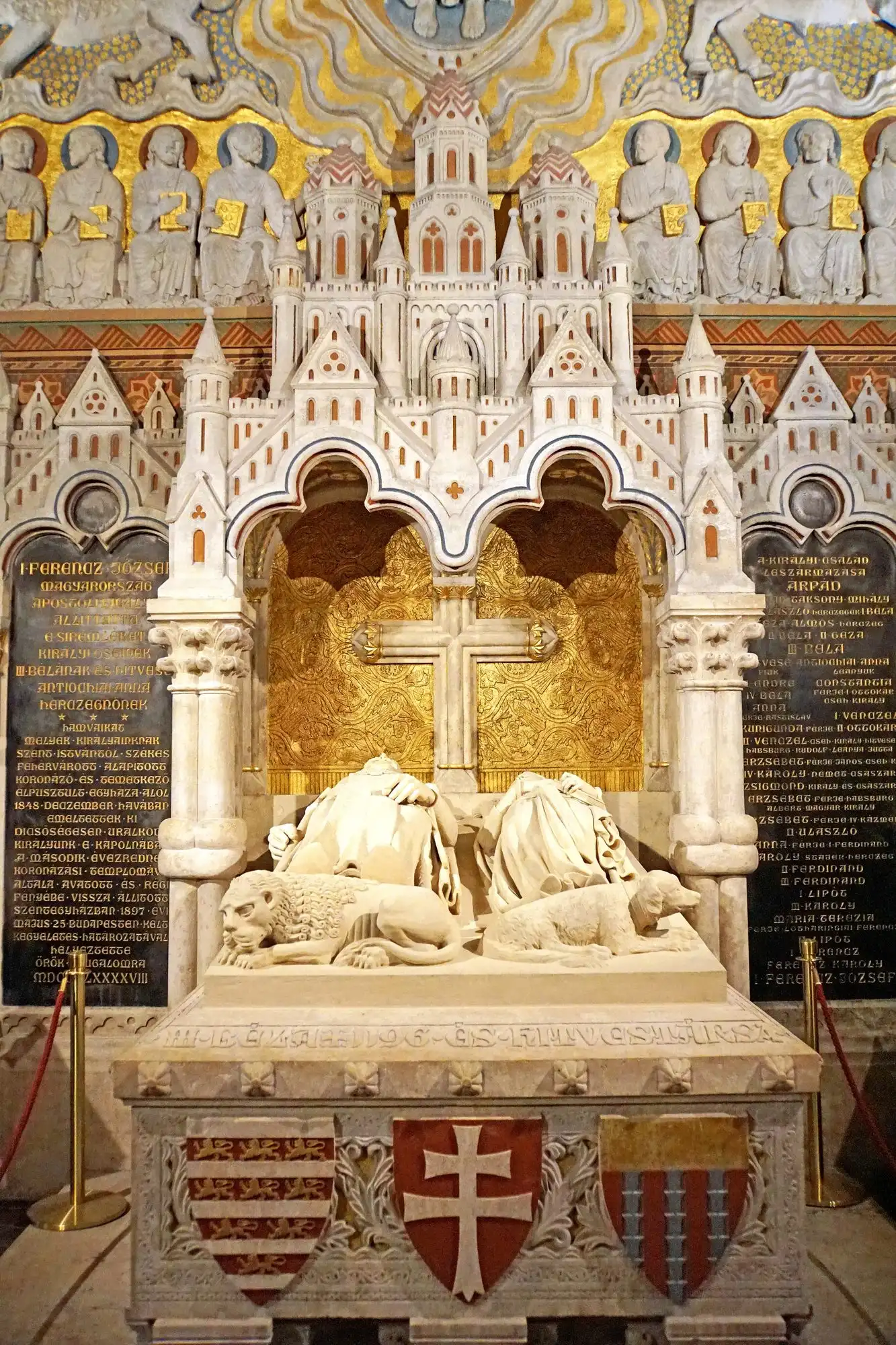
The chapels run along the north side of the church, and the second one from the main door holds the grave of King Béla III and his wife Anne of Antioch.
Their remains were found in 1848 among the ruins of the royal basilica at Székesfehérvár, and in 1898, two years after the restored church was consecrated, they were reburied here in a canopied double sarcophagus that Schulek designed and Ferenc Mikula and István Hausen carved.
The chapel before it, the first on the left as you come in, is the St Imre chapel, with an altarpiece of the prince’s life by Mihály Zichy and murals by Székely. The St Stephen chapel further along, Schulek’s own design with Székely’s scenes of the king’s life, is on the museum route.
Take the chapels slowly. The tomb is the one place in the building where the medieval kingdom is present in person rather than in paint.
Go up to the museum
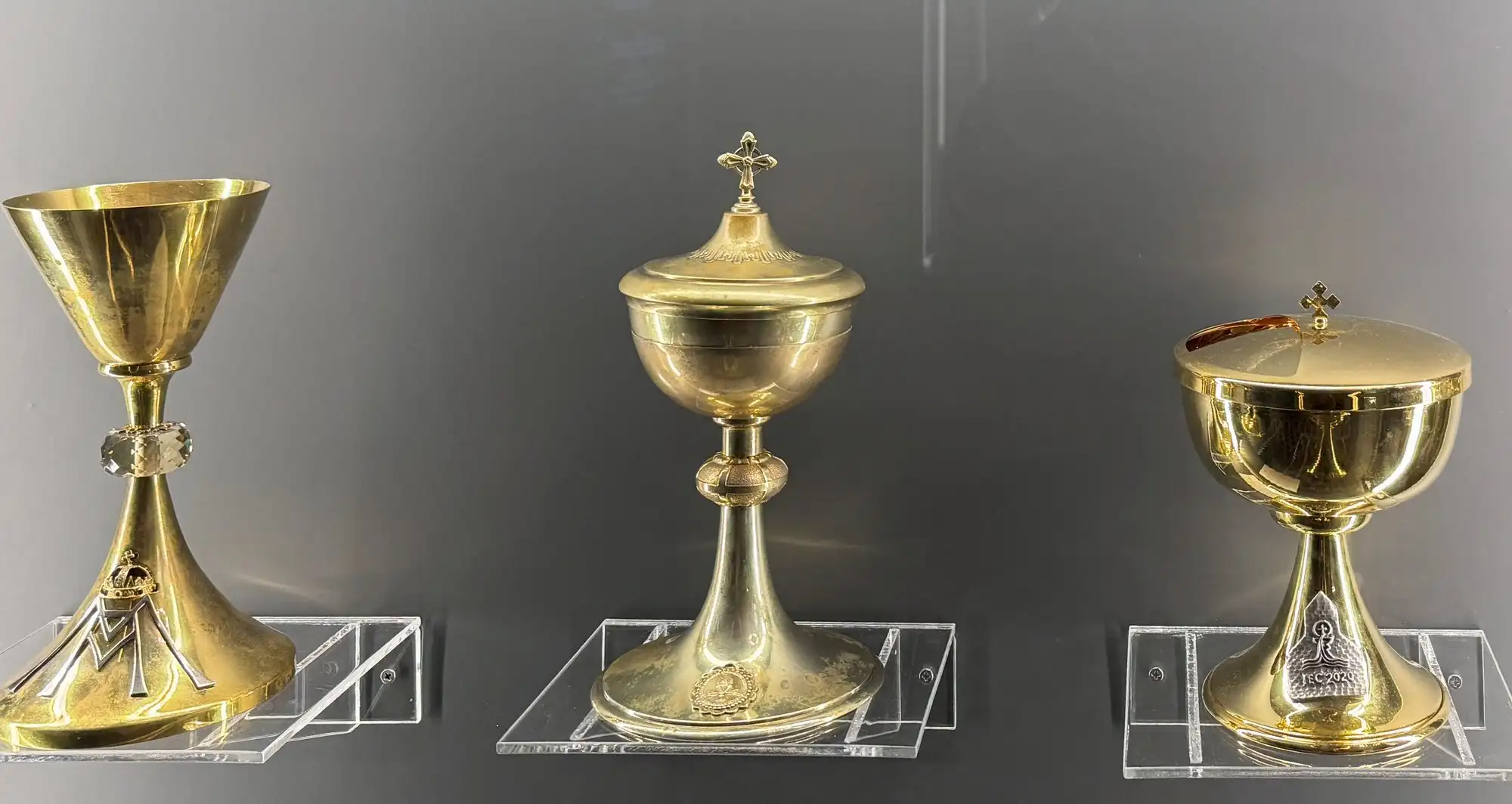
The church’s ecclesiastical art collection is included in the church ticket and is easy to miss, because the route to it starts with a staircase down.
From the south side-chancel you go into the crypt, where the church keeps original medieval stone fragments and a red marble sarcophagus holding bones from the royal tombs at Székesfehérvár, then climb the north stair to the St Stephen chapel, the royal oratory, the oratory of the Knights of Malta and the north gallery.
The rooms hold vestments, chalices and monstrances, among them robes worn at the 1867 coronation and the coronation chair of Charles IV and Zita, a 15th-century winged altar, and copies of the coronation regalia. From the gallery you get the interior from above, which is the best single view of the painted vaults.
Allow 20 minutes, and put the flash away up here, where it is not allowed.
Climb the tower
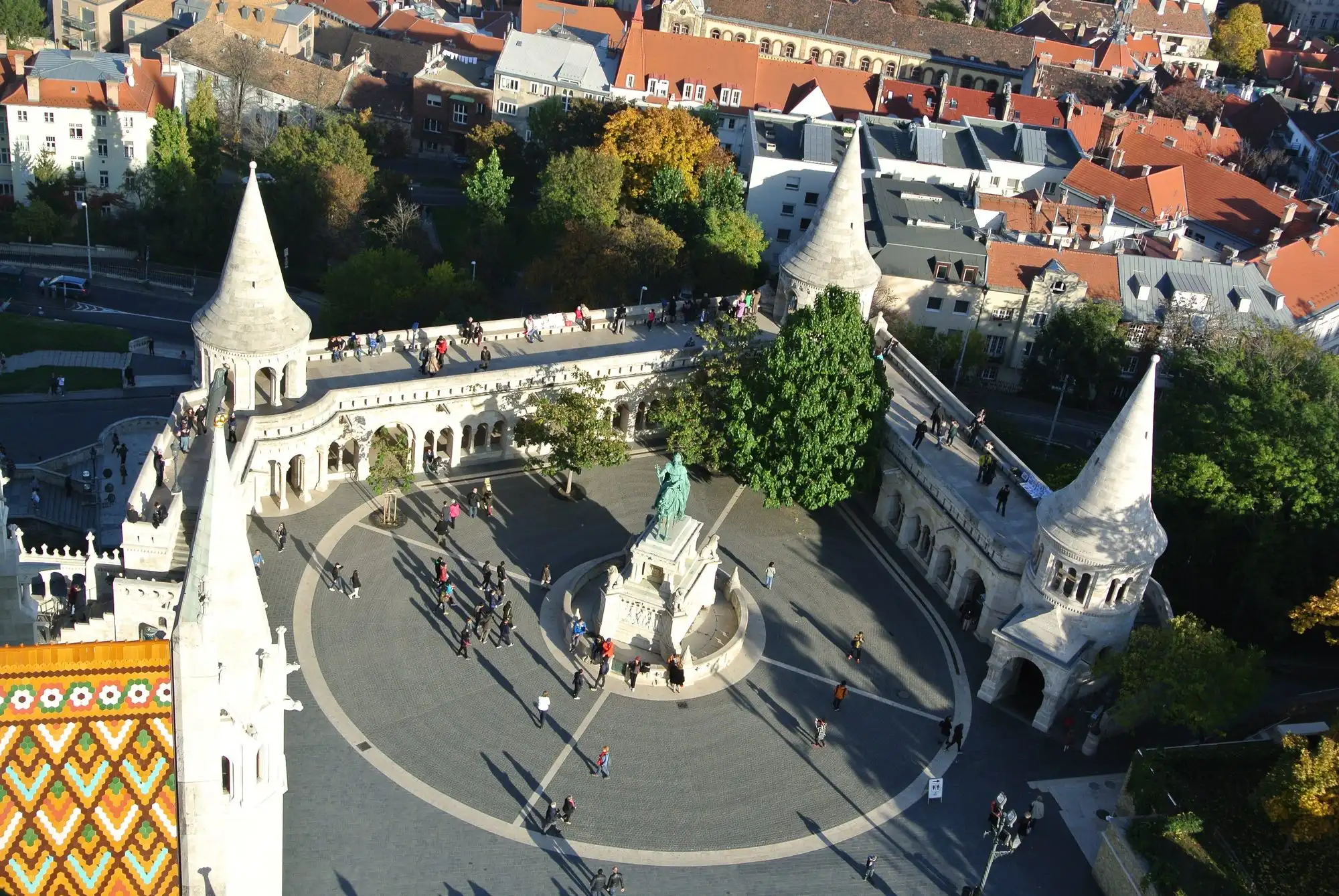
The bell tower climb is a separate ticket, sold only by the church, for a fixed half-hour slot. Groups are small, and the visit opens with a 10-minute guided introduction before 197 steps of spiral staircase take you up past the bells to the lookout level. The staircase is narrow enough that nobody passes, so everyone goes up and comes down together.
The reward is the view over the diamond-patterned roof tiles at arm’s length, Fisherman’s Bastion and its turrets directly below, and the Danube and the Parliament across the river. It is the closest look you will get at the roof.
Be at the entrance five minutes before the time on your ticket. If stairs are a problem, the free level of Fisherman’s Bastion gives you most of the same panorama from below.
See the roof and the spire from outside
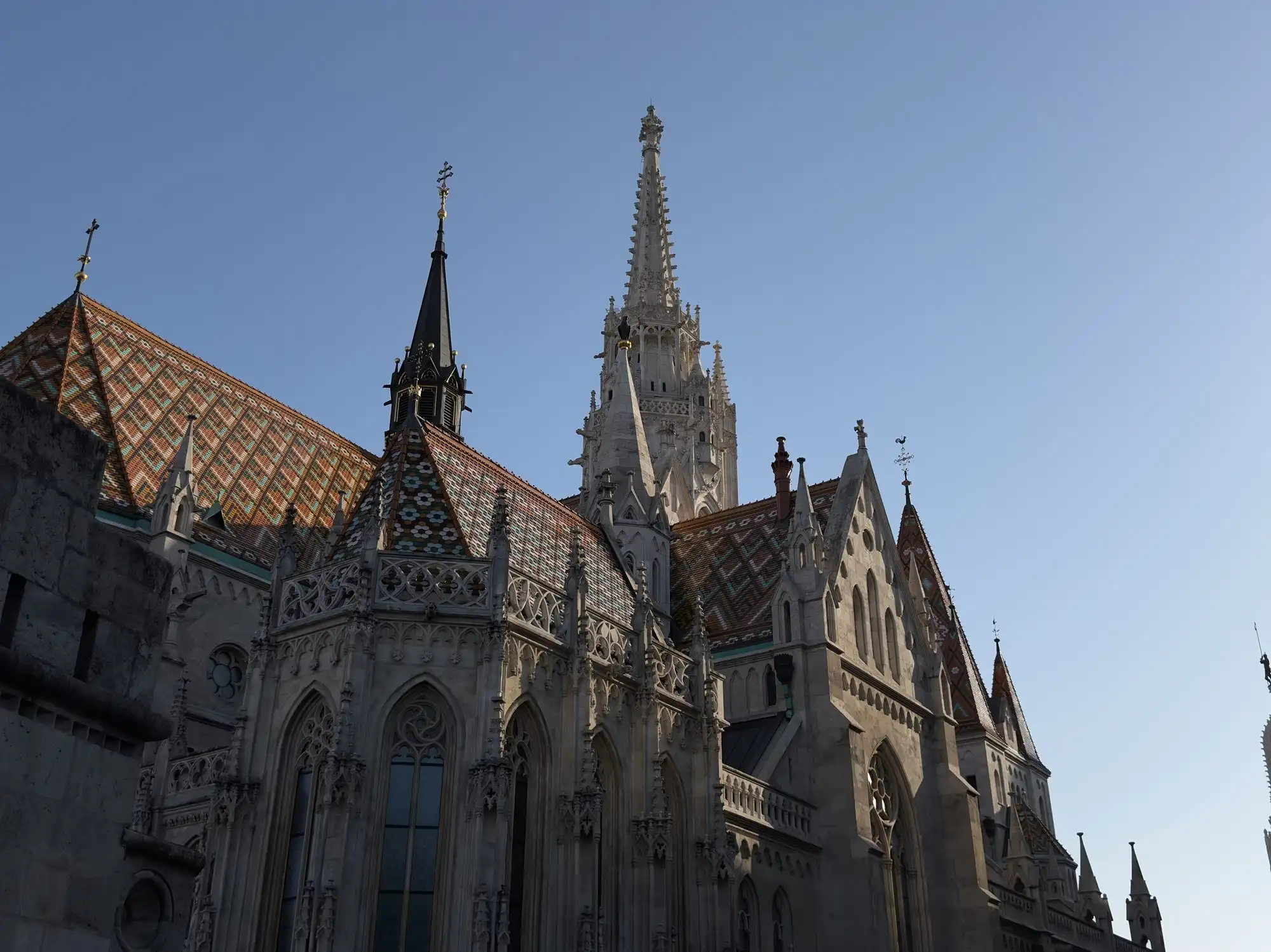
Step out into Szentháromság tér and look up. The roof is laid in glazed Zsolnay tiles in a diamond pattern, and the tall south tower, the Matthias Tower, is a restored copy of the one King Matthias built, topped by a lace-like stone spire that is Schulek’s own invention. The shorter Béla Tower on the north side is Schulek’s too, with a squat four-pinnacled cap in coloured glazed tiles.
Before you go in, look at the porch on the south side. The Mary Gate inside it, with the death of the Virgin carved in its tympanum, is early 15th century and one of the few medieval pieces of the church to survive Schulek.
The coat of arms of King Matthias, with its raven, is what gave the church its everyday name; the repainted original is on the wall inside by the stairs.
Best angles: from the arcades of Fisherman’s Bastion behind the church, and from the south-east corner of the square with the spire against the sky.
Insider tips
Go at 09:00 on a weekday
The first hour after opening is the calmest the church gets, and weekday mornings avoid the two things that spoil a visit here: weekend coach groups and Saturday weddings. Sunday is the one day it does not open in the morning at all.
Book the tower first, then fit the church around it
Tower slots are fixed and small, and the church is the only place that sells them. Pick your slot on the church’s website, then arrive early enough to see the church and the museum before or after it. The last tower slot is before the church closes.
Check Saturday’s hours before you set off
The church’s website shows the hours for the day you pick. On Saturdays in summer they were often cut to the morning, or split around an afternoon ceremony, and people who arrive after lunch find the door barred. Plan a Saturday visit for the morning and you will not be caught out.
Hear the choir at Sunday High Mass
The church’s own choir and orchestra, one of the oldest musical ensembles in Hungary, sing the 10:00 Latin High Mass on Sundays. Mass needs no ticket, and anyone is welcome to attend. It is a service, not a sightseeing slot, so sit, stay for the whole thing and keep the camera away; sightseeing opens at 13:15.
Photograph the roof from the Bastion
Fisherman’s Bastion sits immediately behind the church and gives the cleanest angle on the diamond-tile roof and the spire. The arcades are free; the upper lookout, with its turret windows, needs a ticket in the daytime. Our Fisherman’s Bastion guide has the free hours.
Nearby attractions
Matthias Church anchors the Castle District, and everything else on the hill is a short walk away on the level.
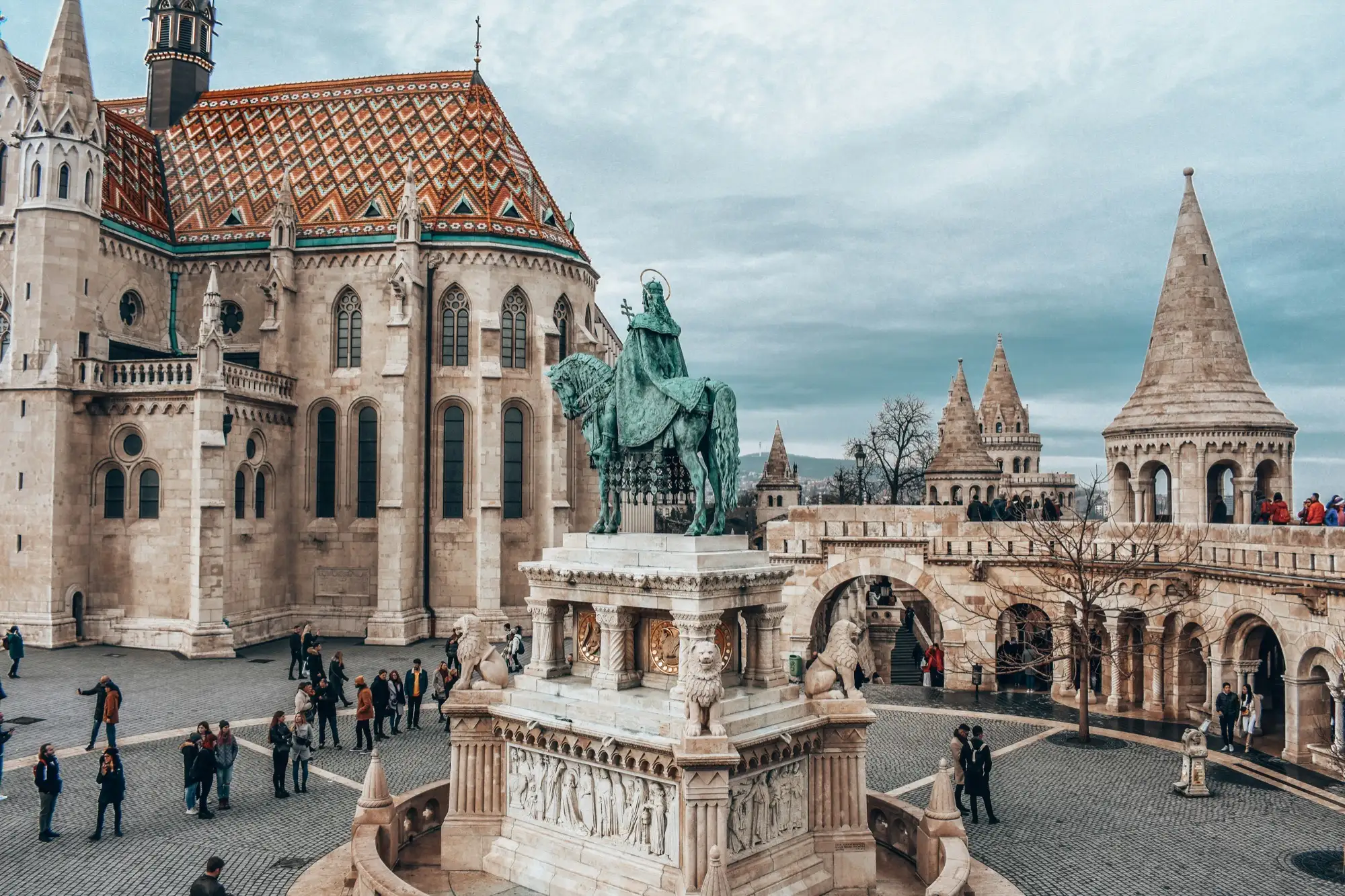
Fisherman's Bastion
Immediately behind the church. Schulek’s Neo-Romanesque lookout, with the Parliament view.
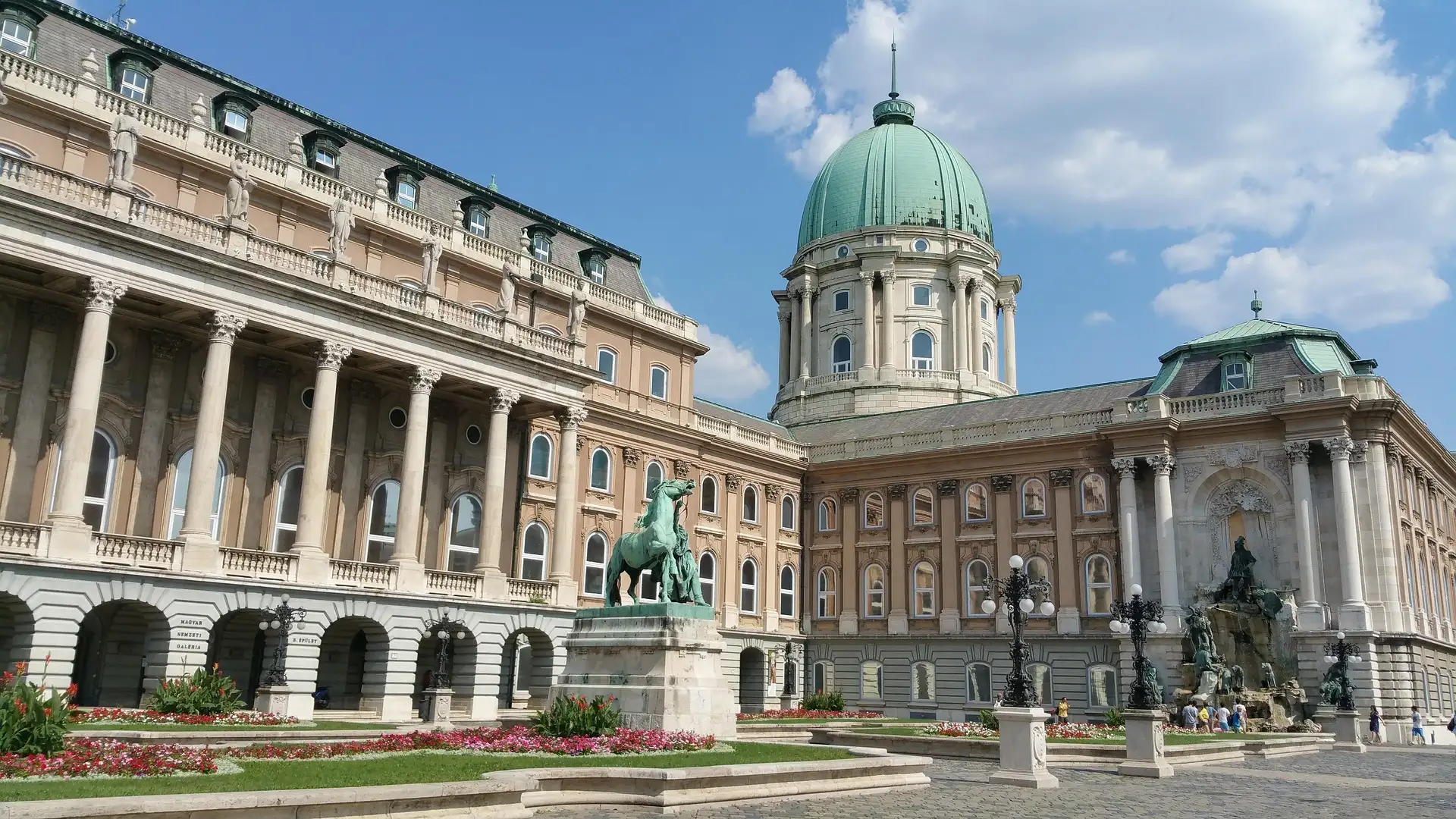
Buda Castle
About 13 minutes south on foot along the top of the hill. The Royal Palace and its courtyards.
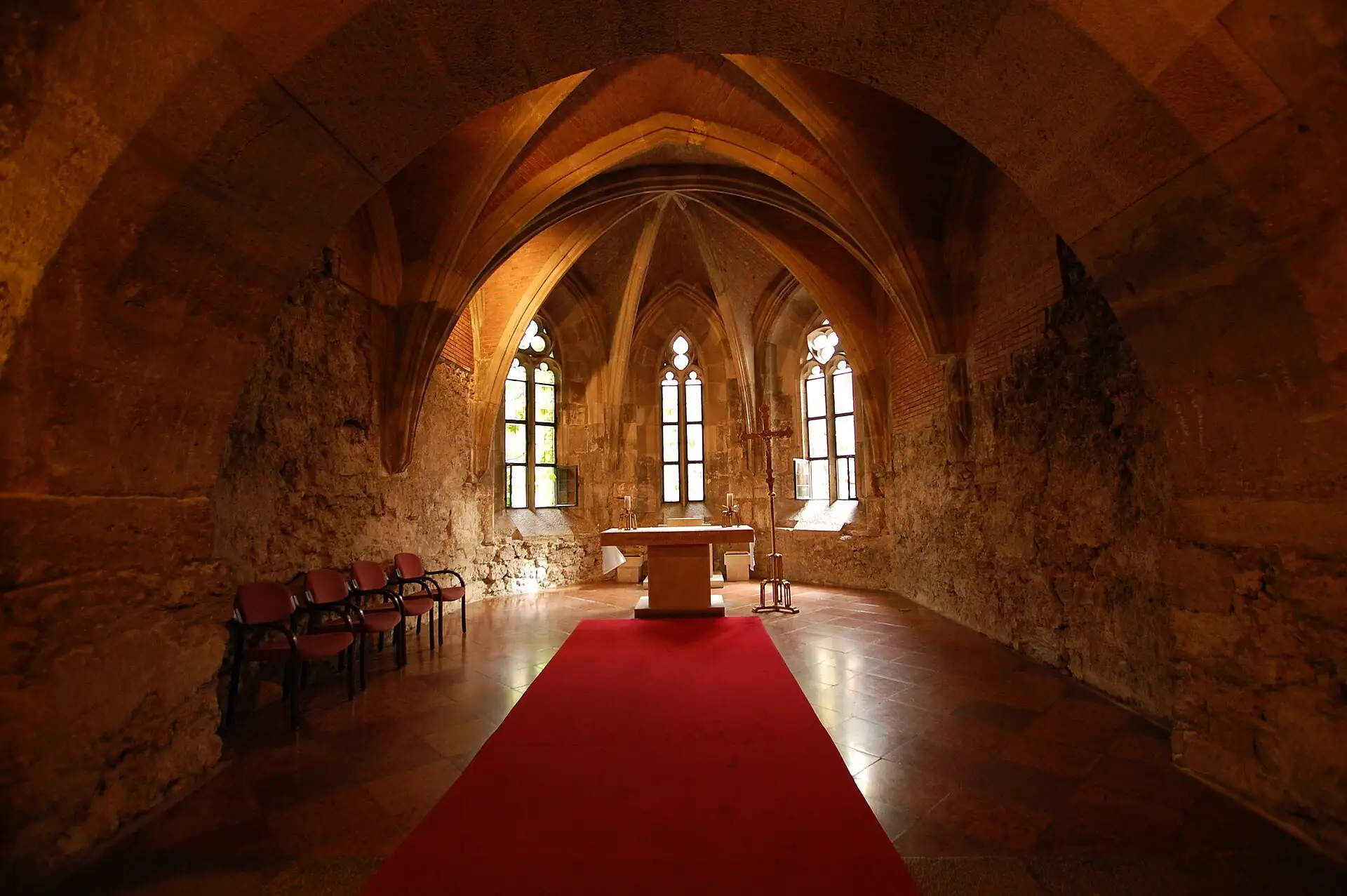
Budapest History Museum
About 14 minutes south on foot, inside the Royal Palace. The medieval palace excavations and the city’s own history.
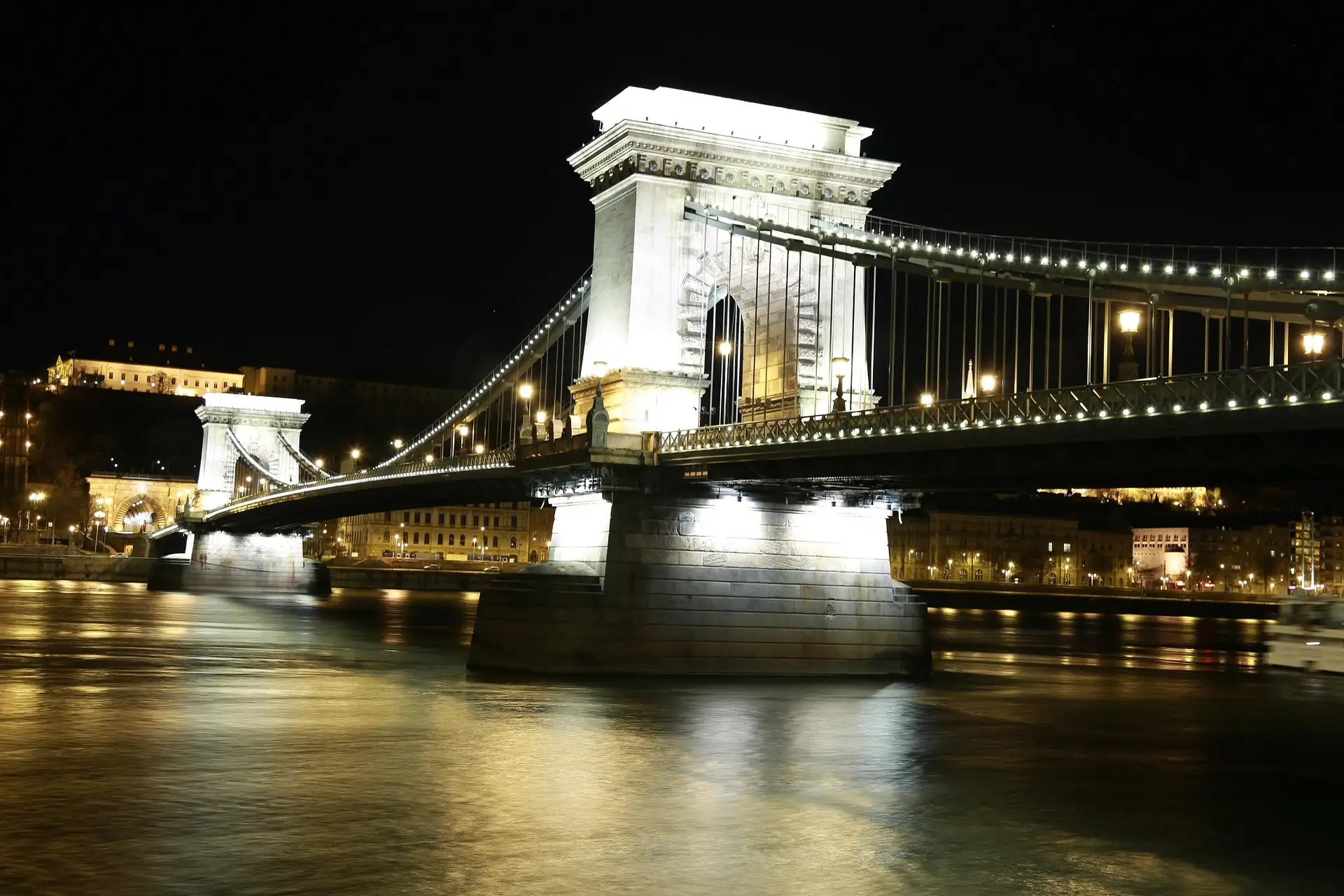
Széchenyi Chain Bridge
About 10 minutes’ walk down to the foot of the hill, by the funicular’s lower station. The walk across to Pest starts here.
Did you know?
- Nobody called it Matthias Church until the 19th century. The name caught on after King Matthias’s coat of arms of 1470, with its raven, was found on the tower. The church has always been dedicated to the Virgin, as the Church of the Assumption of Buda Castle.
- When Suleiman took Buda in 1541 he had the altars and pews cleared out and said his Friday prayer here, making the point that the city was his. It stayed a mosque for 145 years.
- The building you see is almost all Schulek. He judged the 13th-century fragments the most valuable, demolished late medieval, Turkish and Baroque work alike, had most of the carved stones lifted out and recut, and reworked the rest to his own design.
- In July 1994 a bomb went off at the east entrance to the crypt. The repairs were paid for by public donations.
- The church has six bells. Four were cast in 2010 and 2011 to join the two historic ones.
History
The church has been rebuilt more often than most, and the Schulek restoration of 1874 to 1896 is the one you see. Under it lie a 13th-century parish church, a 15th-century hall church, a Turkish mosque and a Jesuit Baroque church.
- 1247
First mention
A charter of the Veszprém chapter records the church under construction; the church dates its foundation, by King Béla IV, to 1246.
- 1384
The south tower collapses
The tower falls during Mass on 14 February. Nobody is hurt, and the whole church is rebuilt as a hall church over the following decades.
- 1470
Matthias’s tower
The rebuilt south tower is finished and King Matthias has his coat of arms set on it. He is married here twice, in 1463 and 1476.
- 1541
Buda falls to the Ottomans
The main church of the city becomes a mosque, and stays one until Buda is retaken on 2 September 1686.
- 1867
Coronation of Franz Joseph and Elisabeth
On 8 June the emperor and empress are crowned king and queen of Hungary here, and Liszt’s Coronation Mass is heard for the first time.
- 1896
Schulek’s church consecrated
After a restoration begun in 1874, Frigyes Schulek’s reinvention of the church is consecrated on 15 August, in the Millennium year.
- 1916
The last coronation
Charles IV and Zita are crowned on 30 December, the last king and queen of Hungary.
- 1944 to 1945
The siege of Budapest
The roof burns and the southern vaults partly collapse. Restoration runs from 1954 into the 1970s, and a full refurbishment follows in 2004 to 2013.