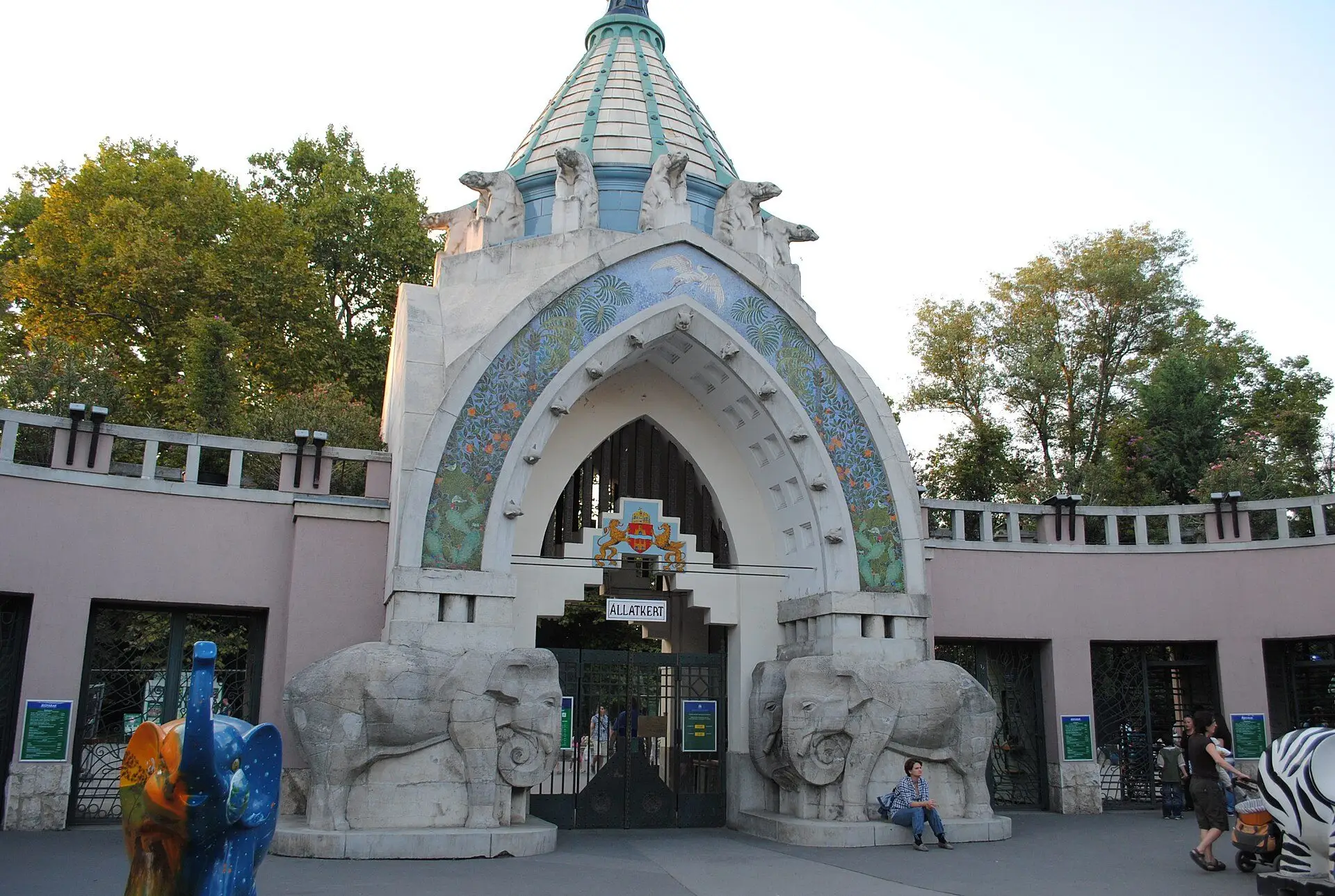
Budapest Zoo was founded in 1864 by a private company, because the city of the day was in no position to pay for one itself, and it opened to the public at noon on Thursday, 9 August 1866. It is one of the oldest zoos in the world and the first in Hungary, and it has never moved.
Almost nothing of the first fifty years survives. The zoo the founders built went bankrupt, the city bought it, and between 1909 and 1912 it was knocked down and rebuilt as the Art Nouveau park visitors photograph today.
At a glance
Timeline
- 1864
Founded by a private company
Four founders, among them the zoologist, ethnographer and traveller János Xántus, set up a company to build a zoo, because urbanisation had not gone far enough for the state or the city to take it on.
- 9 Aug 1866
Opened to the public
The gates open at noon on a Thursday with about six hundred animals from around a hundred species. The favourite is Kristóf the brown bear. Leopold Fitzinger, the first director, resigns almost at once and Xántus takes over.
- 1873
Tightrope walkers and fire-eaters
Director Károly Serák brings in variety acts to draw a crowd. The zoo also stages the ethnographic shows of the period, and William Cody’s Wild West show appears.
- 1893
The first hippopotamus
Jónás arrives. A Sumatran rhinoceros follows in 1894, in time for the millennium celebrations held in City Park.
- 1907
Bankruptcy and the city takeover
The operating company fails. Interior Minister Gyula Andrássy Jr. asks the city to take the zoo on, and the city decides on an entirely new zoo on the old site.
- 1909 to 1912
Closed and rebuilt
The rebuild that produced the Main Gate, the Elephant House, the Palm House, the artificial rocks and Hungary’s first public aquarium. The zoo reopens on 20 May 1912.
- 1914 to 1918
Open through the war
The zoo stays open for the whole of the First World War, although its keepers are conscripted.
- 1929 to 1941
Herbert Nadler's renovations
One animal house or exhibit is renovated a year, the African mixed-species enclosure is built, and Csaba Anghi begins the studbooks and the early work on zoo nutrition.
- 1944 to 1945
The siege
The front passes over the zoo. Two dozen of its 2,500 animals survive, most of the buildings are rubble, and it reopens on 1 May 1945 with fewer than a hundred animals.
- 1956
Anghi returns
Csaba Anghi comes back as director in March. The war damage is finally repaired and the zoo is modernised for its centenary in 1966.
- 1994
Persányi and the reconstruction
Miklós Persányi is appointed. The listed houses are restored through the 1990s, and the Elephant House reopens in 1999.
- 2014
The funfair land comes back
The closed Vidámpark site next door is handed to the zoo, and the Biodome is planned for it. The shell is finished in 2020.
- 1 July 2026
The Urban Oasis opens
The first hectare of the Biodome takes visitors, and the zoo turns 160 the following month.
Key facts
- Founded
- 1864
- Opened
- Noon, 9 August 1866
- Best-known founder
- János Xántus
- Rebuilt
- 1909 to 1912, reopened 20 May 1912
- Main Gate and Elephant House
- Neuschloss Kornél
- Palm House and Great Rock
- Végh Gyula
- Size
- About 11 hectares
- Membership
- EAZA accredited, WAZA member
Who built the animal houses
The rebuild of 1909 to 1912 was shared out among several architects, which is why the buildings look related without looking the same.
- The Main Gate and the Elephant House are by Neuschloss Kornél. The Elephant House is the Zsolnay pyrogranite and coloured glass one, and it is the building most often credited to the wrong architect
- The Palm House and the Great Rock are by Végh Gyula, the Palm House with Räde Károly, Ilsemann Keresztély and Lendl Adolf
- The former Bird House, now the Australia House, is by Kós Károly and Zrumeczky Dezső, who between them produced sixteen pavilions here
- The Owl Castle was rebuilt on the lines of the first houses by Antal Szkalnitzky and Henrik Koch Jr.
- The Xantus House is post-war, finished in 1955 by the FŐTERV collective
The history of Budapest Zoo
A zoo built by a company, because the city could not
The founders set up a private company to do it. Their own reasoning was that urbanisation in Pest had not gone far enough for the state or the city to support public goals of this kind, so four men took it on themselves.
The best known of them is János Xántus, zoologist, ethnographer, traveller and soldier. The first animal houses were designed by Antal Szkalnitzky and Henrik Koch Jr., the paths and the layout by Ferenc Reitter and the planting by Ármin Petz. Leopold Fitzinger was made the first director and resigned almost immediately, leaving Xántus in charge.
Opening day was noon on Thursday, 9 August 1866. Visitors saw about six hundred animals from around a hundred species, and the one they came back for was Kristóf the brown bear. Lions and elephants arrived in the 1870s.
The sideshow decades, and the shows the zoo now owns up to
From 1873 the director Károly Serák set about filling the place. He added tightrope walkers, fire-eaters and sword-swallowers, and the zoo took the ethnographic shows that European zoos of the period traded in. William Cody, better known as Buffalo Bill, brought his Wild West show here, and groups of Lapps, Samoyeds, Sioux, Sinhalese and Dahomeyans were put on display.
People were put on display in the zoos of that era, and this was one of them. The zoo says so plainly in its own history, and explains it by an age that had no television and no other way of seeing the rest of the world.
The collection grew alongside the spectacle. The first hippopotamus, Jónás, arrived in 1893, and a Sumatran rhinoceros in 1894, bought for the millennium celebrations that filled City Park.
Bankruptcy, Adolf Lendl, and the rebuild of 1909 to 1912
The company went bankrupt in 1907. Interior Minister Gyula Andrássy Jr. asked the capital to take the zoo over, and the city, having looked at what it had bought, decided not to repair it but to build an entirely new zoo on the same ground.
The man who shaped it was Adolf Lendl. He argued that a zoo should show a broad cross-section of biodiversity rather than the most popular mammals and birds, that it should include the other vertebrates and the invertebrates too, and that the same logic applied to plants.
From that point the institution was a botanical park as well, which is where the second half of its name comes from. He also thought a zoo should keep farm animals and old domestic breeds, which it still does.
The zoo closed for the works. Most of the historic buildings a visitor sees today went up between 1909 and 1912, including the Main Gate, the Elephant House, the Palm House and the artificial rocks, along with Hungary’s first public aquarium, which showed marine animals as well as freshwater ones. The rebuilt zoo reopened on 20 May 1912.
Two wars, and two dozen animals
The zoo stayed open through the First World War, and went on improving through the 1930s under Herbert Nadler, a house or an exhibit renovated every year. The African mixed-species enclosure came out of that run of work, and Csaba Anghi began the studbooks and the first work on zoo nutrition.
The Second World War ended all of it. By the time the front had passed over the grounds at the end of the winter of 1944 to 1945, only two dozen of the original 2,500 animals were alive and most of the buildings were rubble.
It reopened on 1 May 1945 with fewer than a hundred animals, and the park was ploughed up to grow fodder for them. The Stalinist years brought their own indignity, when the party appointed a shoemaker to run the place. Anghi returned as director in March 1956, the war damage was at last repaired, and the zoo was modernised in time for its centenary in 1966.
The land it lost, and the land it got back
Of the 18 hectares set aside for the zoo in 1864, pieces were taken away again and again for a circus, an amusement park and a restaurant, until by the 1950s it was down to 10.8 hectares. That is the reason a zoo of this age is not larger.
The comprehensive reconstruction began in the mid-1990s, after Miklós Persányi was appointed in 1994, restoring the listed houses to their original state while the enclosures behind them were modernised. The Elephant House reopened in 1999 and its restoration was given a Europa Nostra gold medal the following year.
Then the land came back. The old Vidámpark amusement park next door closed and its site was handed to the zoo in 2014, and the Biodome was designed for it. The shell was completed in 2020 and then stood waiting, and the first hectare inside it, the Urban Oasis, opened to visitors on 1 July 2026, a month before the zoo’s 160th anniversary.
Did you know?
A founder became a character in a Western
János Xántus travelled and collected in North America before he helped found the zoo, and he is said to be the model Karl May used for Old Shatterhand.
Budapest hosted the third bison congress
The zoo was one of the first to join the International Society for Bison Protection, and it held the society’s third congress in 1927.
The keepers' families kept it running in 1914
When the keepers were conscripted in the First World War, their wives and children took over the work and the zoo stayed open throughout.
Konrad Lorenz and Joy Adamson came to see it
Both the founder of modern animal behaviour studies and the author of Born Free are among the visitors the zoo records.
Visiting today
The clearest way to read the history on the ground is to look at the dates of the buildings rather than the animals in them. The gatehouse, the Elephant House, the Palm House and the Great Rock are all from the same four years, the Xantus House is post-war, and the Biodome is the land that came back in 2014 finally being used.