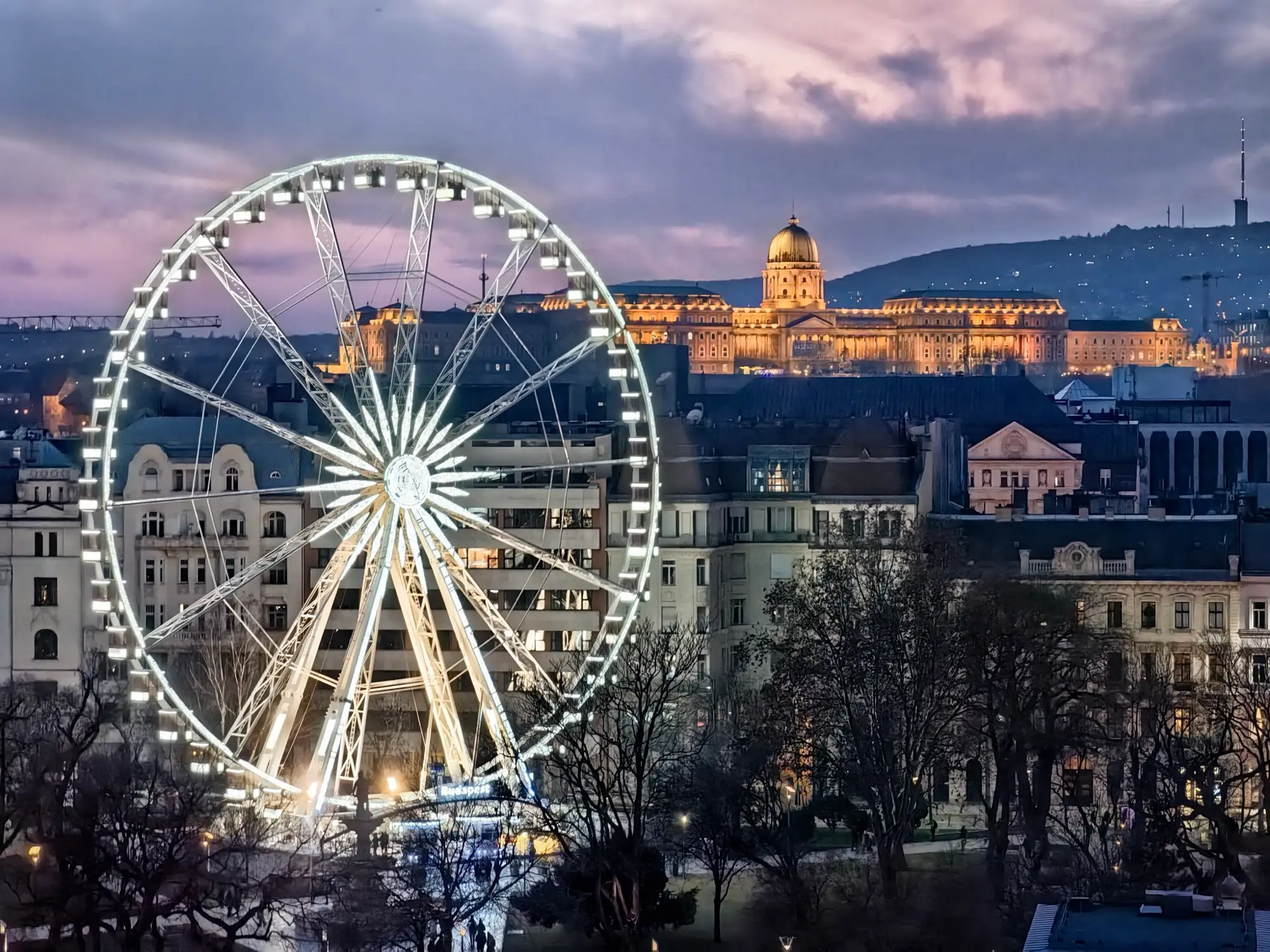
The Budapest Eye is the white wheel standing over Erzsébet tér, 65 metres tall, lit up after dark and turning every day of the year. The operator trades as the Ferris Wheel of Budapest and the wheel was christened the Sziget Eye when it first went up on the square in 2013, but Budapest Eye is the name that stuck.
A ticket buys three full turns in an enclosed cabin, about eight minutes in all, shared with whoever is next in the queue. The operator sells the tickets itself, and buying online books a voucher rather than a time. This page covers how entry actually works, what you can pick out from the top, and when the ride is worth doing.
- Visit length
- About 8 minutes, plus the queue
- Entry
- Ticket, one ride of three turns
- Book ahead
- No need, and it saves no time
- Opening hours
- Mon to Thu 11:00 to 23:00, Fri to Sat 11:00 to 24:00, Sun 11:00 to 23:00
- Best time
- After dark, or at sunset
- Nearest stop
- Metro M1/M2/M3 Deák Ferenc térAbout 4 minutes across the square, at the far end of Erzsébet tér
- Accessibility
- A wheelchair cabin, and a level platform
- Under 14s
- Must be with an adult
- Cabins
- Shared, 4 to 6 people
Budapest Eye tickets
Tickets come from the wheel’s own operator, sold online and at the kiosk under the wheel. There are five, and age separates most of them: a standard ticket from 12 up, a little child ticket for 2 to 11 with proof of age, and a baby ticket for children under two.
The other two buy time rather than a different ride. A priority ticket has its own lane at the front of the queue, and a priority ticket with champagne adds ten minutes in the Priority Lounge and a glass poured as you board. There is no family ticket, no group rate and no student or senior rate.
Buying online does not book a slot. What arrives by email is a voucher, good for a month, that you swap for a ticket at the kiosk, and the ticket it becomes is valid only on the day you swap it. No date to choose, nothing to miss, and the same queue as everyone else unless you hold a priority ticket.
Highlights
Pest from 65 metres
The Basilica a few streets away, the Danube bridges to the west and Buda Castle on the skyline behind them, from the middle of the city rather than the edge of it.
A viewpoint that works in the rain
Cabins are glazed and air conditioned, which makes this one of the few Budapest views that is still pleasant in January or in the rain.
Three metro lines at the end of the square
Deák Ferenc tér, the only station where M1, M2 and M3 meet, is about four minutes’ walk away, so the wheel slots into a gap in the day.
Plan your visit
Opening hours
Open every day of the year from 11:00 until 23:00, and until midnight on Fridays and Saturdays, though high wind or a storm can stop the wheel at short notice.
Mon to Thu 11:00 to 23:00, Fri to Sat 11:00 to 24:00, Sun 11:00 to 23:00Our opening hours guide has when to reach the kiosk before closing, holidays, what happens when the wheel stops and the quietest times to go.
Getting there
The wheel stands at the north-east corner of Erzsébet tér, about four minutes’ walk from the Deák Ferenc tér interchange. Vörösmarty tér on the M1 is marginally closer if you are walking up from the pedestrian streets.
Nearest stops
By car: there is nowhere to stop, and nowhere to park on the square itself.
See our complete guide on how to get there for every line, the walks from nearby landmarks and the step-free route.
Before you go
- Children under 14 may only ride accompanied by an adult, and a child who turns up without one can be turned away at the platform
- Pushchairs do not go on. Prams, pushchairs and children’s bikes are banned from the platform and the cabins, and are left empty in the operator’s camera-monitored parking area
- Dogs stay on the ground, apart from guide dogs and police dogs
- No food, drink, bottles or glasses are allowed on board, and there is no smoking. The champagne package is the operator’s own exception, poured for you as you board
- The usual weapons and fireworks list is banned from the site, along with paint and marker pens. Clothes and shoes are compulsory
- Photographs and video for yourself are fine. Filming for commercial use needs the operator’s written permission
- If the wheel stops mid-turn, stay in the cabin and wait for instructions. Every cabin has a telephone for reaching the operator
Accessibility
This is one of the easier viewpoints in the city to use.
- Boarding is onto a level platform. There are no steps between the square and the cabin
- There is a larger cabin for wheelchair users. Ask at the kiosk when you buy
- What is not published: how many wheelchair cabins there are, whether one can be reserved ahead, and whether the Priority Lounge is step-free. If your visit depends on any of that, ring the operator on +36 70 636 0629 or email info@oriaskerek.com
- Guide dogs are allowed on the wheel
- Deák Ferenc tér has a lift at one entrance, but the station as a whole is not step-free. Our getting there guide has the detail
What to see and do
Know what the ride gives you
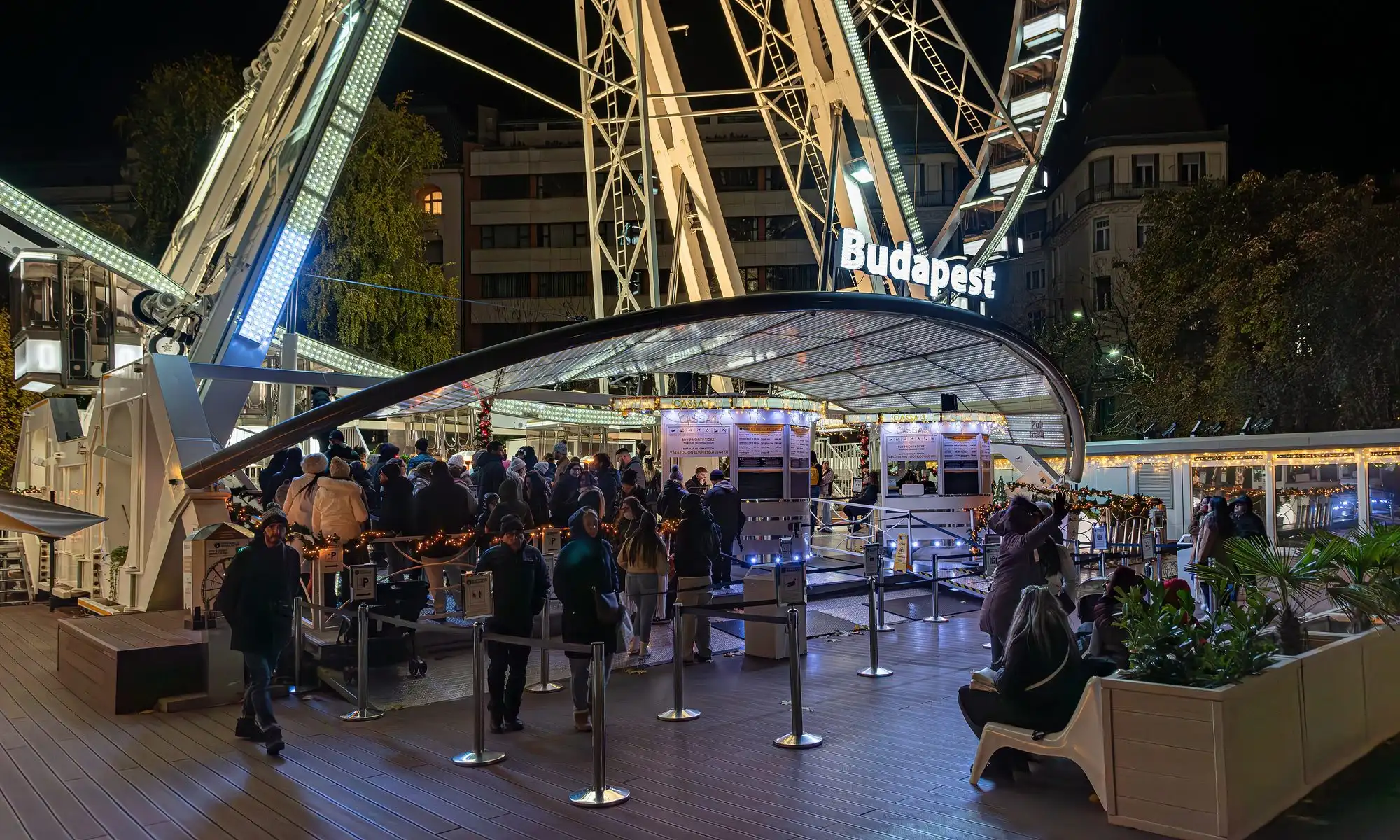
Three full turns, about eight minutes, and then you are back on the platform. That is the number worth knowing before you queue, because the wheel looks like a half-hour attraction and is not one.
Cabins are fully enclosed, glazed and air conditioned, and hold four to six people. The operator fills them from the queue and will not hold one for a couple, so a cabin to yourselves means buying four tickets. Weight, not seats, is what limits the load.
The enclosure is the reason to keep this one in reserve for bad weather. Budapest’s free viewpoints are all out in the open, and this one keeps you dry on a wet evening.
Pick out your landmarks at the top
At 65 metres you are lower than Gellért Hill and much closer to what you are looking at, which is the trade this wheel makes. St Stephen’s Basilica is the nearest landmark, its dome a few streets north. Look west for the Danube, the Széchenyi Chain Bridge across it and Buda Castle above the far bank, with the Hungarian Parliament just over a kilometre away to the north-west.
The time of day changes what you get. After dark the city is a field of lights and very little detail; in daylight you can name the buildings one by one. Sunset splits the difference, and it is when we would join the queue.
The honest verdict: Budapest gives away better views for nothing from Gellért Hill and Fisherman’s Bastion. The wheel earns its ticket in cold or wet weather, late in the evening when the free viewpoints are unlit and the city is not, for anyone who cannot manage steps, and when you have twenty minutes to fill in the middle of Pest.
Give the square ten minutes underneath
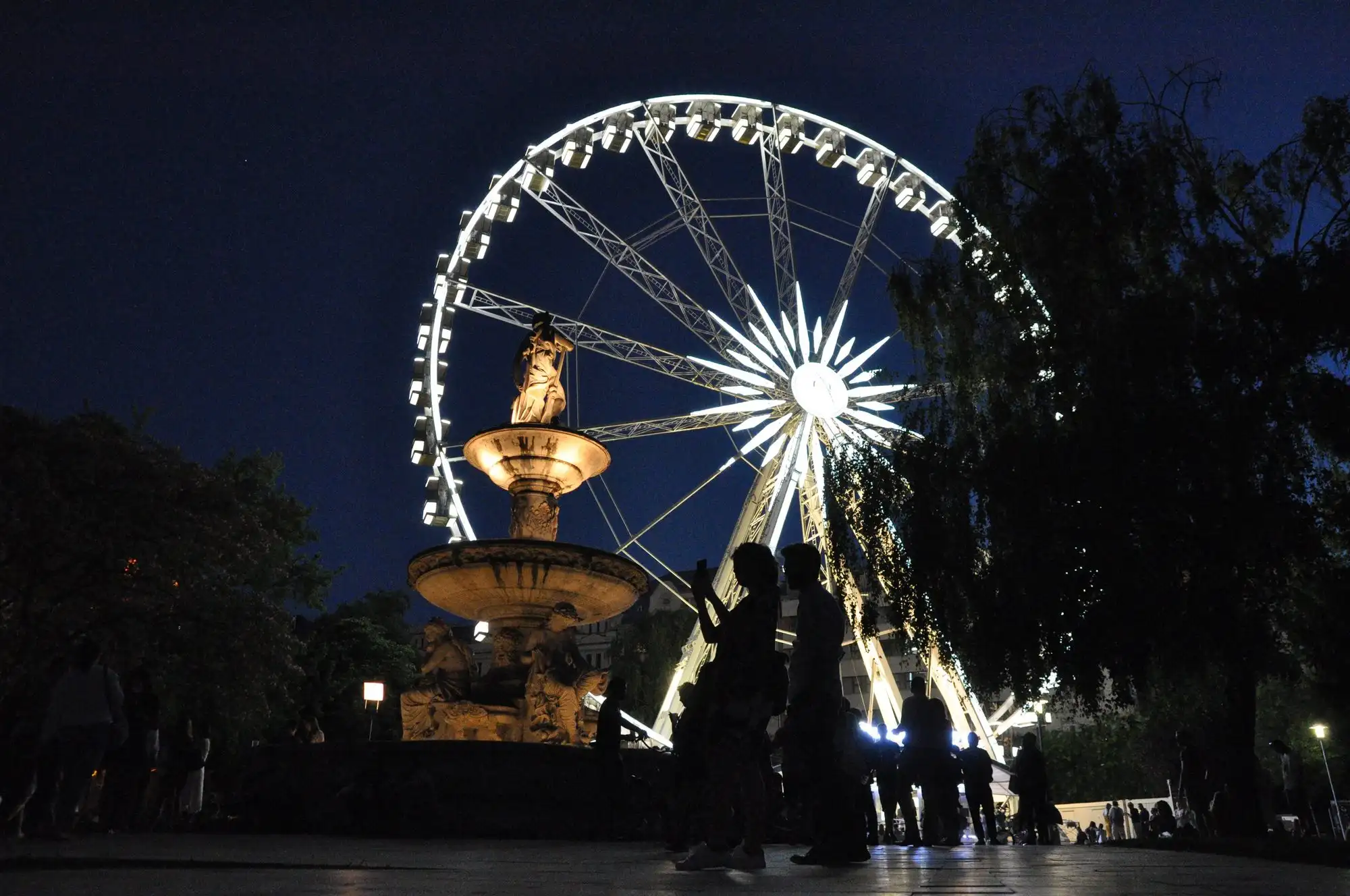
Erzsébet tér is a laid-out park square with lawns and benches, and the wheel takes up one corner of it rather than the whole thing. The set piece is the Danubius Fountain: Danubius on top with the Tisza, the Dráva and the Száva below him, designed by Miklós Ybl with figures by Leó Fessler, handed over on Kálvin tér in 1883 and moved here in 1958.
That makes it the work of the architect who rebuilt the Basilica up the road, and it is far and away the best foreground for a photograph of the wheel. The Akvárium Klub, a concert venue with three halls, is on the same square at number 12.
If you are here after dark, walk round to the fountain side before you join the queue. Ten minutes and a photograph is about right, and it is the one part of the visit that costs nothing.
Insider tips
Euros work at the window
The kiosk takes cash in euros as well as forints, along with cards. That is unusual in Budapest, where most places want forints, and it saves a trip to a cash machine on the day you arrive.
Buy priority only for a timed evening
The wheel turns continuously and the queue moves at the speed of the cabins. A priority ticket is worth it when you have a table booked or a concert to get to on a busy summer evening, and not otherwise.
Walk in from Vörösmarty tér
Coming from Váci utca or the river side, keep going north from Vörösmarty tér and cross the square on the diagonal. The wheel rises over the trees the whole way, which beats arriving under it from the metro exit.
Nearby attractions
The wheel sits in the middle of everything on the Pest side, with four major sights inside a fifteen-minute walk.
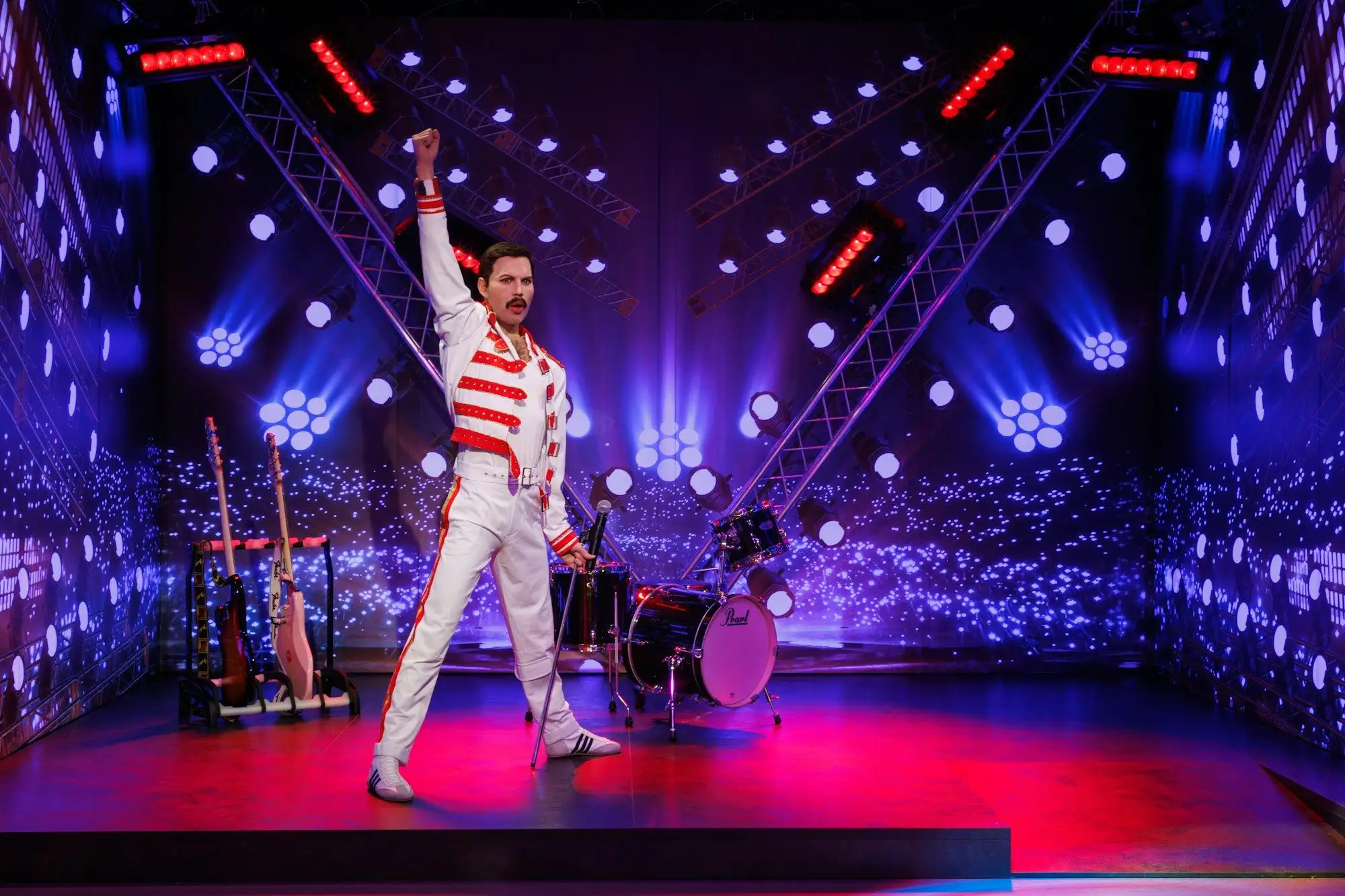
Madame Tussauds Budapest
About 6 minutes west on foot, in Palazzo Dorottya on Dorottya utca.
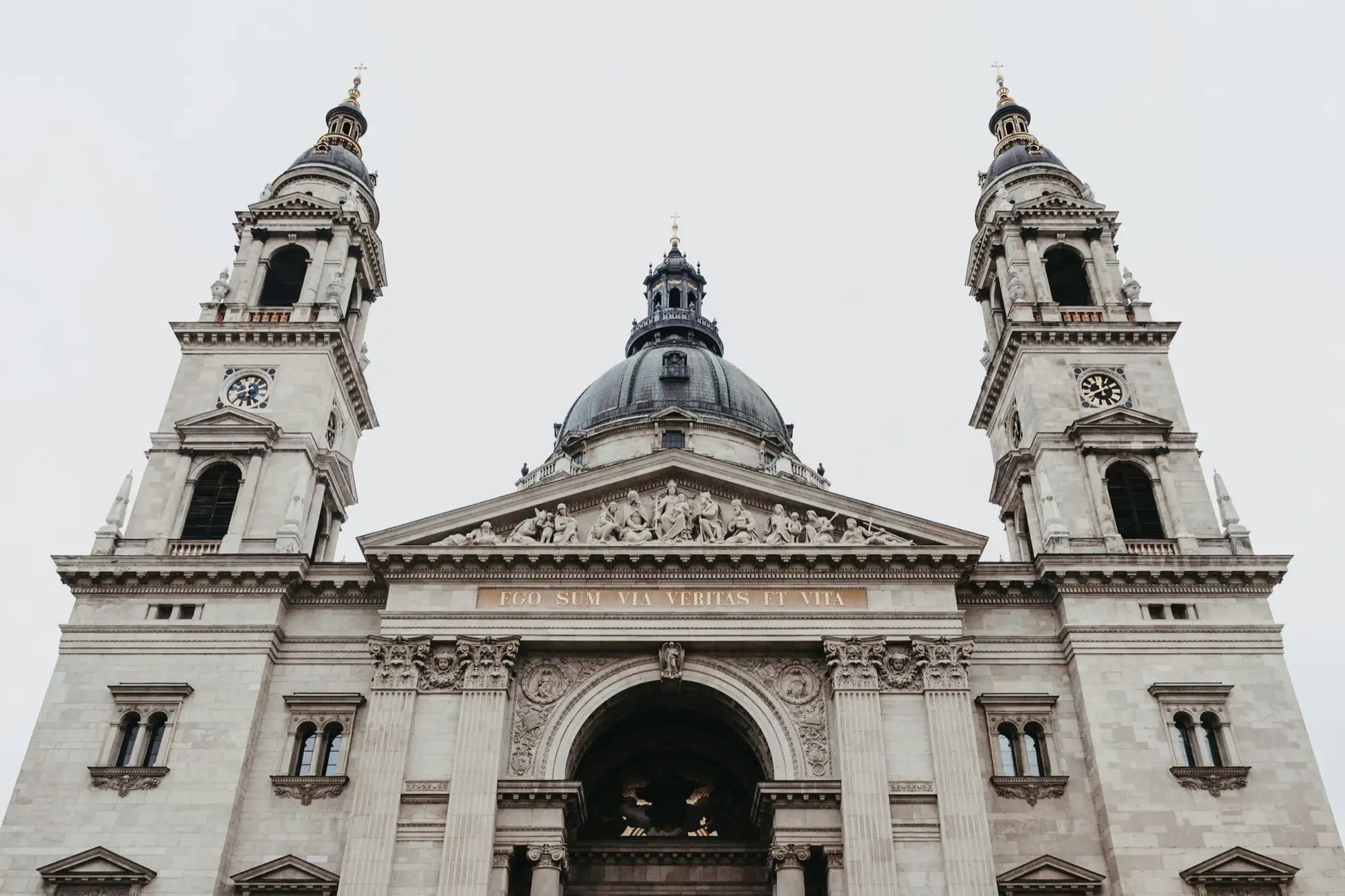
St. Stephen's Basilica
About 7 minutes north on foot, up Bajcsy-Zsilinszky út.
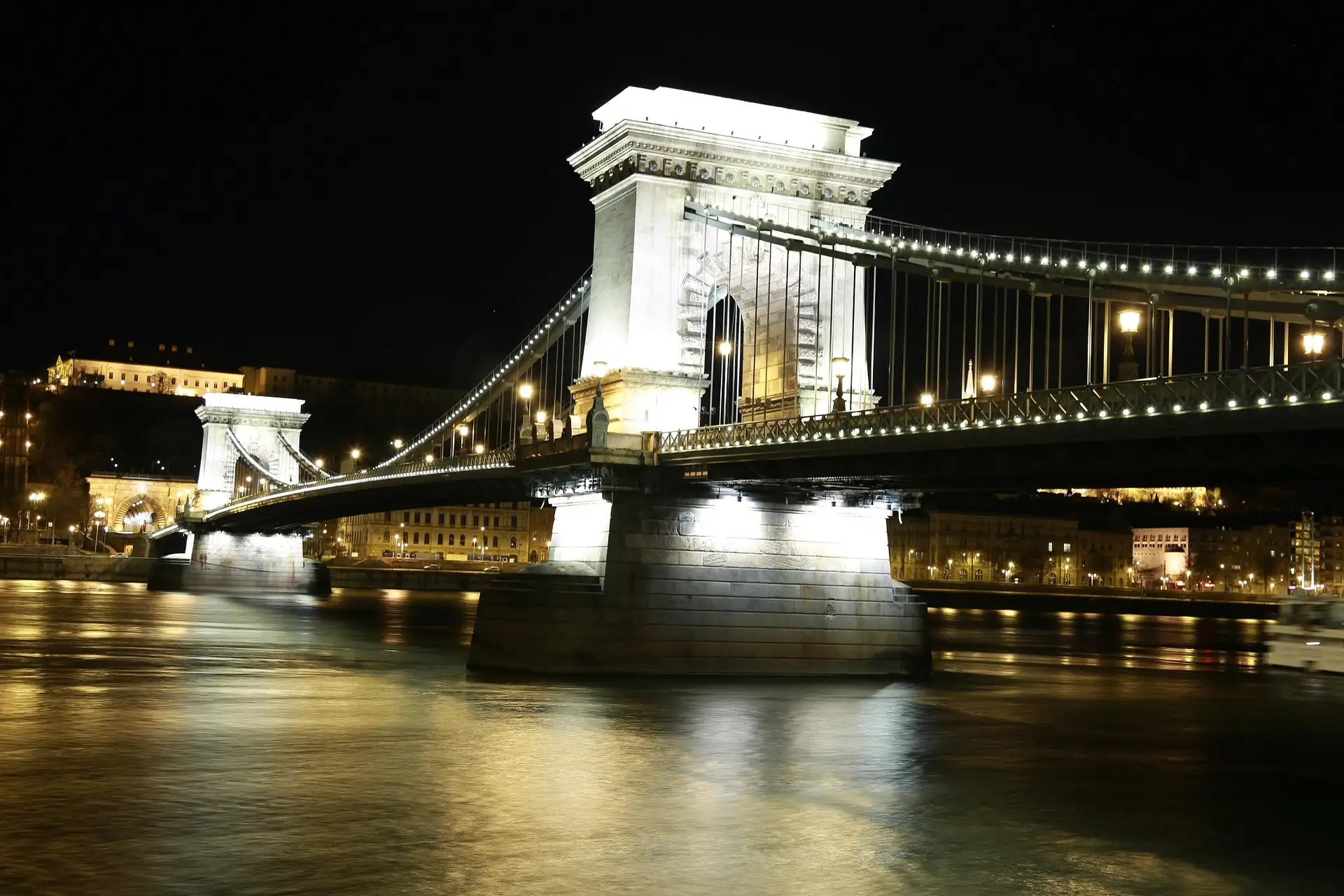
Széchenyi Chain Bridge
About 9 minutes west on foot, at the Pest end of the bridge.
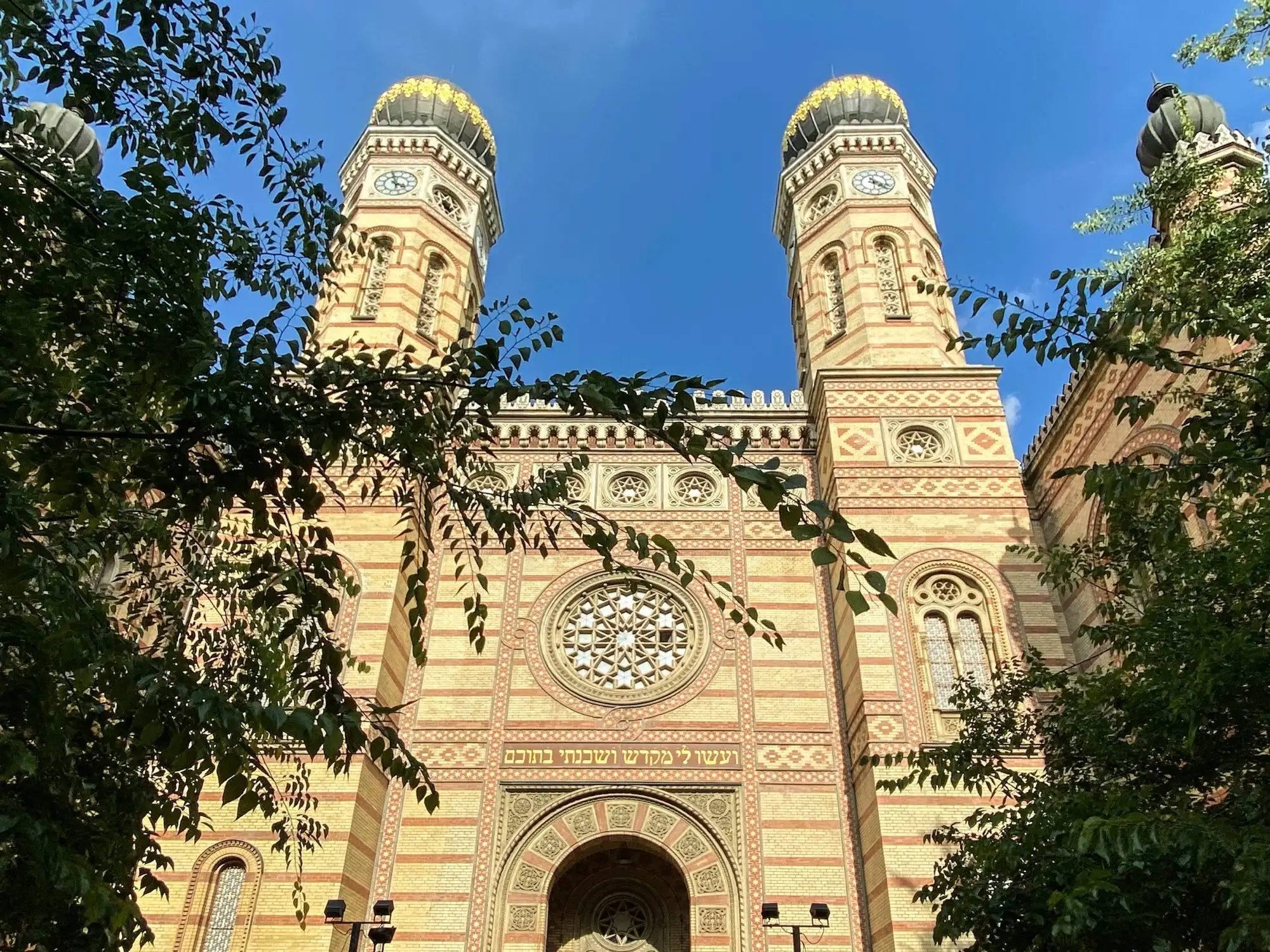
Dohány Street Synagogue
About 11 minutes south-east on foot, in the old Jewish quarter.
A short history of the Budapest Eye
The wheel is a Sziget Festival idea that moved into town. It went up on Erzsébet tér for six weeks in 2013, came and went for a few seasons after that, and has turned there all year round since 2017. It has never been a permanent structure. The machine is transportable, and the company that runs it rents it.
- 2012
A wheel on the festival site
The organisers of the Sziget Festival put up a ferris wheel on Óbuda Island, out at the festival rather than in the city.
- 7 May 2013
The permit, after an argument
The city’s public space committee votes the wheel onto Erzsébet tér. The finance ministry had objected twice over, on environmental grounds and over the balance between entertainment and rest on a public square.
- June 2013
Six weeks as the Sziget Eye
The wheel starts turning on 2 June, opens officially on 7 June under the name Sziget Eye, runs until 22 July and is then taken to the festival island for August.
- May 2014
Rebuilt on a rebuilt square
It returns to the middle of the renewed square, to the same specification and from the same manufacturer, brought in on 24 containers and put up by 15 people in eight days.
- March 2017
Turning all year
The wheel goes back up for good, running from 15 March and, for the first time, through the winter as well. This is the year it became the fixture visitors know.
- 2024
Three million riders
The operator counts more than three million riders since 2013 and says it would rather own a wheel than rent the Belgian one it runs, given a few years and the money to build one.