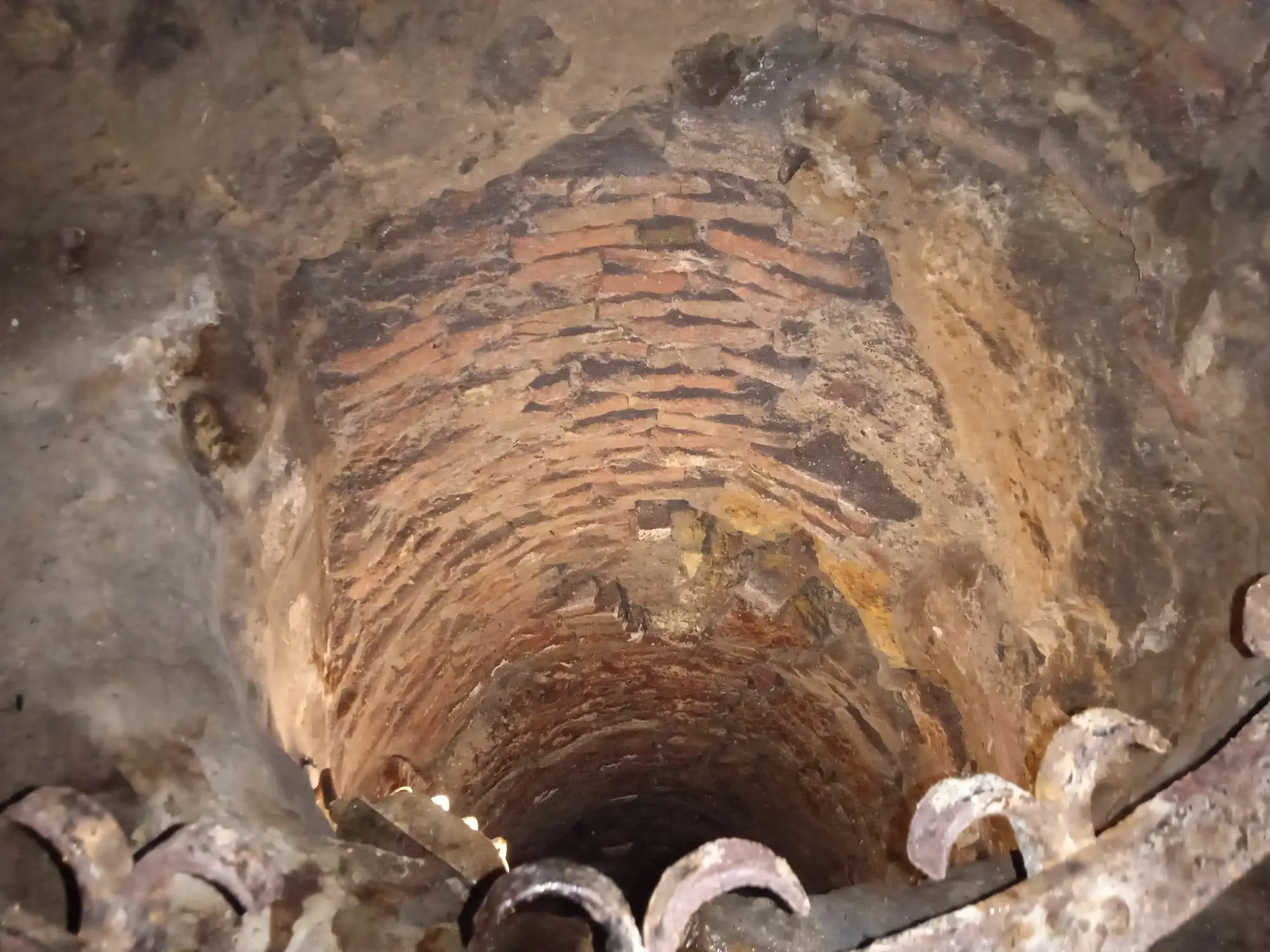
Castle Hill is a slab of travertine, and travertine is what hot springs leave behind. The water that built the hill also ate holes in it, and for eight hundred years the people living on top have been finding those holes, widening them and putting them to use.
What that produced is not one cave but a layered system of 3.3 kilometres: cellars built under houses, passages part cut and part found, and natural hollows below them. It has been a water supply, a wine store, a prison, an air-raid shelter, a military labyrinth, a nuclear bunker and a museum, usually several of those at once.
At a glance
Three short tabs: the dates in order, the figures worth knowing, and the geologist who got the whole system surveyed.
Timeline
- Prehistory
Hot springs build the hill
Thermal water lays down the travertine of Castle Hill and leaves cavities in the rock.
- 13th to 15th centuries
Wells, cellars and vaults
Residents of Buda find the cavities while digging for water, widen them and join them up. The upper level’s roofs move from vaults on stone consoles in the 13th century to barrel vaults in the 14th and 15th. Wine and cold-sensitive food go in, and people shelter here during sieges and fires.
- 18th to 19th centuries
Decline
Winemaking falls away, the cellars lose their purpose, waste fills the deep levels and water works into the foundations of the houses above.
- 1882 to 1886
The first survey
The city’s engineering office surveys 120 rock cellars between Bécsi kapu tér and Dísz tér.
- 1897
The road falls in
A road collapses in Szentháromság tér. In 1904 a newspaper reports dangerous conditions under several Castle buildings.
- 1932 to 1936
Kadić's works
Repairs at last, under the geologist Ottokár Kadić and the Hungarian Caving Society, with archaeological and geological finds along the way.
- 1935
The first Cave Museum
It opens on 17 August under Szentháromság utca 2. Two more rooms follow in 1936, one of them the Bone Chamber.
- 1943
The army takes over
In May the City Council closes the museum. The sections under Szentháromság tér, Úri utca, Dísz tér and Országház utca are joined into a labyrinth of about four kilometres, and a hospital is cut between Szentháromság utca and Lovas út.
- 1945
The siege
Thousands of soldiers and civilians shelter underground while the Castle District above is fought over and destroyed.
- 1950s
The bunker years
The labyrinth is rebuilt as a modern air-raid shelter, with new drains, bathrooms and toilets. It is open to the public from 1961 to 1975.
- 1975
The deep cellars close
The deep cellar system shuts for want of money to keep it going.
- 1983
The Labyrinth opens
The southern section opens as the Buda Labyrinth, which is still a separate attraction with its own door.
- 1987
World Heritage listing
The Castle District, with the system running beneath it, is inscribed as part of Budapest’s World Heritage Site.
- 1997
The central section comes back
The part visited today is reconstructed and opens to guided groups only.
Key facts
- Length
- 3.3 km of cave system
- Rock
- Travertine, laid by hot springs
- Levels
- Three: built, part natural, natural
- Temperature
- 12°C all year
- First museum
- Opened 17 August 1935
- Wartime labyrinth
- About 4 km, joined from 1943
- Reconstructed
- Central section, 1997
- World Heritage
- Castle District, listed 1987
Ottokár Kadić
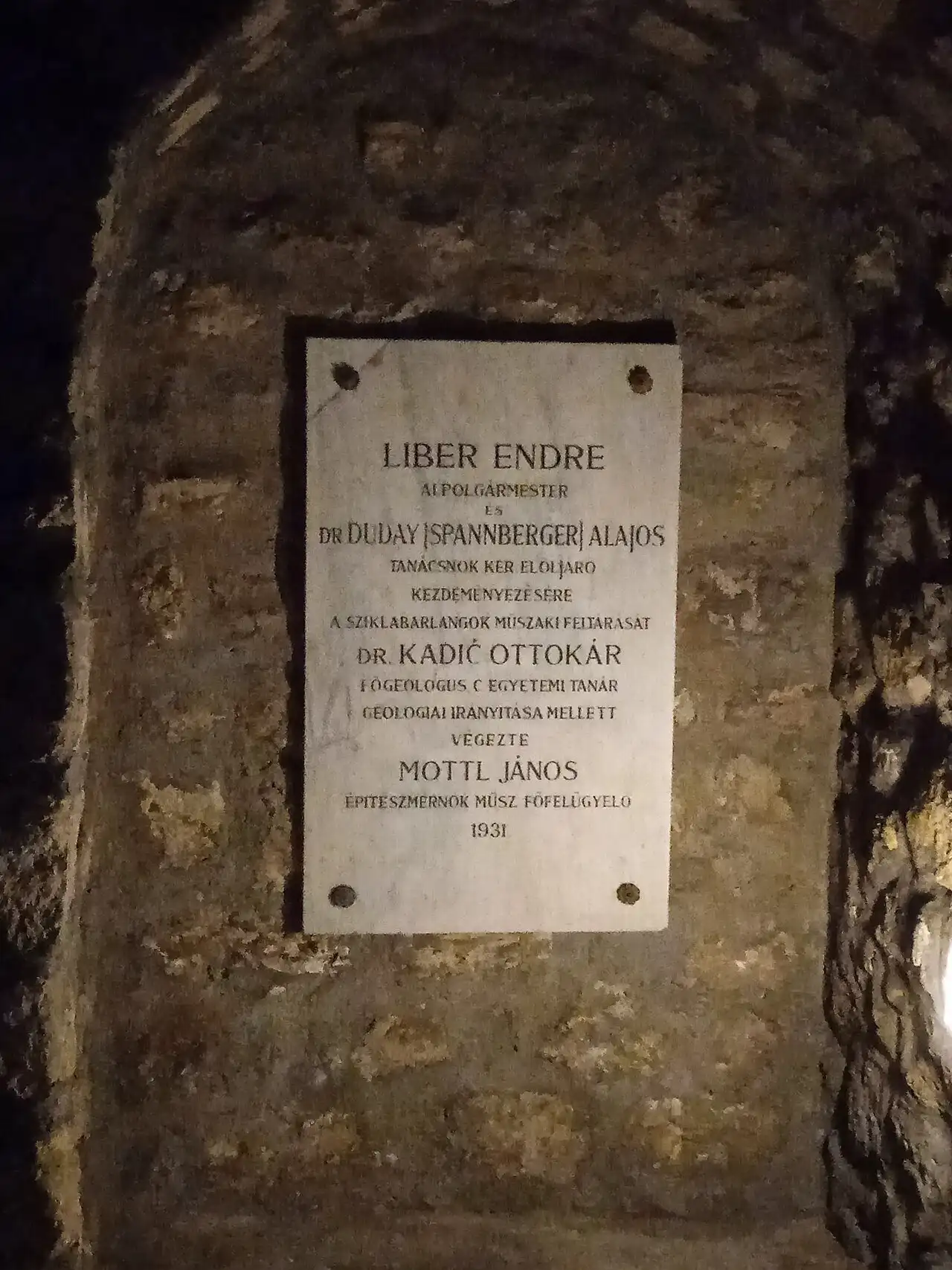
Ottokár Kadić was the geologist who turned a dangerous hole under a world-famous district into something a city could manage. Between 1932 and 1936 he and the Hungarian Caving Society ran the repair works, and the exploration turned up archaeological and geological finds as it went.
A marble plaque still set into the cave wall records the start of that effort, dated 1931 and naming Kadić as the geological director of the work, alongside the deputy mayor and the engineer who carried it out.
His other legacy is the first Cave Museum, opened in 1935. It lasted eight years before the army closed it.
The history of the Buda Castle Caves
Five threads run through the system, and a guided tour of it touches the first four.
How the hill made the caves
Castle Hill was built by thermal water, the kind that still comes up under this city. Mineral-rich water depositing travertine over a very long time leaves a porous rock, and water moving through porous rock makes voids.
That is why the system reads as three layers. The upper level is almost entirely built, the middle level is part built and part natural, and the lower level is mostly hollow that nobody cut. Walking the route you cross between them, which is why the ceiling keeps changing from brick to raw rock and back.
Nothing here grew in the way a limestone show cave grows. There are no formations to speak of, and anyone arriving with Postojna or Carlsbad in mind has come to the wrong kind of cave.
Wine, water and the medieval town
Medieval Buda lived on wine, and wine needs cold, dark storage. Diggers looking for water under their houses kept breaking into cavities, and what began as a well became a cellar, then a cellar joined to the neighbour’s.
The dating is in the roofs. Thirteenth-century vaults sit on stone consoles; by the 14th and 15th centuries the builders had moved to barrel vaults, the shape most people picture when they hear the word cellar. Food that had to stay cool went down with the barrels, and when the town was besieged or burning, so did the townspeople.
The system had a darker job too. It served as a prison, which is the sort of use a town finds for a hole in the rock that only has one way out.
Collapse, survey and rescue
By the 18th century the wine trade had faded and the cellars had lost their point. Rubbish went into the deep levels, water got into the foundations, and nobody held a map of what was down there.
The reckoning came in stages. Between 1882 and 1886 the city’s engineering office surveyed 120 rock cellars between Bécsi kapu tér and Dísz tér. In 1897 a road fell in at Szentháromság tér, and by 1904 the press was reporting dangerous ground under several Castle buildings.
Work finally started in 1932 and ran to 1936, and with it came the idea of showing the place to the public. The first Cave Museum opened under Szentháromság utca 2 on 17 August 1935, and in 1936 two more rooms were added, one of them built from human and animal bones dug up under what is now Szentháromság utca 9.
The war and the bunker years
The museum lasted until May 1943, when the City Council closed it and the military took the cave. Engineers joined the sections under Szentháromság tér, Úri utca, Dísz tér and Országház utca into a single labyrinth of about four kilometres, and cut a hospital into the rock between Szentháromság utca and Lovas út.
Through the siege of 1945 thousands of soldiers and civilians lived in it while the district above them was destroyed house by house. In the 1950s the labyrinth was rebuilt again, this time as a modern air-raid shelter with its own drains, bathrooms and toilets, and from 1961 to 1975 the public could walk it.
Then the money ran out. The deep cellar system closed in 1975 and has stayed closed.
One system, three attractions
The confusion visitors have about Castle Hill’s underground is not their fault, because one system really did become three businesses.
The southern section opened as the Buda Labyrinth in 1983 and is still its own attraction, at Úri utca 9, walked without a guide. The wartime hospital on the western slope became the Hospital in the Rock, a museum at Lovas út 4/c with its own guided tour. And in 1997 the central section was reconstructed and opened to guided groups only, which is the cave this guide is about.
They share a hill and a geology, and nothing else. Different doors, different operators, different tickets.
Did you know?
A road fell into the caves in 1897
The ground gave way in Szentháromság tér, in front of what is now one of the busiest squares in Budapest. Seven years later newspapers were still reporting dangerous conditions under Castle buildings.
One room was built out of bones
The Bone Chamber, added in 1936, was made from human and animal bones found under what is now Szentháromság utca 9, and it was part of the original museum.
The city counted 120 rock cellars
The survey of 1882 to 1886 covered the stretch from Bécsi kapu tér to Dísz tér, which is most of the length of the old town.
The wartime labyrinth was longer than the cave you walk
Joined up from 1943, it ran to about four kilometres, against the 3.3 kilometres of the cave system as it is described today.
The public could walk the bunker for 14 years
After its rebuild as an air-raid shelter in the 1950s, it was open from 1961 until 1975, when the deep cellars were closed and stayed shut.