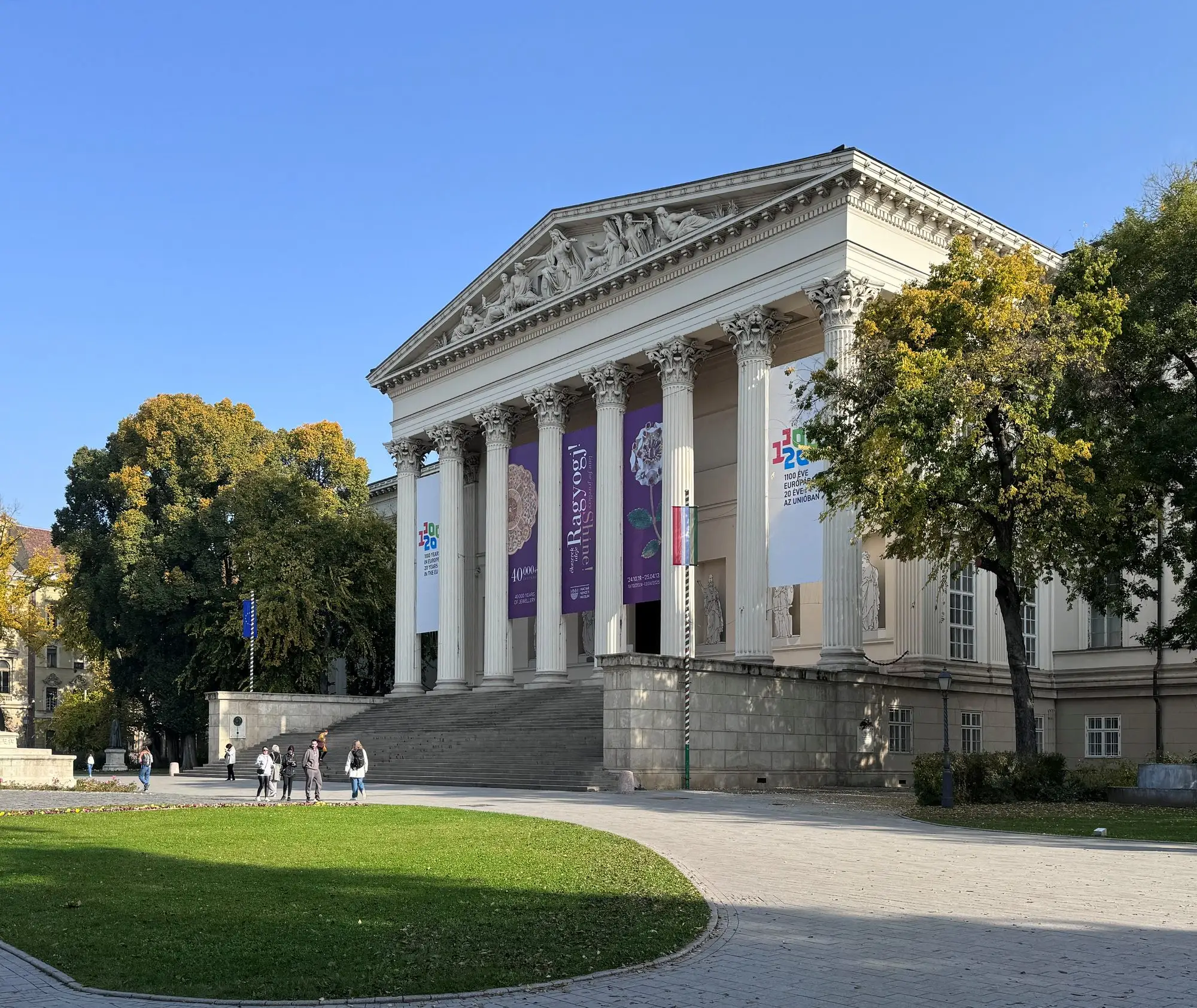
The Hungarian National Museum began as one man’s library, and almost everything else in Hungarian public collections was later cut out of it. Count Ferenc Széchényi handed over his books, manuscripts, maps and coins in 1802; the Diet turned the gift into a national institution by law in 1808; and a building went up to hold it that was, for half a century, also where the country’s parliament sat.
That is the thread worth following here. This page covers the founding, Pollack’s palace, the revolution that happened on the doorstep, the garden the public paid for, and the long sequence of splits, occupations and rebuildings that left the museum with what it has now.
At a glance
Timeline
- 25 November 1802
The founding gift
Count Ferenc Széchényi gives his library, manuscripts, maps, coins and antiquities to the nation, irrevocably and forever. Royal approval follows the next day.
- 1807 and 1808
Two acts of the Diet
Act XXIV of 1807 thanks Széchényi for laying the foundations of a national museum yet to be established. Act VIII of 1808 establishes it and secures its money from the counties.
- 1812
A first director
Jakab Ferdinand Miller takes charge of the collections, then housed in the library hall of the Pauline monastery in Pest.
- 1813
The plot is bought
The state buys the ground on Múzeum körút from the Batthyány family.
- 1836 to 1847
Pollack builds
Act XXXVII of 1836 pays for a building. Mihály Pollack designs it and construction runs from 1837 to 1847.
- 1848 to 1849
Revolution at the steps
The square in front becomes one of the revolution’s most memorable sites, and the Ceremonial Hall holds the Upper House of the first representative National Assembly.
- 1855 to 1857
The garden is planted
A public fund and concerts in the Ceremonial Hall pay for Ármin Petz’s English landscape garden. The first trees go in on 24 November 1855.
- 1867 to 1902
The Upper House sits here
Parliament’s upper chamber meets in the building until the Parliament on the Danube is finished.
- 1872 and 1896
Two collections leave
The Museum of Applied Arts becomes independent, and part of the picture collection becomes the Museum of Fine Arts.
- 1919
Fourteen lorries turned away
General Harry Hill Bandholtz stops Romanian troops removing the Transylvanian treasures, using a riding crop.
- 1926 to 1927
Rebuilt for storage
Work to Jenő Kismarty-Lechner’s designs creates stores in the attics.
- 1949
The Museum Act
The Museum of Ethnography and the Hungarian Natural History Museum are separated and the National Széchényi Library becomes independent.
- 1956
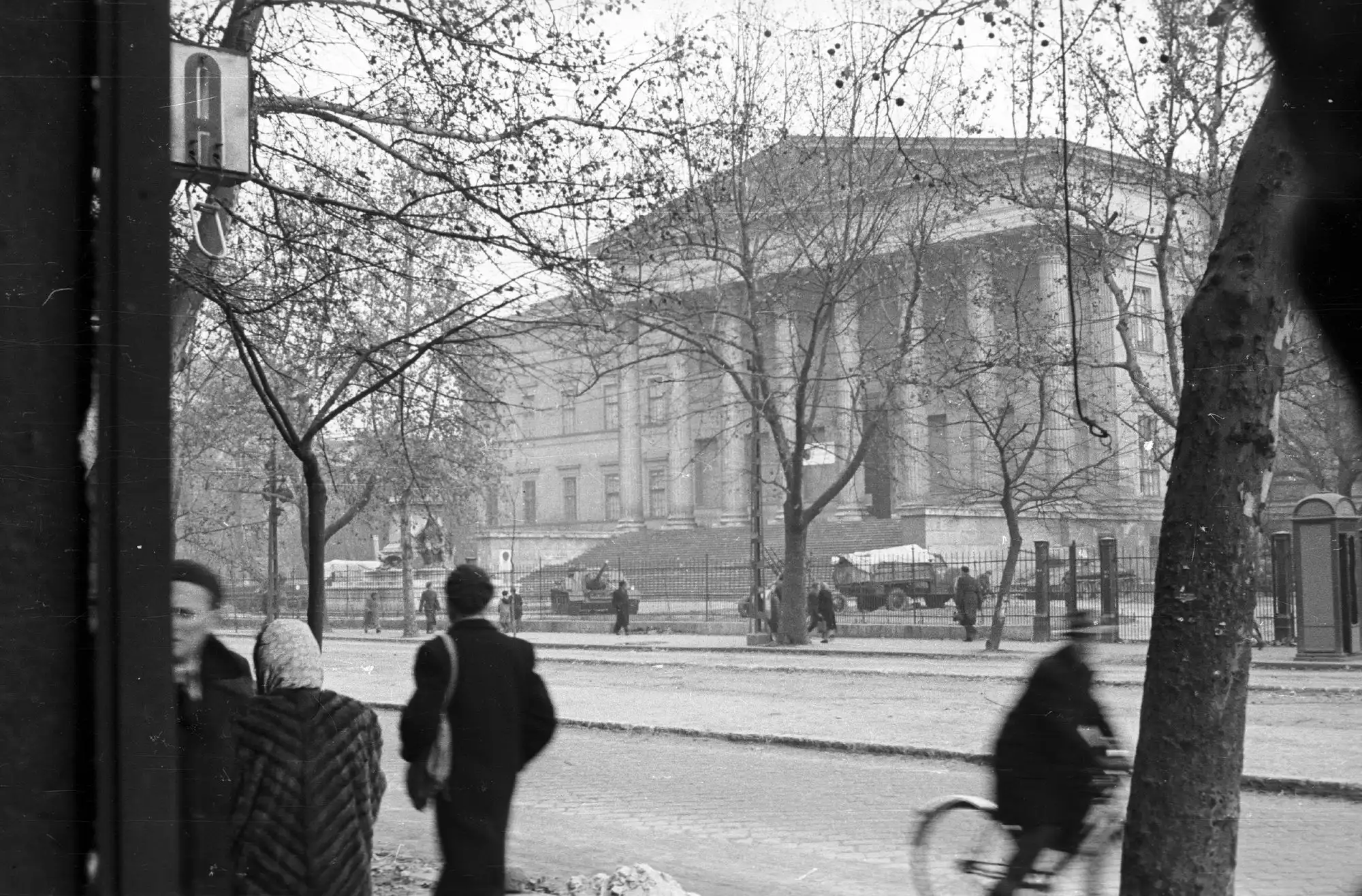
Armour in the garden
Soviet tanks stand in the Museum Garden in November.
- 1996 to 2006
Under the courtyards
A major reconstruction puts workspaces and new exhibition areas beneath the two inner courtyards, among them the Roman Lapidary.
- 2024
Into a public collections centre
From 28 April the museum operates as part of the Hungarian National Museum Public Collections Centre.
- 2 December 2025
Four exhibitions close
The Coronation Mantle, the Seuso Treasure, the Széchényi Hall and the Open Storage shut for rebuilding.
Key facts
- Founded
- 25 November 1802
- Founder
- Count Ferenc Széchényi
- Made national by law
- Act VIII of 1808
- Architect
- Mihály Pollack
- Built
- 1837 to 1847
- Pediment
- Rafael Monti, of Munich
- Staircase frescoes
- Károly Lotz and Mór Than, from 1875
- Garden laid out
- 1855 to 1857, by Ármin Petz
The pediment
The figures over the columns are the work of Rafael Monti, a sculptor from Munich, and they are worth stopping for before you go up the steps.
Pannonia sits enthroned at the centre with laurel wreaths in her hands, offering them to Science and Art on her right and to History and Fame on her left. The Danube fills one corner of the triangle and the Drava the other.
It is a statement about what the building was for, made before a single object had moved in.
The history of the Hungarian National Museum
Széchényi's gift, 1802 to 1813
On 25 November 1802 Count Ferenc Széchényi gave his collections to the nation, in his own words irrevocably and forever, and the king approved the gift the following day. It was a serious library rather than a gesture: 11,884 printed volumes, 1,156 manuscripts, 142 bound maps and engravings and 2,019 gold coins, along with coats of arms, antiquities and paintings.
The Diet of 1807 thanked him for laying the foundations of a national museum yet to be established. The real founding document is the next one, Act VIII of 1808, which established the Hungarian National Museum and made the counties pay for it, turning a private donation into a public institution with an income.
For its first years the collection sat in the library hall of a former Pauline monastery in Pest, with Jakab Ferdinand Miller as its first director from 1812. In 1813 the state bought the plot on Múzeum körút from the Batthyány family, and the museum had somewhere to build.
Pollack's palace, 1837 to 1847
Act XXXVII of 1836 found the money, and Mihály Pollack, the leading neoclassical architect in Hungary, designed the building that resulted. Construction ran from 1837 to 1847, and the palace was finished in the 1840s.
The eight-columned portico and the pediment above it were the point. Rafael Monti carved Pannonia enthroned, holding out laurel wreaths to Science and Art on one side and History and Fame on the other, with the Danube and the Drava in the corners.
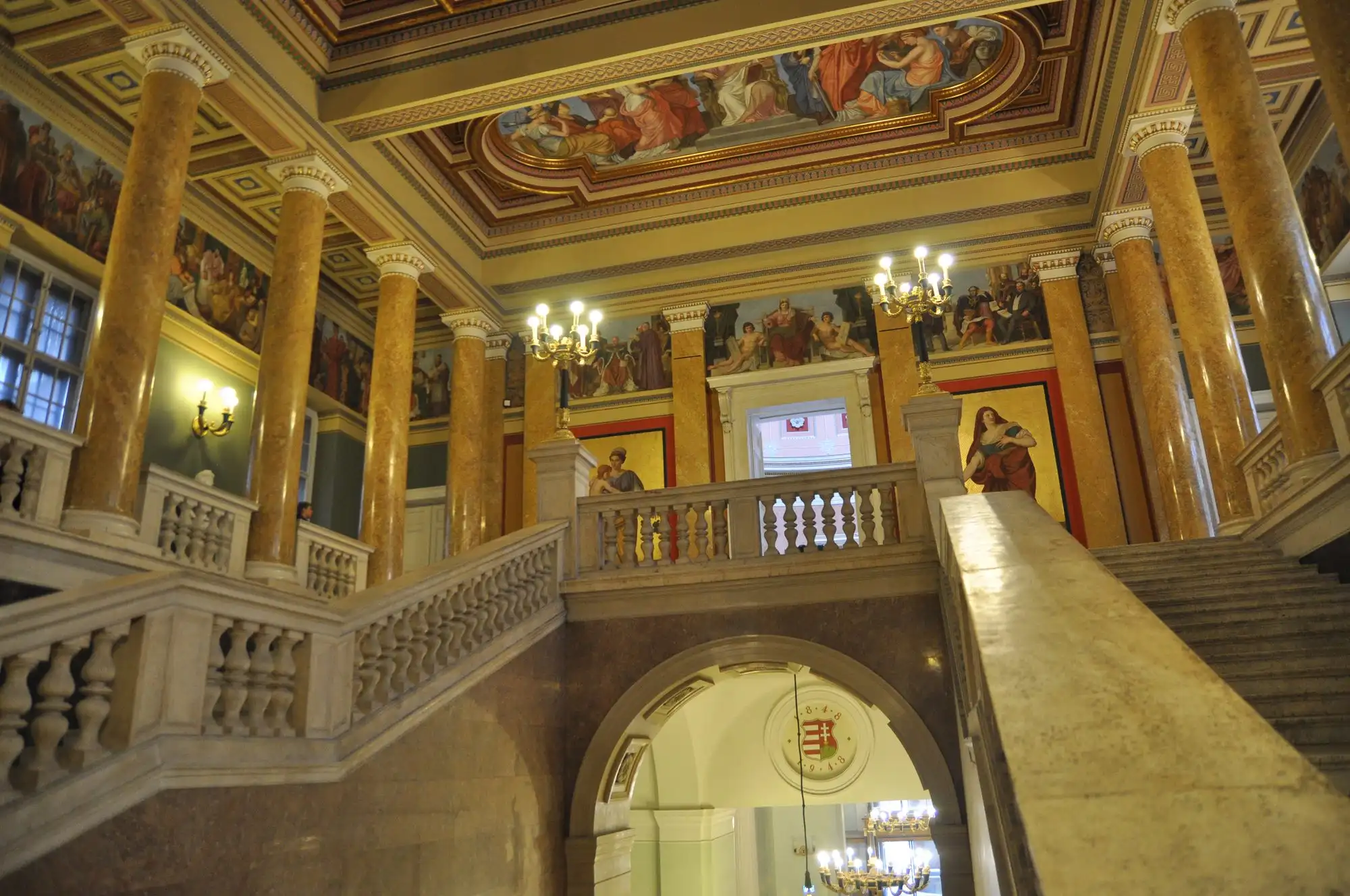
The interior took longer to finish than the shell. From 1875 the walls and ceiling of the grand staircase carried the allegorical and historical frescoes of Károly Lotz and Mór Than, and that staircase is still the part of the building visitors remember best, before they have looked at a single exhibit.
1848, and the years when parliament met here
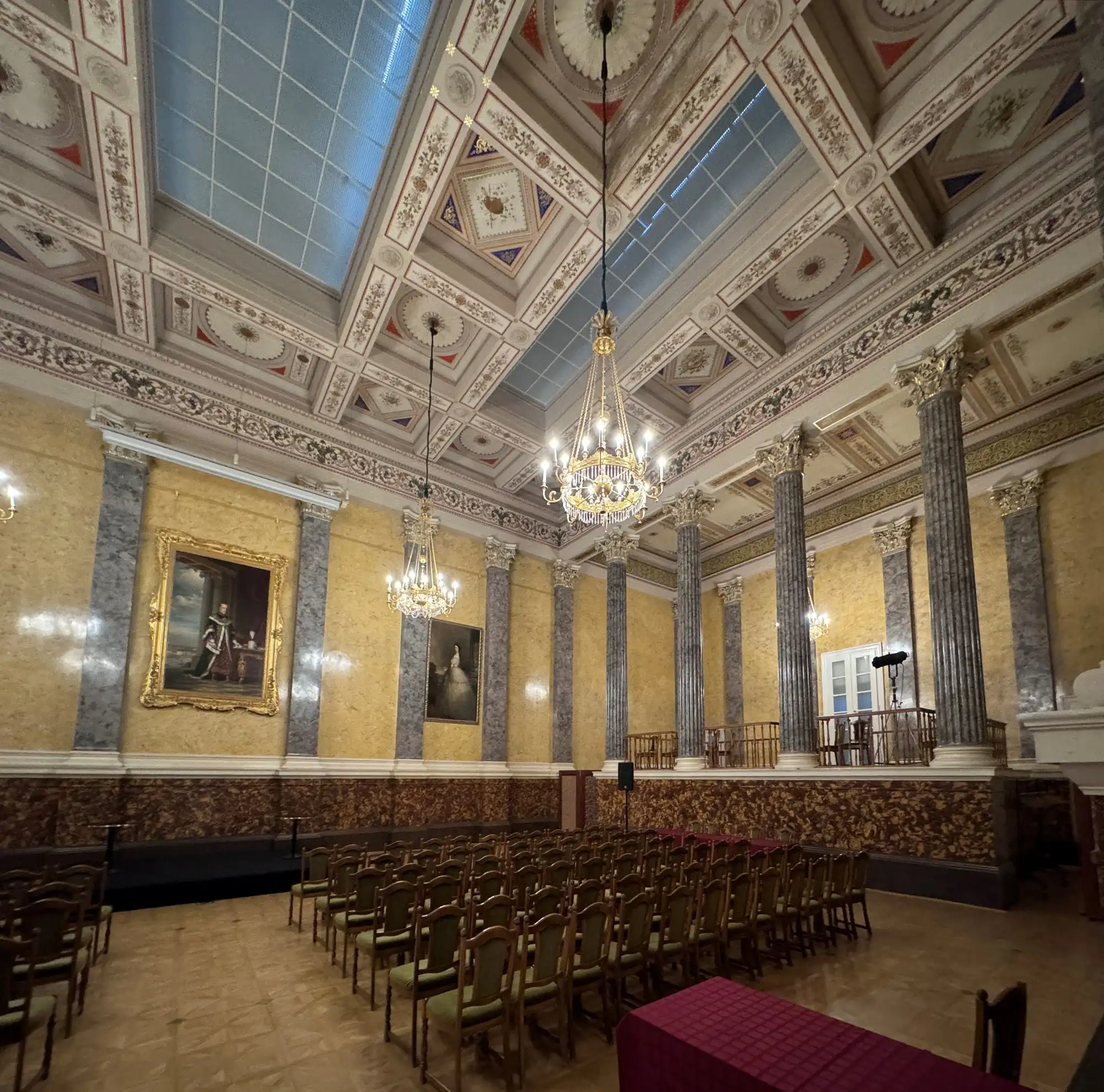
The square in front of the steps became, as the museum puts it, one of the revolution’s most memorable sites in March 1848. It also corrects the best-known story about that day: contrary to later tradition, Sándor Petőfi did not recite the National Song here, though he did address the crowd. The state’s central commemoration of the national holiday is still held in front of the building every 15 March.
Inside, the Ceremonial Hall held the Upper House of the first representative National Assembly in 1848. It was not a one-off. The House of Representatives met here in 1861 and again in 1865 and 1866, and the Upper House sat in the museum from 1867 until 1902, while the Parliament on the riverbank was being built.
Those years left their own exhibits. Room 16 displays splinters of the furniture the opposition smashed in the Chamber of Deputies in 1904, signed by the members who broke it.
The Museum Garden, paid for by the public
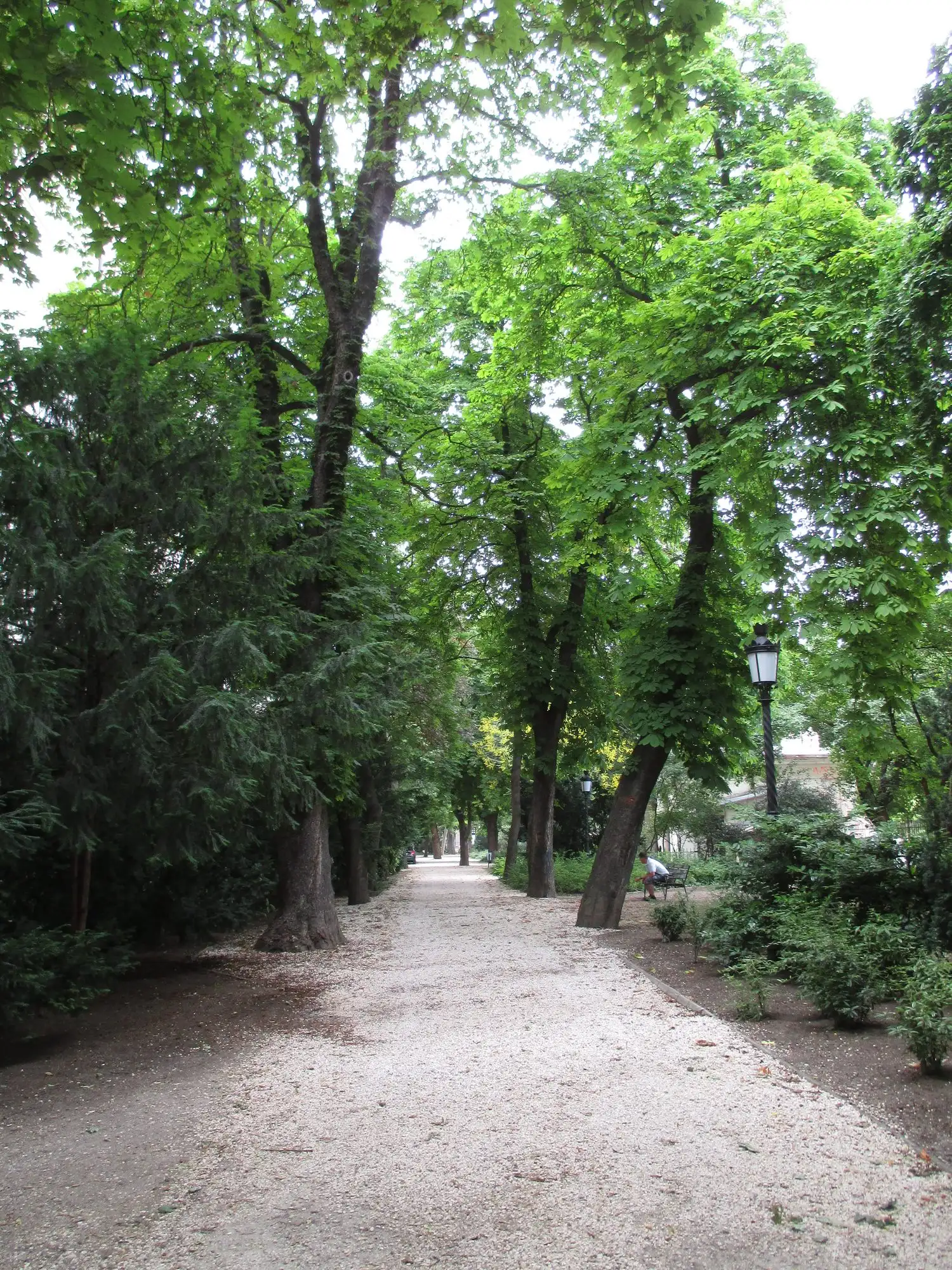
The ground bought from the Batthyánys in 1813 stayed a bare outer courtyard for forty years. A public garden fund changed that in 1855, topped up by concerts in the Ceremonial Hall that made the museum the leading concert venue in the capital while they lasted.
Ármin Petz laid the garden out in the English landscape style. The first trees went in on 24 November 1855, at the corner of Múzeum körút and Bródy Sándor utca, watered from a tinsmith’s ornate can, and the planting was finished by 1857. Miklós Ybl designed the railings in 1865, and they were moved inwards in 1880 when the boulevard was widened.
It has been a public space ever since, and it still works like one. The Museums’ May Festival has been held here every May since 1996.
How the National Museum was divided up, 1872 to today
The museum spent the next century getting smaller. The Museum of Applied Arts became independent in 1872, part of the picture collection became the Museum of Fine Arts in 1896, and the Museum Act of 1949 separated the Museum of Ethnography and the Natural History Museum and made the National Széchényi Library independent. Four of Hungary’s national institutions started life inside this one building.
In 1919, Romanian troops occupying Budapest prepared to take the Transylvanian treasures away on fourteen lorries. General Harry Hill Bandholtz, the American commander of the Entente military mission, turned them out with a riding crop. A memorial stone was laid in the garden on the centenary in 2019.
Rebuilding to Jenő Kismarty-Lechner’s designs created attic stores in 1926 and 1927. In November 1956 Soviet armour stood in the Museum Garden. The largest change of all came between 1996 and 2006, when workspaces and new exhibition areas were dug in beneath the two inner courtyards, which is how the Roman Lapidary came to be underground.
The most recent chapter is administrative. From 2022 the museum took on national archaeological work and set up the National Archaeological Institute, and from April 2024 it operated as part of a Public Collections Centre. That centre is now being wound up, and the closures that began on 2 December 2025 are the visible part of a larger rebuilding programme.