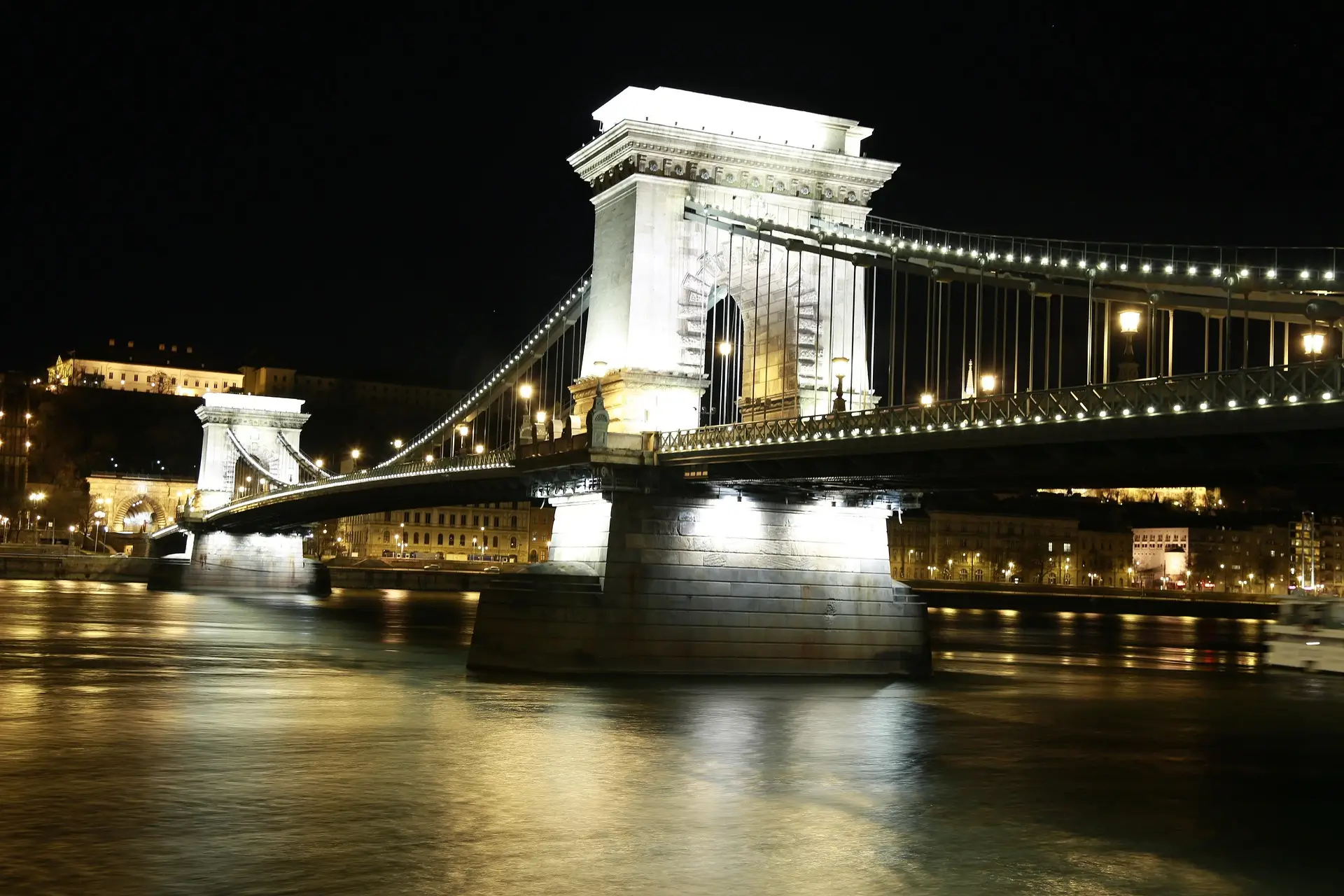
Ten years of work put the first permanent bridge across the Danube at Budapest, and almost everything about the way it was opened went wrong. The man whose name it carries was in a clinic and had not been invited. The soldier who inaugurated it had spent the autumn executing the leaders of the revolution the bridge was meant to serve.
What came after was a toll that outlasted an empire, a name granted only in 1915, a demolition in 1945, a rebuild that reopened a hundred years to the day after the first crossing, and a restoration that ended with the city voting to keep private cars off for good. This page follows all of it, and settles the lion story on the way.
At a glance
Timeline
- 1839
Work begins
Building starts on the Danube, and the first job is to get a dry working site down into the riverbed.
- 24 Aug 1842
The foundation stone
The stone is laid at five in the afternoon, with Archduke Charles standing in for the king, the Palatine Joseph present, and Széchenyi István carrying the wooden hammer.
- 20 Nov 1849
The bridge opens
Baron Julius Jacob von Haynau, the Vienna government’s plenipotentiary, inaugurates the bridge with his officers.
- 1870
The state buys the toll
The state buys the right to collect the toll from the Chain Bridge Company, which had owned the bridge and traded its shares in Vienna.
- 1915
Rebuilt, and finally named
A reconstruction begun in 1913 is finished, and the bridge is given its official name, Széchenyi Lánchíd.
- 1 Dec 1918
The toll ends
Tolls on Budapest’s bridges are abolished. Everyone had paid to cross for 69 years.
- 18 Jan 1945
Blown up
Retreating German troops destroy the bridge. The piers and the lions survive.
- 20 Nov 1949
Rebuilt and reopened
The new bridge opens exactly a hundred years after the first, with Rákosi Mátyás and Gerő Ernő presiding.
- 16 Jun 2021
Closed for restoration
The bridge shuts completely to road traffic. The pavements had already closed in March.
- 16 Dec 2022
The roadway reopens
Buses, taxis, motorcycles, bicycles and scooters return. Private cars do not.
- 4 Aug 2023
The pavements reopen
The walkways and the rebuilt bridgehead underpasses open, a month and a half ahead of contract, ending 25 months of work.
Key facts
- Built
- 1839 to 1849
- Designed by
- William Tierney Clark
- Built by
- Ádám Clark
- Paid for largely by
- György Sina
- Length
- 376 metres
- Main span
- 202.6 metres, between the two river piers
- Width
- 14.5 metres
- Lions
- Marschalkó János, in Sóskút limestone
- Destroyed
- 18 January 1945
- Reopened
- 20 November 1949
The two Clarks
Two men called Clark built this bridge and they were not related. William Tierney Clark was an English engineer who designed it in England. Ádám Clark came out to run the site, stayed in Budapest, and later drove the tunnel through Castle Hill at the Buda end.
Tierney Clark designed several bridges in England, and one of them still stands largely unchanged, the Thames bridge at Marlow. That is why the Chain Bridge is so often called a copy of an English bridge. It is not a copy of anything. It is the same designer’s hand and many of the same engineering solutions, built on a far bigger river.
The square at the Buda end, Clark Ádám tér, is named after the builder. The bridge is named after neither of them.
The name
For its first 66 years the bridge had no official name at all. People called it the Lánchíd, the chain bridge, which is what it was.
Kossuth Lajos had proposed naming it after Széchenyi as early as 1842, when the foundation stone went down. The name was only granted in 1915, with the reconstruction, long after Széchenyi’s death. The full official name today is Széchenyi Lánchíd.
The history of the Széchenyi Chain Bridge
Building it, 1839 to 1849
Before this bridge there was no permanent way across the Danube here at all. People crossed by ferry, or over a pontoon bridge that was taken apart every winter, or on the ice when the river froze hard enough. Széchenyi István spent years pushing for a proper crossing, William Tierney Clark designed it in England, Ádám Clark came out to build it, and György Sina found most of the money.
Work started in 1839. The foundation stone was not laid until 24 August 1842, because getting a dry working site down into the riverbed took three years on its own. The ceremony that afternoon was choreographed down to which guest carried the trowel and which the hammer. Archduke Charles stood in for the king, the Palatine Joseph attended, and Széchenyi carried the wooden hammer.
Ten years after the first work began, the bridge was finished. When it opened it was among the largest and most modern bridges anywhere in the world.
The opening nobody enjoyed, 1849
The bridge opened on 20 November 1849. The revolution it had been built to serve had been crushed weeks earlier, and the man who inaugurated it was Baron Julius Jacob von Haynau, the Vienna government’s plenipotentiary, the soldier who had just had the leaders of that revolution executed. He crossed with his officers. Crowds came, but the mood was frosty rather than festive.
Széchenyi István was not there. By then he was being treated at the Döbling clinic outside Vienna, and he was not sent an invitation. The man the bridge is named after never crossed it, not on the opening day and not afterwards.
A toll bridge with no name, 1849 to 1918
Everybody paid to cross from the first day. The Chain Bridge Company owned the bridge and collected the toll, and its shares traded on the Vienna stock exchange. The state bought the toll right in 1870 and simply went on collecting it. Tolls on Budapest’s bridges were not abolished until 1 December 1918, 69 years after the bridge opened.
Through all of that the bridge had no official name. It was simply the Lánchíd until 1915.
The lions, and the story about their tongues
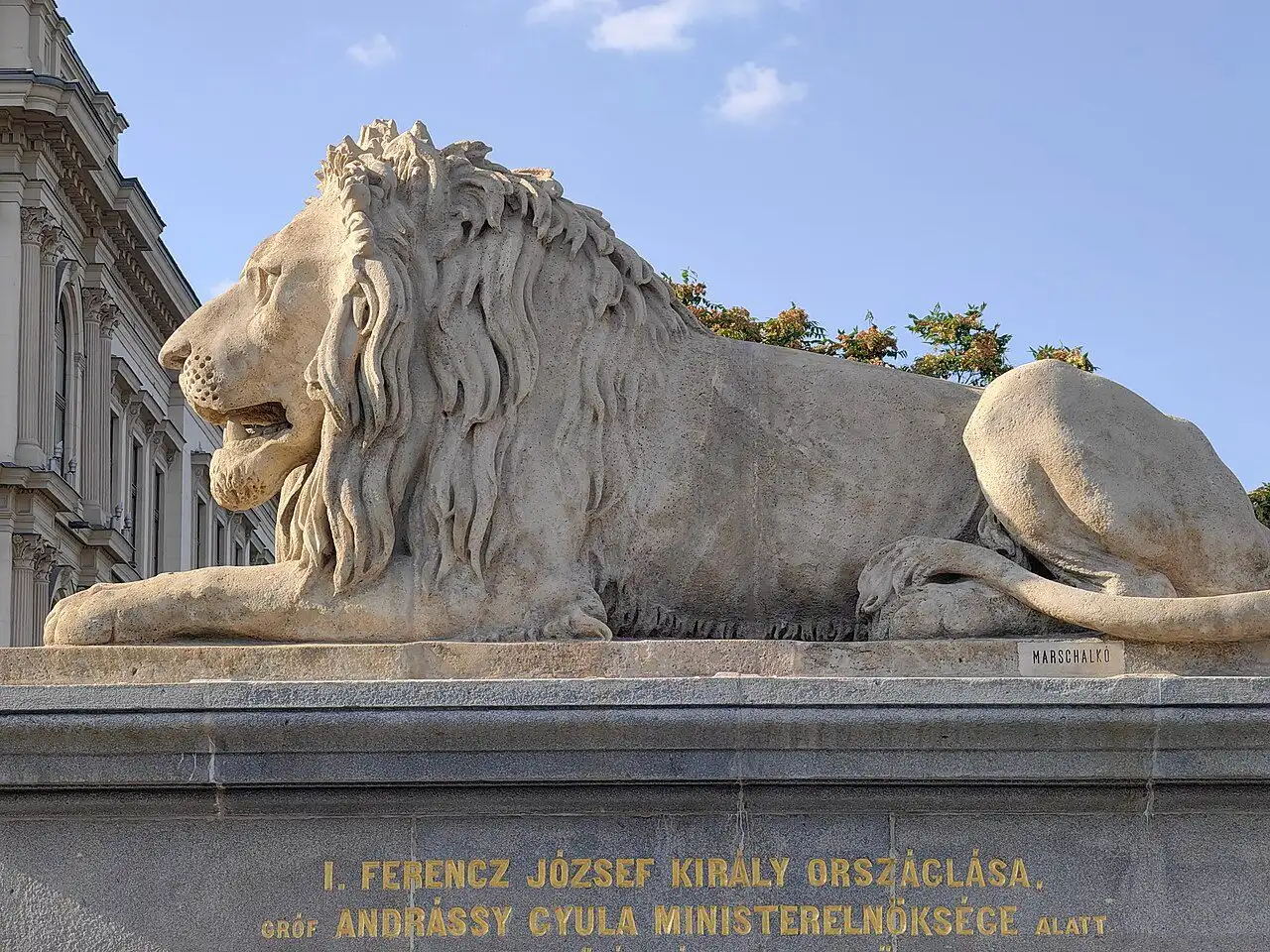
Marschalkó János, born in Lőcse in 1819, was commissioned in 1849 to carve the four lions. Each one is Sóskút limestone, 4.6 metres long and 2.2 metres wide, built up from three blocks, and set on a granite plinth three metres high. The plinths on the Buda side carry the arms of Széchenyi István and György Sina, modelled by Marschalkó and cast in bronze by Gál András.
The lions were on the bridge when it opened. What arrived later, in 1852, were those coats of arms from the same workshop, and that is almost certainly where the confusion started. The painter Barabás Miklós recorded another detail from the first weeks: the lions were set the wrong way round, heads towards the middle of the bridge, and when Tierney Clark visited in the autumn of 1849 he was furious and had them turned.
As for the tongues, Marschalkó did not drown himself and the tongues are there. He went on to carve for the Academy of Sciences, the Vigadó and the Rudas bath, and he died in 1877 a respected man. The tale of the humiliated sculptor was being told about a monument in Bohemia years before this bridge existed, and about an Austrian equestrian statue too. It travelled here and stuck.
Blown up and built again, 1945 to 1949
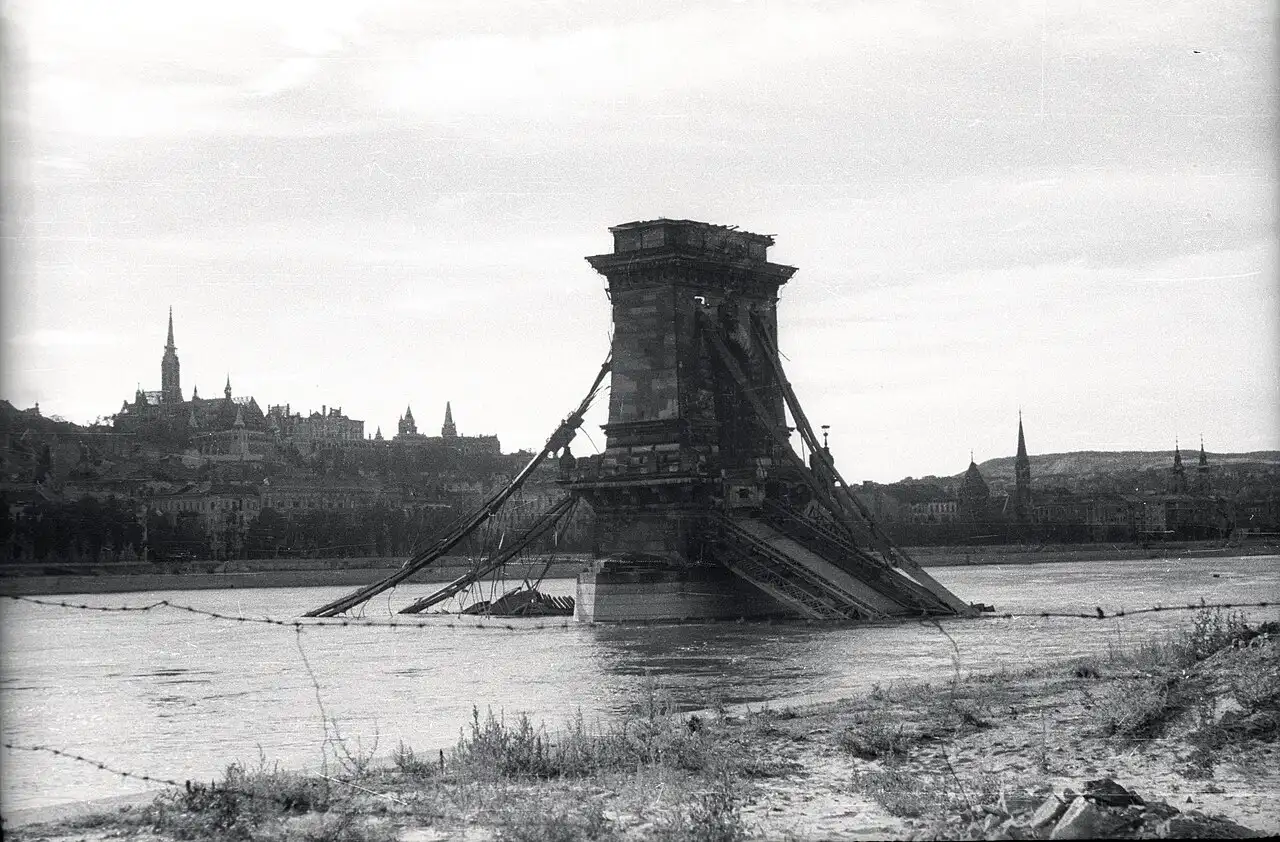
Retreating German troops destroyed the bridge on 18 January 1945. The two river piers and the bridgehead structures stayed standing, and the lions came through with minor damage.
The bridge you walk over now was built between 1947 and 1949, to the plans drawn up for the 1913 to 1915 reconstruction. More than 70 per cent of the old chain material was reused and everything else was made new. Apart from that chain metal, the foundations and the lower parts of the piers are the only fabric that has been in place since 1849.
It reopened on 20 November 1949, exactly a hundred years to the day after the first opening, this time with Rákosi Mátyás and Gerő Ernő presiding. One bridge, two openings a century apart, and neither of them a happy occasion.
The restoration, and the vote that kept the cars off
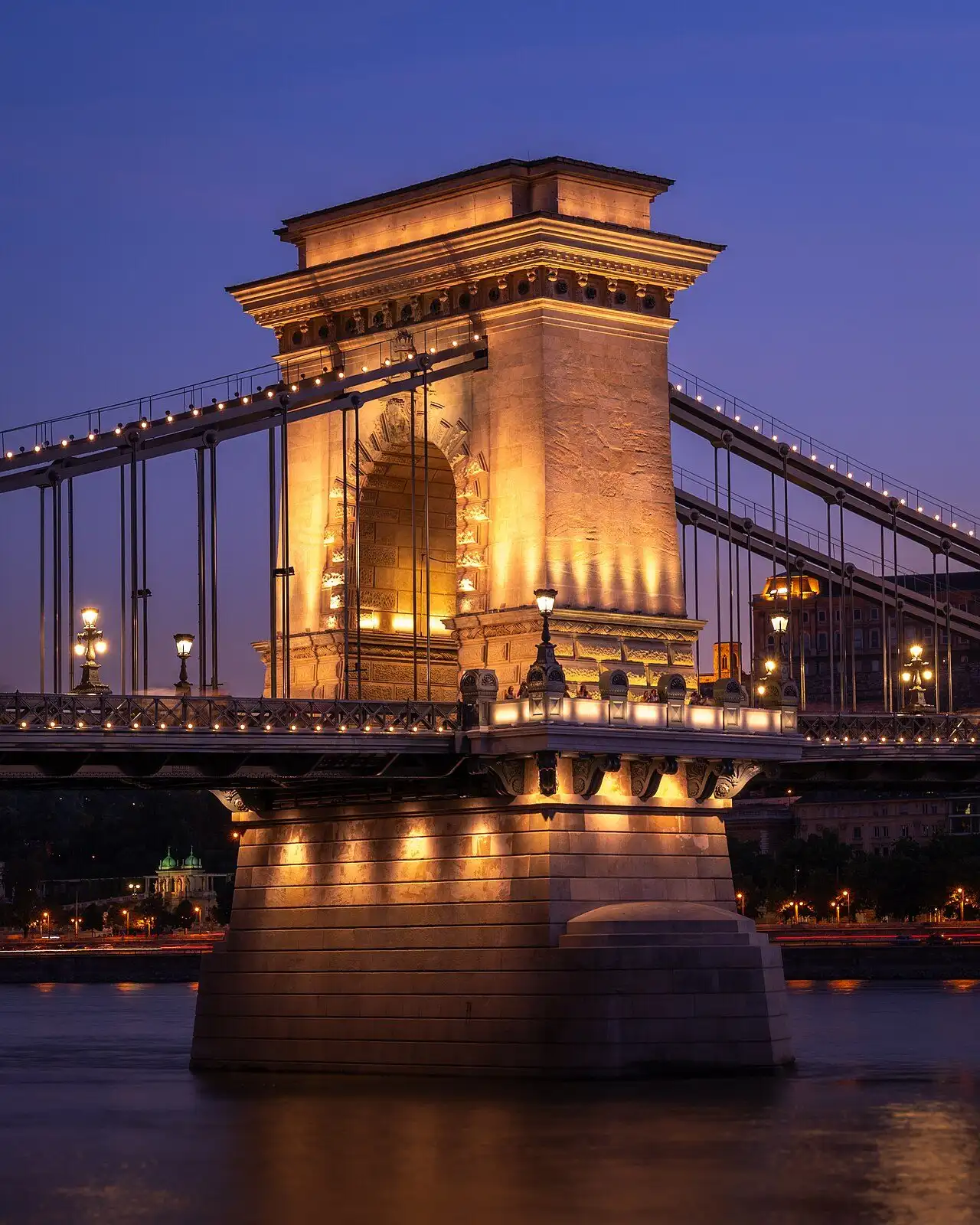
The contract with A-Híd Zrt. was signed in February 2021, the pavements closed that March, and the bridge shut completely to road traffic on 16 June 2021.
The tired reinforced concrete deck came out and 94 orthotropic steel panels made in Csepel went in, most of them weighing about six tonnes each. Some 23,000 square metres of chain links and hanger rods were given new corrosion protection, and the lions were taken down in three pieces each and restored for over a year in a workshop in Újpest.
Divers clearing the riverbed turned the works into an excavation. They brought up a 150 kg Turkish-era stone cannonball, two smaller stone balls, two Second World War bombs, medieval and Ottoman pottery, and pieces of the bridge blown up in 1945, including a length of the old railing. The cannonball went to the Budapest History Museum.
The roadway reopened on 16 December 2022 without private cars, as a temporary arrangement. In June 2023 Budapest put the question to its residents, and 109,037 of them, four in five, voted to keep the buses running freely rather than go back to the pre-renovation traffic. The mayor announced the result on 20 June 2023. The pavements opened on 4 August, a month and a half ahead of contract, and the arrangement has been permanent ever since.
Did you know?
It has always been grey
The bridge has been grey since 1849, in a good many different shades. The restorers matched the colour they found as closely as they could rather than picking a new one.
No tooth was invented
The restorers were allowed to replace only parts that could be shown to have existed, so not one tooth was added that had not been there. They left the small pits that 170 years had put into the limestone.
One-way walking until 1937
For the bridge’s first 88 years pedestrians were required to keep to the right-hand pavement, in one direction only.
Bicycles only since 2012
Cycling across was not allowed until August 2012. Cyclists now use the roadway itself, sharing it with the buses and taxis.
The whole deck was surfaced in a day
The 2,400 square metres of asphalt on the roadway between the two bridgeheads went down in a single day.