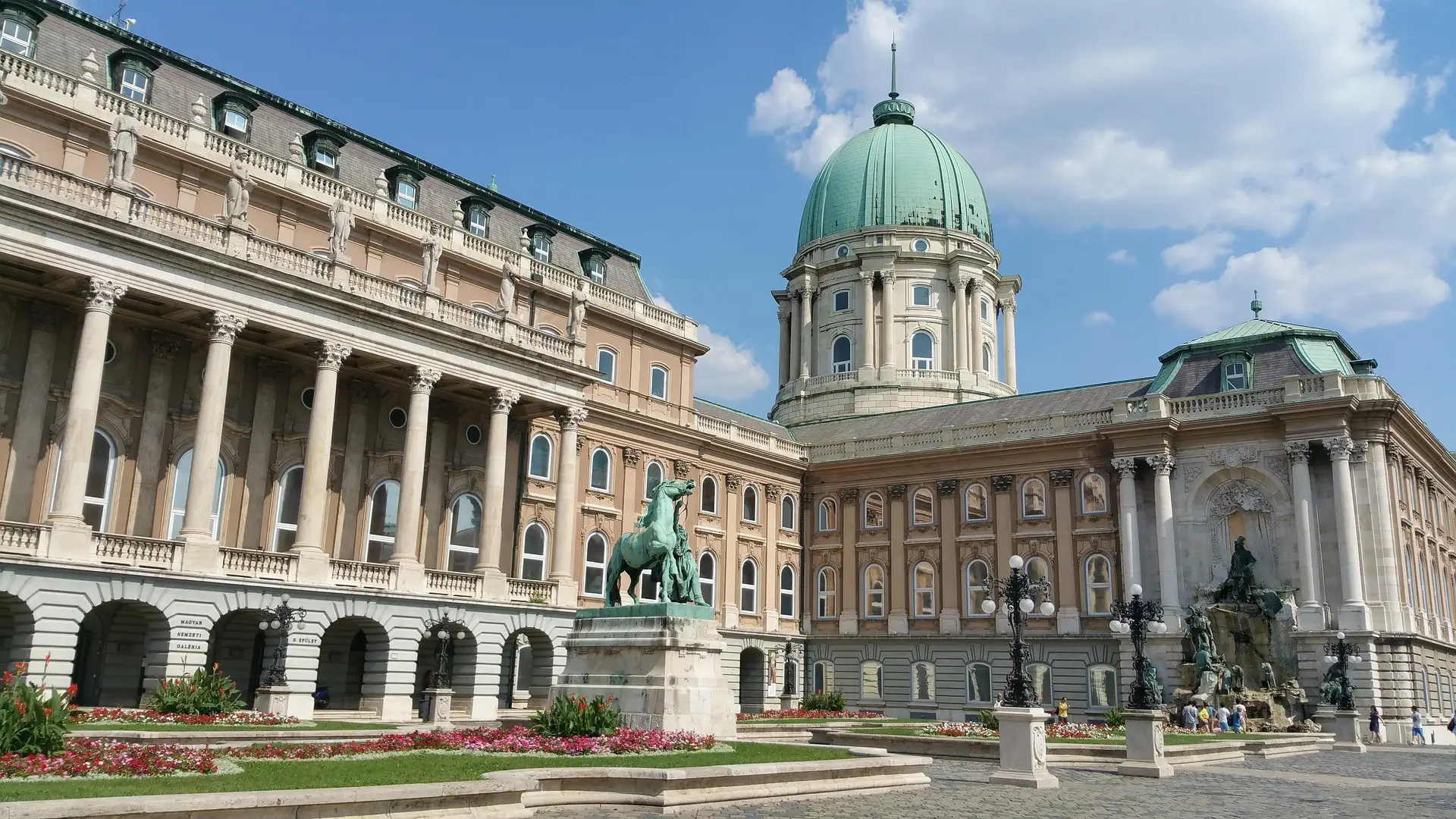
Buda Castle has been pulled down and put back up more often than any building in Budapest. A fortress after the Mongols, a Renaissance court that was the talk of Europe, a ruin under the Ottomans, a Baroque palace, a Neo-Baroque showpiece, a burnt shell, a socialist museum block, and since 2019 a reconstruction of the palace that was lost. What you see today is at least three buildings on one site.
The thread running through it is destruction. Almost nothing you can touch on the hill is older than the 18th century, the palace under your feet was dug out of rubble in the 1940s, and the dome you photograph is not the one the postcards show.
At a glance
Timeline
- 1241 to 1242
The Mongol invasion
The Mongols devastate Hungary. King Béla IV orders stone castles built across the country.
- 1247
Building begins on Castle Hill
Béla IV walls the south-western end of the hill. Within a few decades there is a royal residence and a town of churches and monasteries.
- 14th century
Buda becomes the royal seat
Louis the Great moves his court from Visegrád and enlarges and strengthens the castle.
- early 15th century
Sigismund's Fresh Palace
Sigismund of Luxembourg, King of Hungary and Holy Roman Emperor, adds the Fresh Palace and the Broken Tower.
- late 15th century
Matthias's Renaissance court
King Matthias builds a chapel and a new palace in the Italian Renaissance manner, with the Corvina library, famous across Europe.
- 16th and 17th centuries
Ottoman Buda
Under 150 years of Ottoman rule the palace is damaged and burns out several times.
- 1686
The recapture
Christian armies retake Buda. The medieval walls are demolished almost to their foundations.
- 18th century
Maria Theresa's palace
A Baroque palace rises on the site. From 1766 it is the seat of the governor, Albert of Saxe-Teschen; the university is housed here from 1777 to 1784, and the Holy Right from 1771.
- 1849
The siege of 1849
Görgey’s Hungarian army storms the castle on 21 May. The damaged buildings are repaired by 1856.
- 1870
The funicular
The steam funicular opens on 2 March to carry officials up to the government offices on the hill.
- 1890 to 1905
Ybl and Hauszmann
Miklós Ybl, then Alajos Hauszmann from 1891, extend the palace along the hill until it is one of the largest royal residences in Europe.
- 1945
The siege of Budapest
The palace is the last German stronghold in the city and burns for weeks in January.
- 1946 to 1950
The medieval palace found
László Gerevich’s excavations uncover the medieval palace under the rubble.
- 1959 to 1985
The socialist rebuild
A plainer palace with a new dome is rebuilt for museums. The Castle Museum moves in in 1967, the National Gallery in 1975, the National Széchényi Library in 1985.
- 1987
World Heritage
The Castle District is inscribed as part of Budapest’s World Heritage Site.
- 2019
The Hauszmann Programme
Rebuilding of the pre-war palace quarter begins. St Stephen’s Hall, the Riding Hall and the Guardhouse reopen in 2021.
- 2026
The palace works paused
On 16 September the government halts the palace’s reconstruction and orders a review.
Key facts
- Founded
- 1247, by Béla IV
- Royal seat
- From the 14th century to the Ottoman conquest
- Oldest standing part
- The 18th-century north wing
- Architects of 1905
- Miklós Ybl, Alajos Hauszmann
- Destroyed
- 1686 and 1945
- Museums
- Castle Museum 1967, National Gallery 1975, Library 1985
- World Heritage
- 1987
- Rebuilding
- Hauszmann Programme since 2019
The dome
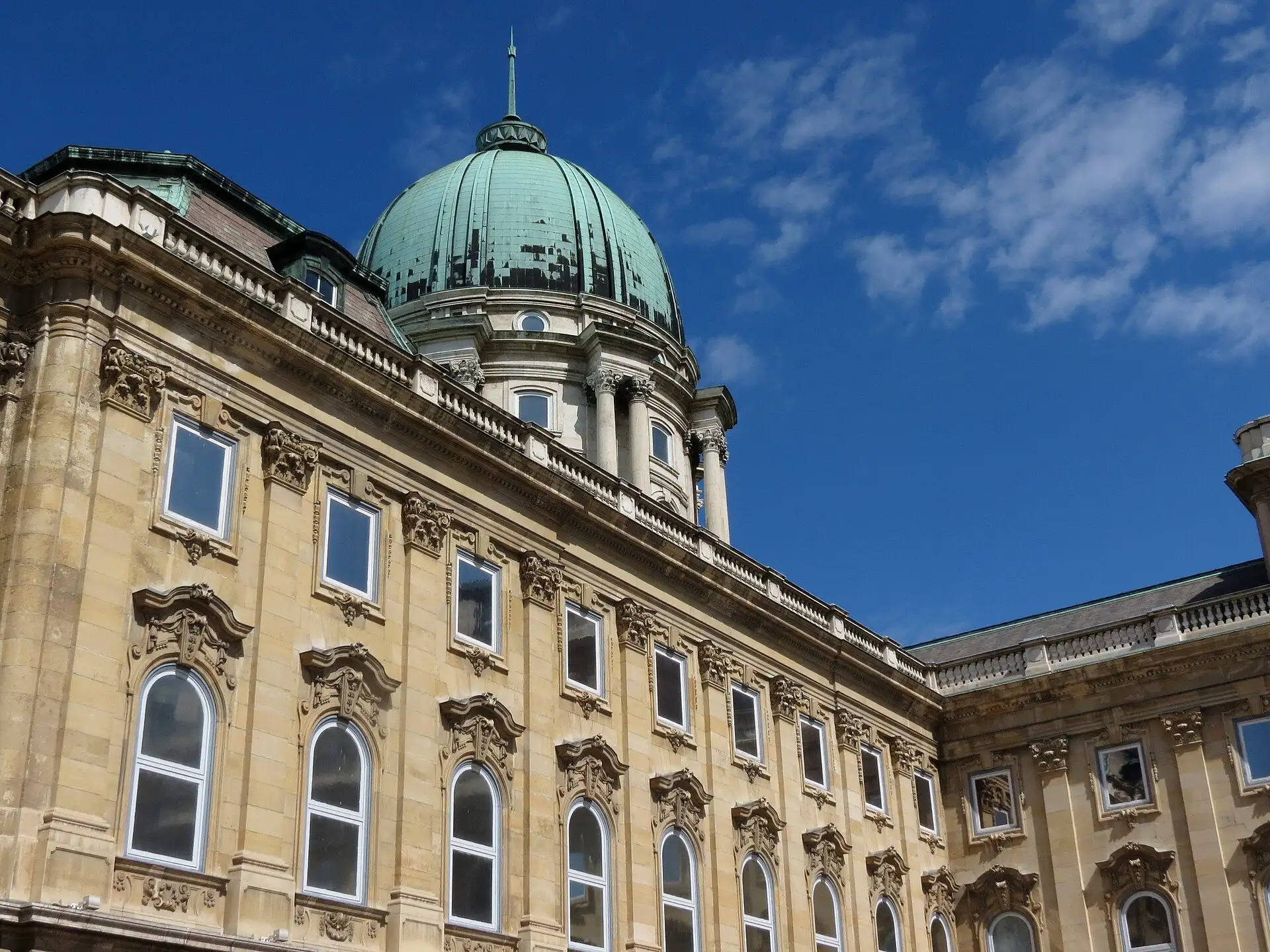
Hauszmann’s dome of 1905 came down after the war, damaged and out of favour. In the summer of 1959 Lajos Hidasi took over the rebuilding from István Janáky and redesigned the replacement in Baroque forms, taller and with paired columns, to sit better with the 18th-century wings. It was finished in the early 1960s with no ornament at all.
What happens to the dome now depends on the review of the palace works ordered in September 2026.
The name
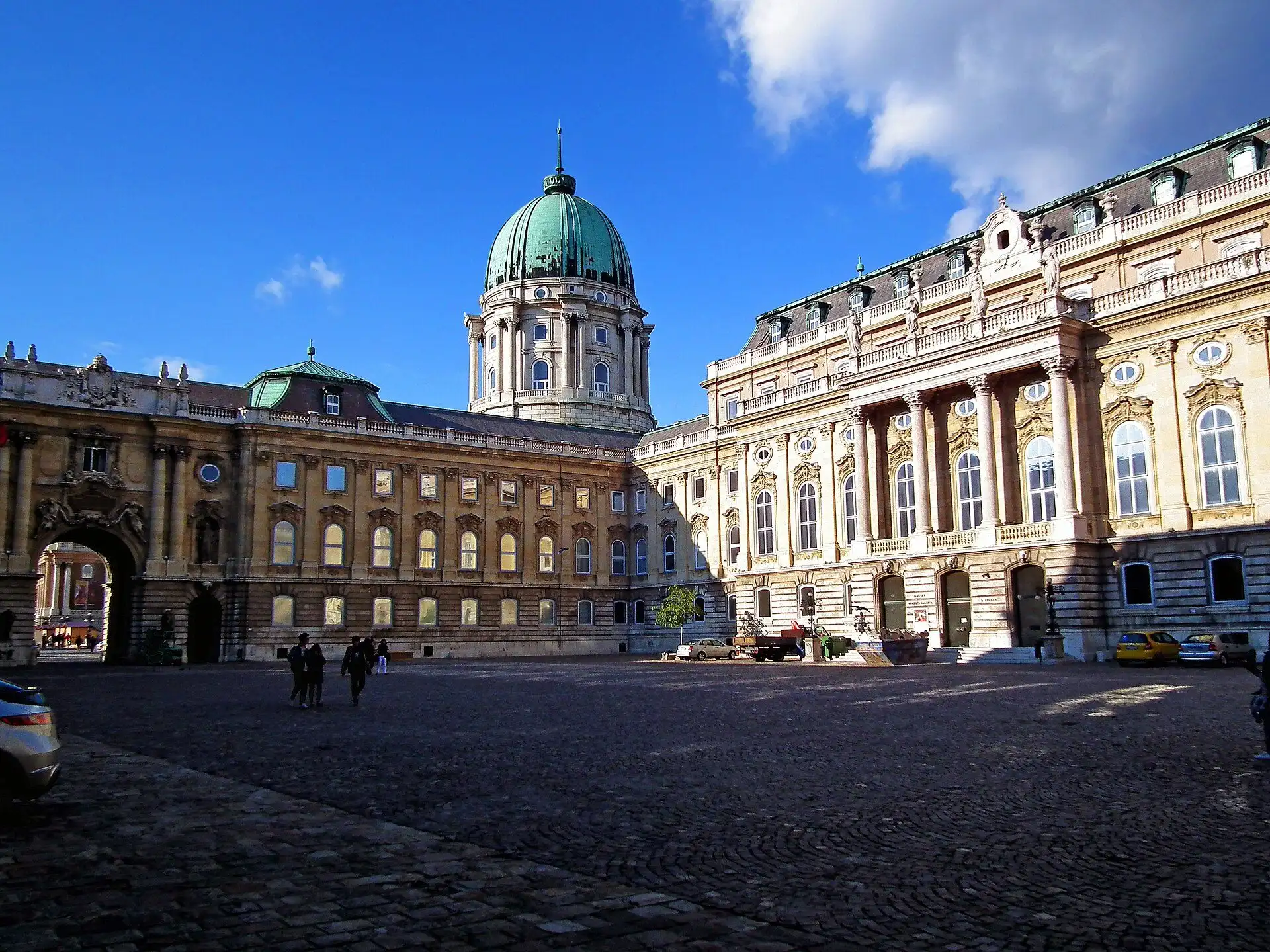
“Buda Castle” in English covers two things the Hungarians keep apart. Budai Vár, the Castle, is the whole walled hill, the civilian town of Matthias Church and Fisherman’s Bastion included. Budavári Palota, the Palace, is the royal complex at the southern end, which is what this hub is about. The hill has been a World Heritage Site since 1987 and a national memorial site since 2011.
The history of Buda Castle
Three palaces have stood on this site, and the story of each ends with a siege.
The medieval royal palace, 1247 to 1686
Béla IV started building on the hill in the spring of 1247, five years after the Mongols had shown that Hungary’s timber forts were no defence. The fortress at the south-western end became a royal residence within decades.
Louis the Great moved his court here from Visegrád in the 14th century, Sigismund added the Fresh Palace and the Broken Tower in the early 15th, and Matthias turned it into a Renaissance court with an Italian chapel, a new palace and the Corvina library that visitors wrote home about.
None of it stands. After the Ottomans took Buda in 1541 the palace burnt out repeatedly, and when the Christian armies retook the city in 1686 they pulled the medieval walls down almost to their foundations. What survived was buried under the palaces that followed, until László Gerevich’s excavations from 1946 to 1950 found the Gothic hall, the chapel and the vaulted rooms that the Castle Museum now shows.
Go down into them. They are the only royal Buda you can stand in.
Maria Theresa's Baroque palace and the Habsburgs
The palace you see began in the 18th century, when a Baroque residence was built for a monarch who never lived in it. The north wing facing the Danube is the oldest part still standing.
From 1766 it housed the governor, Albert of Saxe-Teschen, from 1777 to 1784 the university moved up from Nagyszombat, and for the next century and a half it was the home of the palatines who ruled Hungary for the Habsburgs.
Two national relics lived here too: the Holy Right, St Stephen’s mummified hand, from 1771 in the Sigismund Chapel, and the Holy Crown from the end of the 18th century until 1944.
The revolution of 1848 to 1849 brought the first modern siege. Görgey’s Hungarian army stormed the castle on 21 May 1849, and Franz Joseph, once the Habsburgs had won, had the damage repaired by 1856. After the Compromise of 1867 the hill became the seat of government, and in 1870 Ödön Széchenyi’s steam funicular opened to carry the officials up to it.
Hauszmann's palace of 1905 and the siege of 1945
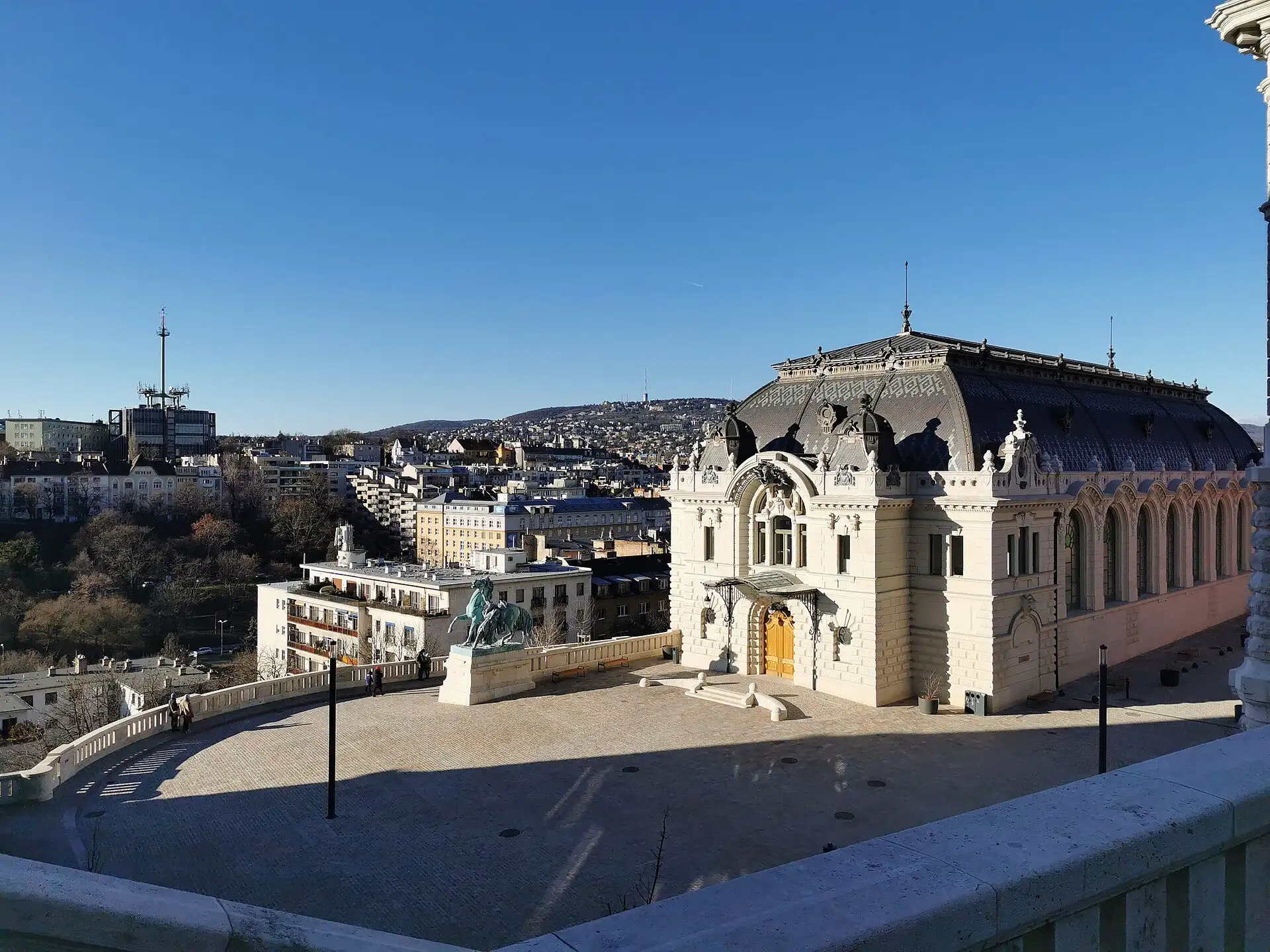
From 1890 the palace was extended to match the new capital’s ambitions. Miklós Ybl, the architect of the Opera House and the Castle Garden Bazaar, drew the plans; when he died in 1891 Alajos Hauszmann took over, tripled the palace’s size along the hill, and by 1905 had produced one of the largest royal residences in Europe, with a dome to crown it, the Riding Hall and the Guardhouse behind, St Stephen’s Hall inside, and Stróbl’s Matthias Fountain and Róna’s Prince Eugene in the courtyards.
Between the wars Regent Miklós Horthy lived here, and that sealed its fate. In the siege of Budapest the palace became the Germans’ last stronghold in the city, and in January 1945 it burnt for weeks.
The socialist rebuild, 1957 to 1985
In 1949 the communist leadership decided the ruin would house the party and the government. That plan died with the 1950s, and in 1957 the palace was given instead to museums.
The rebuild that followed, under István Janáky and from 1959 Lajos Hidasi, was a second destruction: Hauszmann’s Neo-Baroque facade was replaced by a plainer one, the interiors that the fire had spared were stripped out, the damaged dome was demolished and replaced by a taller, barer one, and the Riding Hall, the Guardhouse and the stables were pulled down.
The Castle Museum opened in the southern wing in 1967, the National Gallery under the dome in 1975, and the National Széchényi Library in the western wing in 1985, when the rebuilding was declared finished. It is this palace, not Hauszmann’s, that most visitors have photographed for the last fifty years.
The Hauszmann Programme and the 2026 pause
The National Hauszmann Programme, launched in 2019, set out to put the pre-war palace quarter back from Hauszmann’s plans and photographs. The Riding Hall, demolished in 1950, was rebuilt between 2016 and 2019 and opened in 2021 with the Guardhouse beside it.
St Stephen’s Hall reopened on 20 August 2021 as the first palace interior restored exactly as it was. The Turul went off for restoration and came back by crane in December 2021, the fountains and the western gardens were redone, and in December 2022 work began on the palace itself, starting with the northern wing.
Then, on 16 September 2026, the government halted the palace’s reconstruction, sent the contractor away and ordered a review of the programme’s costs and purpose, leaving open whether the rest of Hauszmann’s palace comes back. What is finished stays finished, and it is the reason to see the hill now.
Visiting today
For all that has been lost, the hill still keeps the medieval palace underground, one royal room upstairs, two national collections and the best terrace in the city.